A.H.M. Golam Hyder, Bintang Nuraeni, Sabine M. Gallagher, Mason Wasilk, Jessica D. Macholz, Albert L. Lipson, Jeffrey Spangenberger
{"title":"Lithium Recovery and Conversion from Wastewater Produced by Recycling of Li-Ion Batteries via Two-Stage Electrodialysis","authors":"A.H.M. Golam Hyder, Bintang Nuraeni, Sabine M. Gallagher, Mason Wasilk, Jessica D. Macholz, Albert L. Lipson, Jeffrey Spangenberger","doi":"10.1021/acssuschemeng.4c07708","DOIUrl":null,"url":null,"abstract":"Electrodialysis (ED) is a membrane separation technique that has been well-established in various applications such as desalination, drinking water production, wastewater treatment, and lithium salt production. A limited number of studies have explored its application in lithium salt production, especially from secondary resources like wastewater. This study investigated a route to recover lithium from wastewater generated from the recycling of end-of-life Li-ion batteries. Two electrodialysis methods, namely standard electrodialysis (ED) and bipolar-membrane electrodialysis (BPED), were combined to concentrate lithium ions and convert them to lithium hydroxide (LiOH), a valuable product that can be fed back into the supply chain for manufacturing Li-ion batteries. Lithium (Li<sup>+</sup>) concentration in recycling wastewater was successfully increased by 58% using ED and converted to LiOH (>96% purity) with a further increase in Li<sup>+</sup> concentration by 67% using BPED. The Coulombic efficiency of the experiments was 91.0 and 92.2%, with specific energy consumption of 1 and 2.5 kWh/kg, and a production rate of 1.01 and 0.14 kg/h/m<sup>2</sup> for the ED and BPED processes, respectively. In addition, preliminary techno-economic and environmental impact analyses show a significant improvement (GHG emission reduction by 77% and total energy reduction by 53%) by producing LiOH via electrodialysis compared to conventional lithium production via brine extraction. The process was assessed to be beneficial for lithium extraction from secondary resources and to enhance overall battery recycling efforts.","PeriodicalId":25,"journal":{"name":"ACS Sustainable Chemistry & Engineering","volume":"13 1","pages":""},"PeriodicalIF":7.3000,"publicationDate":"2025-03-21","publicationTypes":"Journal Article","fieldsOfStudy":null,"isOpenAccess":false,"openAccessPdf":"","citationCount":"0","resultStr":null,"platform":"Semanticscholar","paperid":null,"PeriodicalName":"ACS Sustainable Chemistry & Engineering","FirstCategoryId":"92","ListUrlMain":"https://doi.org/10.1021/acssuschemeng.4c07708","RegionNum":1,"RegionCategory":"化学","ArticlePicture":[],"TitleCN":null,"AbstractTextCN":null,"PMCID":null,"EPubDate":"","PubModel":"","JCR":"Q1","JCRName":"CHEMISTRY, MULTIDISCIPLINARY","Score":null,"Total":0}
引用次数: 0
Abstract
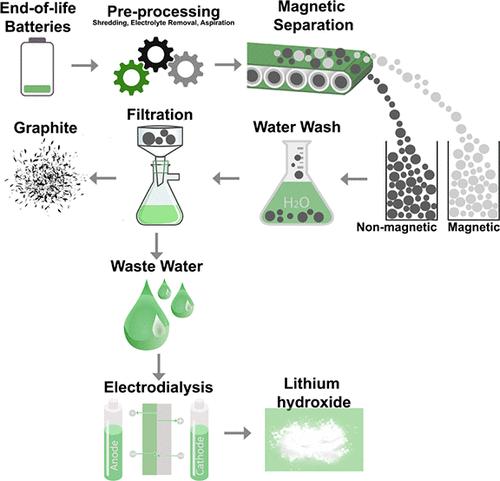
Electrodialysis (ED) is a membrane separation technique that has been well-established in various applications such as desalination, drinking water production, wastewater treatment, and lithium salt production. A limited number of studies have explored its application in lithium salt production, especially from secondary resources like wastewater. This study investigated a route to recover lithium from wastewater generated from the recycling of end-of-life Li-ion batteries. Two electrodialysis methods, namely standard electrodialysis (ED) and bipolar-membrane electrodialysis (BPED), were combined to concentrate lithium ions and convert them to lithium hydroxide (LiOH), a valuable product that can be fed back into the supply chain for manufacturing Li-ion batteries. Lithium (Li+) concentration in recycling wastewater was successfully increased by 58% using ED and converted to LiOH (>96% purity) with a further increase in Li+ concentration by 67% using BPED. The Coulombic efficiency of the experiments was 91.0 and 92.2%, with specific energy consumption of 1 and 2.5 kWh/kg, and a production rate of 1.01 and 0.14 kg/h/m2 for the ED and BPED processes, respectively. In addition, preliminary techno-economic and environmental impact analyses show a significant improvement (GHG emission reduction by 77% and total energy reduction by 53%) by producing LiOH via electrodialysis compared to conventional lithium production via brine extraction. The process was assessed to be beneficial for lithium extraction from secondary resources and to enhance overall battery recycling efforts.
期刊介绍:
ACS Sustainable Chemistry & Engineering is a prestigious weekly peer-reviewed scientific journal published by the American Chemical Society. Dedicated to advancing the principles of green chemistry and green engineering, it covers a wide array of research topics including green chemistry, green engineering, biomass, alternative energy, and life cycle assessment.
The journal welcomes submissions in various formats, including Letters, Articles, Features, and Perspectives (Reviews), that address the challenges of sustainability in the chemical enterprise and contribute to the advancement of sustainable practices. Join us in shaping the future of sustainable chemistry and engineering.



 京公网安备 11010802042870号
京ICP备2023020795号-1
京公网安备 11010802042870号
京ICP备2023020795号-1

 分享
分享
 求助内容:
求助内容: 应助结果提醒方式:
 扫码关注我们
