Aarav Barde, Ruixian Han, Martin A. Olson, Marco Tonelli, Chad M. Rienstra, Katherine A. Henzler-Wildman, Thirupathi Ravula
{"title":"In Situ Light-driven pH Modulation for NMR Studies","authors":"Aarav Barde, Ruixian Han, Martin A. Olson, Marco Tonelli, Chad M. Rienstra, Katherine A. Henzler-Wildman, Thirupathi Ravula","doi":"10.1002/anie.202501440","DOIUrl":null,"url":null,"abstract":"<p>Proton exchange is a fundamental chemical event, and NMR provides the most direct readout of protonation events with site-specific resolution. Conventional approaches require manual titration of sample pH to collect a series of NMR spectra at different pH values. This requires extensive sample handling and often results in significant sample loss, leading to reduced signal or the need to prepare additional samples. Here, we introduce a novel approach to control pH in NMR samples using water soluble photoacids, which alters the pH of the solution from near neutral to acidic pH upon in situ photo illumination. We show that the solution pH can be precisely controlled by choice of illumination wavelength and intensity, and sufficient protons are released from the photoacid to achieve meaningful pH change in samples where the molecule of interest has significant buffering capacity, such as a >100 µM protein sample. The pH is monitored in situ using internal standards with pH-sensitive chemical shifts. This method enables precise, calibrated, and noninvasive change of sample pH within an NMR magnet, dramatically reducing the necessary sample handling. These findings highlight the potential of light-induced pH control in NMR experiments and increase the robustness and reliability of pH-dependent studies.</p>","PeriodicalId":125,"journal":{"name":"Angewandte Chemie International Edition","volume":"64 23","pages":""},"PeriodicalIF":16.9000,"publicationDate":"2025-03-22","publicationTypes":"Journal Article","fieldsOfStudy":null,"isOpenAccess":false,"openAccessPdf":"https://onlinelibrary.wiley.com/doi/epdf/10.1002/anie.202501440","citationCount":"0","resultStr":null,"platform":"Semanticscholar","paperid":null,"PeriodicalName":"Angewandte Chemie International Edition","FirstCategoryId":"92","ListUrlMain":"https://onlinelibrary.wiley.com/doi/10.1002/anie.202501440","RegionNum":1,"RegionCategory":"化学","ArticlePicture":[],"TitleCN":null,"AbstractTextCN":null,"PMCID":null,"EPubDate":"","PubModel":"","JCR":"Q1","JCRName":"CHEMISTRY, MULTIDISCIPLINARY","Score":null,"Total":0}
引用次数: 0
Abstract
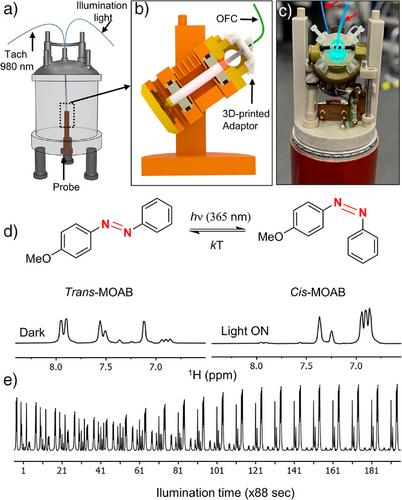
Proton exchange is a fundamental chemical event, and NMR provides the most direct readout of protonation events with site-specific resolution. Conventional approaches require manual titration of sample pH to collect a series of NMR spectra at different pH values. This requires extensive sample handling and often results in significant sample loss, leading to reduced signal or the need to prepare additional samples. Here, we introduce a novel approach to control pH in NMR samples using water soluble photoacids, which alters the pH of the solution from near neutral to acidic pH upon in situ photo illumination. We show that the solution pH can be precisely controlled by choice of illumination wavelength and intensity, and sufficient protons are released from the photoacid to achieve meaningful pH change in samples where the molecule of interest has significant buffering capacity, such as a >100 µM protein sample. The pH is monitored in situ using internal standards with pH-sensitive chemical shifts. This method enables precise, calibrated, and noninvasive change of sample pH within an NMR magnet, dramatically reducing the necessary sample handling. These findings highlight the potential of light-induced pH control in NMR experiments and increase the robustness and reliability of pH-dependent studies.
期刊介绍:
Angewandte Chemie, a journal of the German Chemical Society (GDCh), maintains a leading position among scholarly journals in general chemistry with an impressive Impact Factor of 16.6 (2022 Journal Citation Reports, Clarivate, 2023). Published weekly in a reader-friendly format, it features new articles almost every day. Established in 1887, Angewandte Chemie is a prominent chemistry journal, offering a dynamic blend of Review-type articles, Highlights, Communications, and Research Articles on a weekly basis, making it unique in the field.



 京公网安备 11010802042870号
京ICP备2023020795号-1
京公网安备 11010802042870号
京ICP备2023020795号-1

 分享
分享
 求助内容:
求助内容: 应助结果提醒方式:
 扫码关注我们
