Xulong Fan, Lidan Lan, Yuanyu Chang, Long Yang, Yun Huang, Yi Dan, Long Jiang
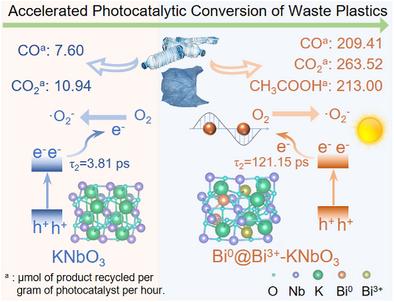
{"title":"Construction of Multistep Charge Transfer Pathways in Bi0@Bi3+-KNbO3 for Significantly Accelerated Photoconversion of Waste Plastics","authors":"Xulong Fan, Lidan Lan, Yuanyu Chang, Long Yang, Yun Huang, Yi Dan, Long Jiang","doi":"10.1002/anie.202502874","DOIUrl":null,"url":null,"abstract":"<p>Photoconversion of waste plastics into valuable CO and CH<sub>3</sub>COOH represents a ground-breaking strategy for addressing plastic pollution issues. However, this process currently encounters significant challenges, primarily due to the limitation of catalyst activity and the difficulty in breaking C─C bonds. Herein, we present a novel approach that integrates multistep charge transfer pathways with photothermal-driven reactions to improve photoconversion efficiency. By incorporating Bi<sup>0</sup>/Bi<sup>3+</sup> metal as an electron transport mediator for multistep charge transfer, we markedly enhanced the separation and transport of photoelectrons, thereby accelerating the generation of active species. Meanwhile, the heat generated by the localized surface plasmon resonance effect of Bi<sup>0</sup> drove the reactions related to the photoconversion of polypropylene. Subsequently, the photoconversion rates of PP into CO by Bi<sup>0</sup>@Bi<sup>3+</sup>-KNbO<sub>3</sub> reached 209.41 µmol g<sub>cat</sub><sup>−1</sup> h<sup>−1</sup>, which is 27.55 times higher than that achieved with KNbO<sub>3</sub>. Furthermore, the dual Bi–Nb sites effectively stabilize the key intermediate *COOH, thereby promoting the production of CH<sub>3</sub>COOH at a rate of 213.00 µmol g<sub>cat</sub><sup>−1</sup> h<sup>−1</sup>. This strategy of boosting photoconversion activity of PP into CO and CH<sub>3</sub>COOH offers an effective green solution to the serious issue of plastic pollution.</p>","PeriodicalId":125,"journal":{"name":"Angewandte Chemie International Edition","volume":"64 22","pages":""},"PeriodicalIF":16.9000,"publicationDate":"2025-03-22","publicationTypes":"Journal Article","fieldsOfStudy":null,"isOpenAccess":false,"openAccessPdf":"","citationCount":"0","resultStr":null,"platform":"Semanticscholar","paperid":null,"PeriodicalName":"Angewandte Chemie International Edition","FirstCategoryId":"92","ListUrlMain":"https://onlinelibrary.wiley.com/doi/10.1002/anie.202502874","RegionNum":1,"RegionCategory":"化学","ArticlePicture":[],"TitleCN":null,"AbstractTextCN":null,"PMCID":null,"EPubDate":"","PubModel":"","JCR":"Q1","JCRName":"CHEMISTRY, MULTIDISCIPLINARY","Score":null,"Total":0}
引用次数: 0
Abstract
Photoconversion of waste plastics into valuable CO and CH3COOH represents a ground-breaking strategy for addressing plastic pollution issues. However, this process currently encounters significant challenges, primarily due to the limitation of catalyst activity and the difficulty in breaking C─C bonds. Herein, we present a novel approach that integrates multistep charge transfer pathways with photothermal-driven reactions to improve photoconversion efficiency. By incorporating Bi0/Bi3+ metal as an electron transport mediator for multistep charge transfer, we markedly enhanced the separation and transport of photoelectrons, thereby accelerating the generation of active species. Meanwhile, the heat generated by the localized surface plasmon resonance effect of Bi0 drove the reactions related to the photoconversion of polypropylene. Subsequently, the photoconversion rates of PP into CO by Bi0@Bi3+-KNbO3 reached 209.41 µmol gcat−1 h−1, which is 27.55 times higher than that achieved with KNbO3. Furthermore, the dual Bi–Nb sites effectively stabilize the key intermediate *COOH, thereby promoting the production of CH3COOH at a rate of 213.00 µmol gcat−1 h−1. This strategy of boosting photoconversion activity of PP into CO and CH3COOH offers an effective green solution to the serious issue of plastic pollution.
期刊介绍:
Angewandte Chemie, a journal of the German Chemical Society (GDCh), maintains a leading position among scholarly journals in general chemistry with an impressive Impact Factor of 16.6 (2022 Journal Citation Reports, Clarivate, 2023). Published weekly in a reader-friendly format, it features new articles almost every day. Established in 1887, Angewandte Chemie is a prominent chemistry journal, offering a dynamic blend of Review-type articles, Highlights, Communications, and Research Articles on a weekly basis, making it unique in the field.



 京公网安备 11010802042870号
京ICP备2023020795号-1
京公网安备 11010802042870号
京ICP备2023020795号-1

 分享
分享
 求助内容:
求助内容: 应助结果提醒方式:
 扫码关注我们
