
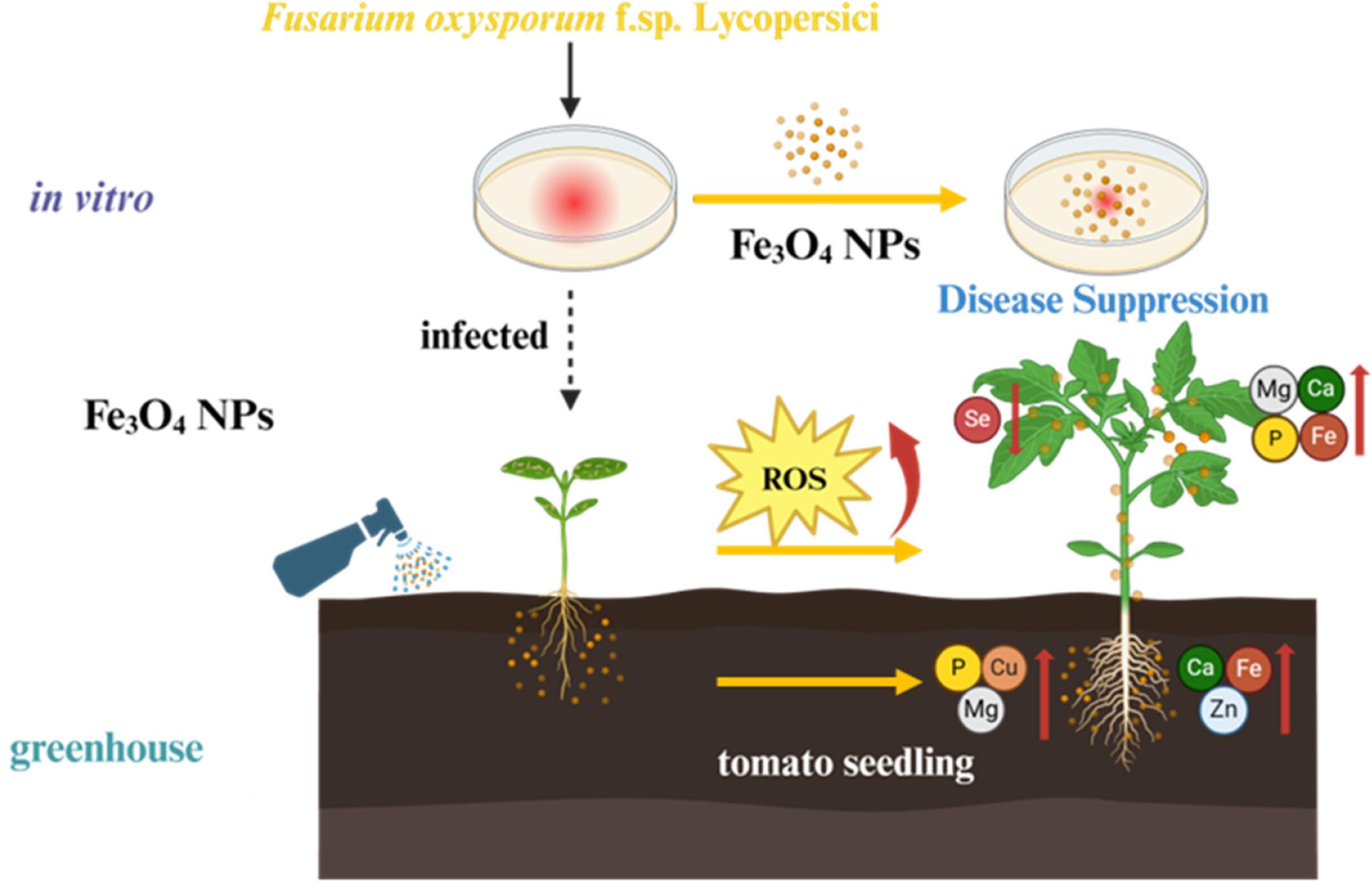
Fusarium wilt disease caused by the soil pathogen Fusarium oxysporum f. sp. lycopersici significantly impacts global tomato production. While conventional fungicides remain the primary control method, their high application volumes and environmental persistence necessitate alternative approaches. We hypothesize that magnetite nanoparticles (NPs) suppress fungal growth through a tripartite mechanism that disrupts membrane integrity at the nano-bio interface, generation of reactive oxygen species through iron-mediated catalysis, and perturbation of fungal iron homeostasis pathways.
In vitro studies demonstrated that 5 nm magnetite NPs exhibited superior antifungal activity with an EC₅₀ of 8.84 mg/L compared to Ningnanomycin at 84.77 mg/L. Comparative disease control efficacy under greenhouse conditions showed that magnetite NPs at 0.5 mg/L achieved 65% pathogen suppression versus Ningnanomycin at 71.4%, while requiring significantly lower application volumes of 180–360 g per hectare versus 4500–5850 mL per hectare. The NP treatment reduced disease index by 35.42%, alleviated root rot symptoms by 19.33%, and enhanced plant defense mechanisms through elevated reactive oxygen species accumulation and increased root iron content of 92.15%.
This study demonstrates that magnetite NPs provide competitive disease control efficacy against Fusarium wilt through multiple mechanistic pathways while reducing total chemical input. The dual functionality of direct pathogen suppression and enhanced plant defense activation, combined with lower application volumes, establishes these nanoparticles as a promising alternative to ecofriendly fungicides in tomato production systems. © 2025 Society of Chemical Industry.





 京公网安备 11010802042870号
京ICP备2023020795号-1
京公网安备 11010802042870号
京ICP备2023020795号-1

 分享
分享
 求助内容:
求助内容: 应助结果提醒方式:
 扫码关注我们
