Vera Bruggink , Clemens Gutjahr , Angelika Decker , Hannes Engelbrecht , Uwe Beekmann , Dana Kralisch , Markus Werner , Patrick Schädel , Paul M. Jordan , Oliver Werz , Robert K. Hofstetter
{"title":"Ginsenosides from Panax ginseng modulate lipid mediator profiles in human leukocytes by interference with cellular 5-lipoxygenase activity","authors":"Vera Bruggink , Clemens Gutjahr , Angelika Decker , Hannes Engelbrecht , Uwe Beekmann , Dana Kralisch , Markus Werner , Patrick Schädel , Paul M. Jordan , Oliver Werz , Robert K. Hofstetter","doi":"10.1016/j.bcp.2025.116882","DOIUrl":null,"url":null,"abstract":"<div><div>Lipid mediators are a superfamily of bioactive molecules that are crucially involved in immune responses, regulating all stages of inflammation. <em>Panax (P.) ginseng</em> has pleiotropic pharmacological effects, including anti-cancer, anti-diabetic, and anti-inflammatory properties. Ginsenosides, unique triterpenoid glycosides from the plant’s root, are proposed as active ingredients responsible for the immunomodulating potential of <em>P.<!--> <!-->ginseng</em>. Here, we comprehensively screened 23 ginsenosides for manipulating the lipid mediator network in various primary human innate immune cells. Several ginsenosides selectively inhibited 5-lipoxygenase (5-LOX)-mediated formation of pro-inflammatory leukotriene B<sub>4</sub>, but not of prostaglandins, in monocyte-derived macrophages and polymorphonuclear leukocytes by a unique irreversible mechanism. Structure-activity relationships revealed (i) higher anti-5-LOX activity of PPD-type ginsenosides, (ii) correlation with lipophilicity (<em>R</em><sup>2</sup> = 0.91), and (iii) eudysmic ratios favoring the 20<em>S</em>-epimers. Our findings highlight ginsenosides as immunomodulatory principles of <em>P. ginseng</em> and reveal abrogation of leukotriene formation rather than interference with prostaglandins as immediate anti-inflammatory mechanism.</div></div>","PeriodicalId":8806,"journal":{"name":"Biochemical pharmacology","volume":"236 ","pages":"Article 116882"},"PeriodicalIF":5.6000,"publicationDate":"2025-03-19","publicationTypes":"Journal Article","fieldsOfStudy":null,"isOpenAccess":false,"openAccessPdf":"","citationCount":"0","resultStr":null,"platform":"Semanticscholar","paperid":null,"PeriodicalName":"Biochemical pharmacology","FirstCategoryId":"3","ListUrlMain":"https://www.sciencedirect.com/science/article/pii/S0006295225001443","RegionNum":2,"RegionCategory":"医学","ArticlePicture":[],"TitleCN":null,"AbstractTextCN":null,"PMCID":null,"EPubDate":"","PubModel":"","JCR":"Q1","JCRName":"PHARMACOLOGY & PHARMACY","Score":null,"Total":0}
引用次数: 0
Abstract
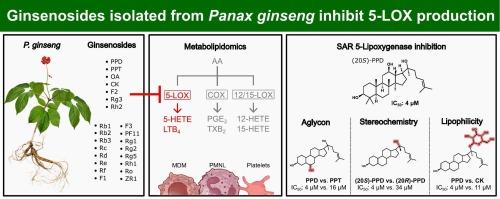
Lipid mediators are a superfamily of bioactive molecules that are crucially involved in immune responses, regulating all stages of inflammation. Panax (P.) ginseng has pleiotropic pharmacological effects, including anti-cancer, anti-diabetic, and anti-inflammatory properties. Ginsenosides, unique triterpenoid glycosides from the plant’s root, are proposed as active ingredients responsible for the immunomodulating potential of P. ginseng. Here, we comprehensively screened 23 ginsenosides for manipulating the lipid mediator network in various primary human innate immune cells. Several ginsenosides selectively inhibited 5-lipoxygenase (5-LOX)-mediated formation of pro-inflammatory leukotriene B4, but not of prostaglandins, in monocyte-derived macrophages and polymorphonuclear leukocytes by a unique irreversible mechanism. Structure-activity relationships revealed (i) higher anti-5-LOX activity of PPD-type ginsenosides, (ii) correlation with lipophilicity (R2 = 0.91), and (iii) eudysmic ratios favoring the 20S-epimers. Our findings highlight ginsenosides as immunomodulatory principles of P. ginseng and reveal abrogation of leukotriene formation rather than interference with prostaglandins as immediate anti-inflammatory mechanism.
期刊介绍:
Biochemical Pharmacology publishes original research findings, Commentaries and review articles related to the elucidation of cellular and tissue function(s) at the biochemical and molecular levels, the modification of cellular phenotype(s) by genetic, transcriptional/translational or drug/compound-induced modifications, as well as the pharmacodynamics and pharmacokinetics of xenobiotics and drugs, the latter including both small molecules and biologics.
The journal''s target audience includes scientists engaged in the identification and study of the mechanisms of action of xenobiotics, biologics and drugs and in the drug discovery and development process.
All areas of cellular biology and cellular, tissue/organ and whole animal pharmacology fall within the scope of the journal. Drug classes covered include anti-infectives, anti-inflammatory agents, chemotherapeutics, cardiovascular, endocrinological, immunological, metabolic, neurological and psychiatric drugs, as well as research on drug metabolism and kinetics. While medicinal chemistry is a topic of complimentary interest, manuscripts in this area must contain sufficient biological data to characterize pharmacologically the compounds reported. Submissions describing work focused predominately on chemical synthesis and molecular modeling will not be considered for review.
While particular emphasis is placed on reporting the results of molecular and biochemical studies, research involving the use of tissue and animal models of human pathophysiology and toxicology is of interest to the extent that it helps define drug mechanisms of action, safety and efficacy.



 京公网安备 11010802042870号
京ICP备2023020795号-1
京公网安备 11010802042870号
京ICP备2023020795号-1

 分享
分享
 求助内容:
求助内容: 应助结果提醒方式:
 扫码关注我们
