Machine learning-based risk prediction model for neuropathic foot ulcers in patients with diabetic peripheral neuropathy

IF 3 3区 医学 Q2 ENDOCRINOLOGY & METABOLISM Journal of Diabetes Investigation Pub Date : 2025-03-21 DOI:10.1111/jdi.70010
Ge Shi, Zhenxuan Gao, Ze Zhang, Quanyu Jin, Sitong Li, Jiaxin Liu, Lei Kou, Abudurezhake Aerman, Wenqiang Yang, Qi Wang, Furong Cai, Li Zhang
{"title":"Machine learning-based risk prediction model for neuropathic foot ulcers in patients with diabetic peripheral neuropathy","authors":"Ge Shi,&nbsp;Zhenxuan Gao,&nbsp;Ze Zhang,&nbsp;Quanyu Jin,&nbsp;Sitong Li,&nbsp;Jiaxin Liu,&nbsp;Lei Kou,&nbsp;Abudurezhake Aerman,&nbsp;Wenqiang Yang,&nbsp;Qi Wang,&nbsp;Furong Cai,&nbsp;Li Zhang","doi":"10.1111/jdi.70010","DOIUrl":null,"url":null,"abstract":"<div>\n \n \n <section>\n \n <h3> Background</h3>\n \n <p>Diabetic peripheral neuropathy (DPN) is a common chronic complication of diabetes, marked by symptoms like hyperalgesia, numbness, and swelling that impair quality of life. Nerve conduction abnormalities in DPN significantly increase the risk of neuropathic foot ulcers (NFU), which can progress rapidly and lead to severe outcomes, including infection, gangrene, and amputation. Early prediction of NFU in DPN patients is crucial for timely intervention.</p>\n </section>\n \n <section>\n \n <h3> Methods</h3>\n \n <p>Clinical data from 400 DPN patients treated at the China–Japan Friendship Hospital (September 2022–2024) were retrospectively analyzed. Data included medical histories, physical exams, biochemical tests, and imaging. After feature selection and data balancing, the dataset was split into training and validation subsets (8:2 ratio). Six machine learning algorithms—random forest, decision tree, logistic regression, K-nearest neighbor, extreme gradient boosting, and multilayer perceptron—were evaluated using k-fold cross-validation. Model performance was assessed via accuracy, precision, recall, F1 score, and AUC. The SHAP method was employed for interpretability.</p>\n </section>\n \n <section>\n \n <h3> Results</h3>\n \n <p>The multilayer perceptron model showed the best performance (accuracy: 0.875; AUC: 0.901). SHAP analysis highlighted triglycerides, high-density lipoprotein cholesterol, diabetes duration, age, and fasting blood glucose as key predictors.</p>\n </section>\n \n <section>\n \n <h3> Conclusions</h3>\n \n <p>A machine learning-based prediction model using a multilayer perceptron algorithm effectively identifies DPN patients at high NFU risk, offering clinicians an accurate tool for early intervention.</p>\n </section>\n </div>","PeriodicalId":51250,"journal":{"name":"Journal of Diabetes Investigation","volume":"16 6","pages":"1055-1064"},"PeriodicalIF":3.0000,"publicationDate":"2025-03-21","publicationTypes":"Journal Article","fieldsOfStudy":null,"isOpenAccess":false,"openAccessPdf":"https://onlinelibrary.wiley.com/doi/epdf/10.1111/jdi.70010","citationCount":"0","resultStr":null,"platform":"Semanticscholar","paperid":null,"PeriodicalName":"Journal of Diabetes Investigation","FirstCategoryId":"3","ListUrlMain":"https://onlinelibrary.wiley.com/doi/10.1111/jdi.70010","RegionNum":3,"RegionCategory":"医学","ArticlePicture":[],"TitleCN":null,"AbstractTextCN":null,"PMCID":null,"EPubDate":"","PubModel":"","JCR":"Q2","JCRName":"ENDOCRINOLOGY & METABOLISM","Score":null,"Total":0}
引用次数: 0

Abstract

Background

Diabetic peripheral neuropathy (DPN) is a common chronic complication of diabetes, marked by symptoms like hyperalgesia, numbness, and swelling that impair quality of life. Nerve conduction abnormalities in DPN significantly increase the risk of neuropathic foot ulcers (NFU), which can progress rapidly and lead to severe outcomes, including infection, gangrene, and amputation. Early prediction of NFU in DPN patients is crucial for timely intervention.

Methods

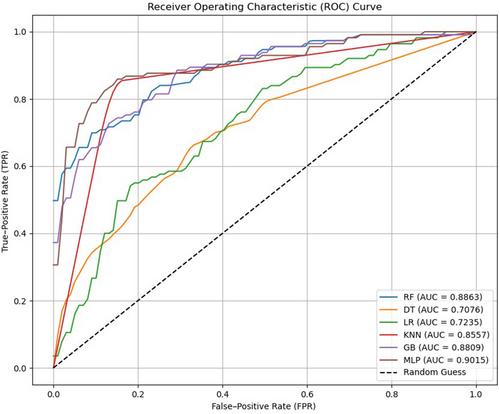
Clinical data from 400 DPN patients treated at the China–Japan Friendship Hospital (September 2022–2024) were retrospectively analyzed. Data included medical histories, physical exams, biochemical tests, and imaging. After feature selection and data balancing, the dataset was split into training and validation subsets (8:2 ratio). Six machine learning algorithms—random forest, decision tree, logistic regression, K-nearest neighbor, extreme gradient boosting, and multilayer perceptron—were evaluated using k-fold cross-validation. Model performance was assessed via accuracy, precision, recall, F1 score, and AUC. The SHAP method was employed for interpretability.

Results

The multilayer perceptron model showed the best performance (accuracy: 0.875; AUC: 0.901). SHAP analysis highlighted triglycerides, high-density lipoprotein cholesterol, diabetes duration, age, and fasting blood glucose as key predictors.

Conclusions

A machine learning-based prediction model using a multilayer perceptron algorithm effectively identifies DPN patients at high NFU risk, offering clinicians an accurate tool for early intervention.
Abstract Image

查看原文
分享 分享
微信好友 朋友圈 QQ好友 复制链接
本刊更多论文
基于机器学习的糖尿病周围神经病变患者神经性足溃疡风险预测模型。
背景:糖尿病周围神经病变(DPN)是糖尿病常见的慢性并发症,以痛觉过敏、麻木和肿胀等症状为特征,影响生活质量。DPN的神经传导异常显著增加神经性足溃疡(NFU)的风险,NFU可迅速发展并导致严重后果,包括感染、坏疽和截肢。DPN患者NFU的早期预测对于及时干预至关重要。方法:回顾性分析中日友好医院2022年9月~ 2024年9月收治的400例DPN患者的临床资料。资料包括病史、体格检查、生化检查和影像学检查。经过特征选择和数据平衡后,将数据集分成训练子集和验证子集(比例为8:2)。六种机器学习算法——随机森林、决策树、逻辑回归、k近邻、极端梯度增强和多层感知器——使用k-fold交叉验证进行评估。通过准确性、精密度、召回率、F1分数和AUC来评估模型的性能。为了便于解释,采用了SHAP方法。结果:多层感知器模型表现最佳(准确率:0.875;AUC: 0.901)。SHAP分析强调甘油三酯、高密度脂蛋白胆固醇、糖尿病病程、年龄和空腹血糖是关键预测因子。结论:采用多层感知器算法的基于机器学习的预测模型可以有效地识别高NFU风险的DPN患者,为临床医生提供早期干预的准确工具。
本文章由计算机程序翻译,如有差异,请以英文原文为准。
求助全文
约1分钟内获得全文 去求助
来源期刊
Journal of Diabetes Investigation
Journal of Diabetes Investigation ENDOCRINOLOGY & METABOLISM-
CiteScore
6.50
自引率
9.40%
发文量
218
审稿时长
6-12 weeks
期刊介绍: Journal of Diabetes Investigation is your core diabetes journal from Asia; the official journal of the Asian Association for the Study of Diabetes (AASD). The journal publishes original research, country reports, commentaries, reviews, mini-reviews, case reports, letters, as well as editorials and news. Embracing clinical and experimental research in diabetes and related areas, the Journal of Diabetes Investigation includes aspects of prevention, treatment, as well as molecular aspects and pathophysiology. Translational research focused on the exchange of ideas between clinicians and researchers is also welcome. Journal of Diabetes Investigation is indexed by Science Citation Index Expanded (SCIE).
期刊最新文献
Issue Information Issue Information The biology of PKM2 in the metabolism and senescence in diabetic kidney disease Letter to the Editor in response to the article “Prediction of future insulin deficiency in glutamic acid decarboxylase autoantibody enzyme-linked immunosorbent assay-positive patients with slowly progressive type 1 diabetes” Advances in insulin pump systems lead to stepwise improvements in treatment satisfaction in people with type 1 diabetes: A single-center retrospective study
×
引用
GB/T 7714-2015
复制
MLA
复制
APA
复制
导出至
BibTeX EndNote RefMan NoteFirst NoteExpress
×
×
提示
您的信息不完整,为了账户安全,请先补充。
现在去补充
×
提示
您因"违规操作"
具体请查看互助需知
我知道了
×
提示
现在去查看 取消
×
提示
确定
0
微信
客服QQ
Book学术公众号 扫码关注我们
反馈
×
意见反馈
请填写您的意见或建议
请填写您的手机或邮箱
已复制链接
已复制链接
快去分享给好友吧!
我知道了
×
扫码分享
扫码分享
Book学术官方微信
Book学术文献互助
Book学术文献互助群
群 号:604180095
Book学术
文献互助 智能选刊 最新文献 互助须知 联系我们:info@booksci.cn
Book学术提供免费学术资源搜索服务,方便国内外学者检索中英文文献。致力于提供最便捷和优质的服务体验。
Copyright © 2023 Book学术 All rights reserved.
ghs 京公网安备 11010802042870号 京ICP备2023020795号-1





