{"title":"Visible light-induced g-C3N4 catalyzed C–H acylation and trifluoromethylation of quinoxalinones: an efficient and recyclable approach†","authors":"Linzhao Li, Zongjie Ma, Cong Li, Gaoli Chen, Taiping Gao and Xiaoxiao Chu","doi":"10.1039/D5OB00018A","DOIUrl":null,"url":null,"abstract":"<p >Photoinduced C–H functionalization of quinoxalines is a key transformation for the derivatization of biologically relevant molecules. Traditionally, homogeneous catalysts such as transition metal complexes or organic dyes are indispensable for these transformations. However, these methods often suffer from limitations related to cost, recyclability, and environmental impact. Herein, by using inexpensive, readily available and recyclable graphitic carbon nitride (g-C<small><sub>3</sub></small>N<small><sub>4</sub></small>) as a heterogeneous photocatalyst, a diverse range of acyl- and trifluoromethyl-functionalized quinoxalinone derivatives were synthesized in good to excellent yields under the irradiation of blue LEDs. Control experiments confirmed that the photogenerated electrons played a pivotal role in promoting the generation of acyl and trifluoromethyl radical intermediates. Moreover, g-C<small><sub>3</sub></small>N<small><sub>4</sub></small> showed no significant loss of activity after at least six reaction cycles. Potentially, g-C<small><sub>3</sub></small>N<small><sub>4</sub></small> represents a promising alternative to noble metal photocatalysts in organic synthesis.</p>","PeriodicalId":96,"journal":{"name":"Organic & Biomolecular Chemistry","volume":" 15","pages":" 3612-3618"},"PeriodicalIF":2.7000,"publicationDate":"2025-03-17","publicationTypes":"Journal Article","fieldsOfStudy":null,"isOpenAccess":false,"openAccessPdf":"","citationCount":"0","resultStr":null,"platform":"Semanticscholar","paperid":null,"PeriodicalName":"Organic & Biomolecular Chemistry","FirstCategoryId":"92","ListUrlMain":"https://pubs.rsc.org/en/content/articlelanding/2025/ob/d5ob00018a","RegionNum":3,"RegionCategory":"化学","ArticlePicture":[],"TitleCN":null,"AbstractTextCN":null,"PMCID":null,"EPubDate":"","PubModel":"","JCR":"Q1","JCRName":"CHEMISTRY, ORGANIC","Score":null,"Total":0}
引用次数: 0
Abstract
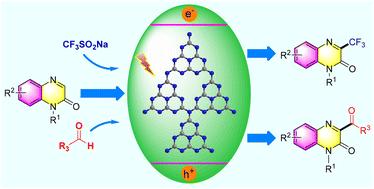
Photoinduced C–H functionalization of quinoxalines is a key transformation for the derivatization of biologically relevant molecules. Traditionally, homogeneous catalysts such as transition metal complexes or organic dyes are indispensable for these transformations. However, these methods often suffer from limitations related to cost, recyclability, and environmental impact. Herein, by using inexpensive, readily available and recyclable graphitic carbon nitride (g-C3N4) as a heterogeneous photocatalyst, a diverse range of acyl- and trifluoromethyl-functionalized quinoxalinone derivatives were synthesized in good to excellent yields under the irradiation of blue LEDs. Control experiments confirmed that the photogenerated electrons played a pivotal role in promoting the generation of acyl and trifluoromethyl radical intermediates. Moreover, g-C3N4 showed no significant loss of activity after at least six reaction cycles. Potentially, g-C3N4 represents a promising alternative to noble metal photocatalysts in organic synthesis.
期刊介绍:
Organic & Biomolecular Chemistry is an international journal using integrated research in chemistry-organic chemistry. Founded in 2003 by the Royal Society of Chemistry, the journal is published in Semimonthly issues and has been indexed by SCIE, a leading international database. The journal focuses on the key research and cutting-edge progress in the field of chemistry-organic chemistry, publishes and reports the research results in this field in a timely manner, and is committed to becoming a window and platform for rapid academic exchanges among peers in this field. The journal's impact factor in 2023 is 2.9, and its CiteScore is 5.5.



 京公网安备 11010802042870号
京ICP备2023020795号-1
京公网安备 11010802042870号
京ICP备2023020795号-1

 分享
分享
 求助内容:
求助内容: 应助结果提醒方式:
 扫码关注我们
