Simon Ladefoged Rasmussen, Lasse Pedersen, Christian Torp-Pedersen, Morten Rasmussen, Inge Bernstein, Ole Thorlacius-Ussing
{"title":"Post-colonoscopy colorectal cancer and the association with endoscopic findings in the Danish colorectal cancer screening programme.","authors":"Simon Ladefoged Rasmussen, Lasse Pedersen, Christian Torp-Pedersen, Morten Rasmussen, Inge Bernstein, Ole Thorlacius-Ussing","doi":"10.1136/bmjgast-2024-001692","DOIUrl":null,"url":null,"abstract":"<p><strong>Objective: </strong>Colorectal cancer (CRC) is the third most common cancer in Denmark, with a 5-year mortality of 40%. To reduce CRC incidence and mortality, a faecal immunochemical test (FIT)-based screening programme was introduced in 2014. Adenoma detection rate (ADR) is an established quality marker inversely associated with post-colonoscopy CRC (PCCRC), but evidence mainly stems from non-FIT populations. Using ADR in a FIT-based setting may be costly due to histopathological examination. Alternative markers like polyp detection rate (PDR) and sessile serrated lesion detection rate (SDR) could be viable but lack evidence for their association with PCCRC.</p><p><strong>Methods: </strong>We conducted a nationwide cohort study of 77 009 FIT-positive participants undergoing colonoscopy (2014-2017). National registry data on CRC outcomes were linked, and endoscopy units were grouped by ADR, PDR and SDR levels. Poisson regression adjusted for age, sex and comorbidities was used to assess PCCRC risk.</p><p><strong>Results: </strong>Among 70 009 colonoscopies within 6 months of FIT positivity, 4401 (92.7%) had CRC, while 342 (7.2%) were PCCRC cases. PCCRC risk was inversely associated with ADR, PDR and SDR. High ADR endoscopy units had a 35% lower PCCRC risk than low ADR units. Similar associations were found for PDR and SDR, with high SDR units showing a 33% lower PCCRC risk than low SDR units.</p><p><strong>Conclusions: </strong>ADR, PDR and SDR predict PCCRC risk, with SDR emerging as a feasible, cost-efficient quality marker in FIT-based screening. This study supports SDR as a primary performance indicator in future protocols.</p>","PeriodicalId":9235,"journal":{"name":"BMJ Open Gastroenterology","volume":"12 1","pages":""},"PeriodicalIF":2.9000,"publicationDate":"2025-03-21","publicationTypes":"Journal Article","fieldsOfStudy":null,"isOpenAccess":false,"openAccessPdf":"https://www.ncbi.nlm.nih.gov/pmc/articles/PMC11931950/pdf/","citationCount":"0","resultStr":null,"platform":"Semanticscholar","paperid":null,"PeriodicalName":"BMJ Open Gastroenterology","FirstCategoryId":"1085","ListUrlMain":"https://doi.org/10.1136/bmjgast-2024-001692","RegionNum":0,"RegionCategory":null,"ArticlePicture":[],"TitleCN":null,"AbstractTextCN":null,"PMCID":null,"EPubDate":"","PubModel":"","JCR":"Q2","JCRName":"GASTROENTEROLOGY & HEPATOLOGY","Score":null,"Total":0}
引用次数: 0
Abstract
Objective: Colorectal cancer (CRC) is the third most common cancer in Denmark, with a 5-year mortality of 40%. To reduce CRC incidence and mortality, a faecal immunochemical test (FIT)-based screening programme was introduced in 2014. Adenoma detection rate (ADR) is an established quality marker inversely associated with post-colonoscopy CRC (PCCRC), but evidence mainly stems from non-FIT populations. Using ADR in a FIT-based setting may be costly due to histopathological examination. Alternative markers like polyp detection rate (PDR) and sessile serrated lesion detection rate (SDR) could be viable but lack evidence for their association with PCCRC.
Methods: We conducted a nationwide cohort study of 77 009 FIT-positive participants undergoing colonoscopy (2014-2017). National registry data on CRC outcomes were linked, and endoscopy units were grouped by ADR, PDR and SDR levels. Poisson regression adjusted for age, sex and comorbidities was used to assess PCCRC risk.
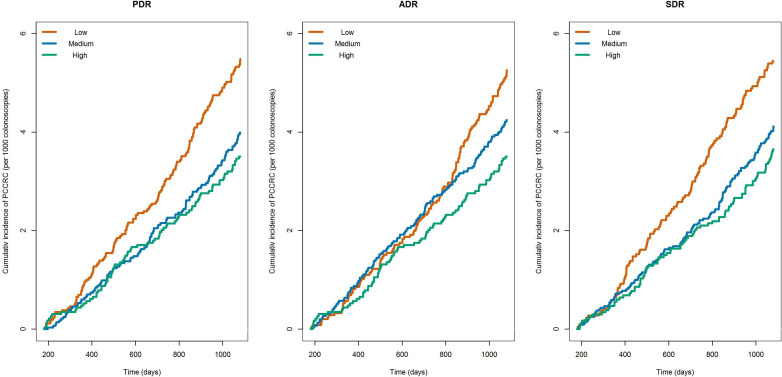
Results: Among 70 009 colonoscopies within 6 months of FIT positivity, 4401 (92.7%) had CRC, while 342 (7.2%) were PCCRC cases. PCCRC risk was inversely associated with ADR, PDR and SDR. High ADR endoscopy units had a 35% lower PCCRC risk than low ADR units. Similar associations were found for PDR and SDR, with high SDR units showing a 33% lower PCCRC risk than low SDR units.
Conclusions: ADR, PDR and SDR predict PCCRC risk, with SDR emerging as a feasible, cost-efficient quality marker in FIT-based screening. This study supports SDR as a primary performance indicator in future protocols.
期刊介绍:
BMJ Open Gastroenterology is an online-only, peer-reviewed, open access gastroenterology journal, dedicated to publishing high-quality medical research from all disciplines and therapeutic areas of gastroenterology. It is the open access companion journal of Gut and is co-owned by the British Society of Gastroenterology. The journal publishes all research study types, from study protocols to phase I trials to meta-analyses, including small or specialist studies. Publishing procedures are built around continuous publication, publishing research online as soon as the article is ready.




 京公网安备 11010802042870号
京ICP备2023020795号-1
京公网安备 11010802042870号
京ICP备2023020795号-1

 分享
分享
 求助内容:
求助内容: 应助结果提醒方式:
 扫码关注我们
