{"title":"Causal Relationship Between Psoriasis and Bullous Pemphigoid: A Mendelian Randomization Analysis.","authors":"Xiaoxue Wang, Zexin Zhu","doi":"10.5826/dpc.1501a4458","DOIUrl":null,"url":null,"abstract":"<p><strong>Introduction: </strong>Psoriasis and bullous pemphigoid (BP) are the two major types of immune-mediated inflammatory skin diseases. Studies have reported the association between psoriasis and BP; however, no studies have reported whether a causal relationship exists between these two skin diseases.</p><p><strong>Objectives: </strong>In order to explore the causal relationship between psoriasis and BP, we performed a bidirectional two-sample Mendelian randomization (MR) study.</p><p><strong>Methods: </strong>Genome-wide association study (GWAS) data related to psoriasis and BP were collected. The inverse-variance weighted (IVW) method was primarily applied for our MR analysis; MR-Egger, weighted median, simple mode, and weighted mode methods were also used. Heterogeneity, horizontal pleiotropy, and potential outliers were assessed for the MR analysis results.</p><p><strong>Results: </strong>GWAS data for psoriasis (three cohorts) and BP (one cohort) from publicly available trials were selected. Our MR results showed that psoriasis was causally associated with BP, that psoriasis could increase the risk of BP, and that reversed MR showed BP has no causal effect on psoriasis. No heterogeneity or pleiotropy was detected.</p><p><strong>Conclusion: </strong>These findings provided new evidence of the causal relationship between psoriasis and BP. Our MR suggested that psoriasis is potentially causal to BP, which helps us to improve the treatment strategy for patients with psoriasis. The mechanism remains open for further investigation.</p>","PeriodicalId":11168,"journal":{"name":"Dermatology practical & conceptual","volume":"15 1","pages":""},"PeriodicalIF":2.3000,"publicationDate":"2025-01-30","publicationTypes":"Journal Article","fieldsOfStudy":null,"isOpenAccess":false,"openAccessPdf":"https://www.ncbi.nlm.nih.gov/pmc/articles/PMC11928123/pdf/","citationCount":"0","resultStr":null,"platform":"Semanticscholar","paperid":null,"PeriodicalName":"Dermatology practical & conceptual","FirstCategoryId":"3","ListUrlMain":"https://doi.org/10.5826/dpc.1501a4458","RegionNum":4,"RegionCategory":"医学","ArticlePicture":[],"TitleCN":null,"AbstractTextCN":null,"PMCID":null,"EPubDate":"","PubModel":"","JCR":"Q2","JCRName":"DERMATOLOGY","Score":null,"Total":0}
引用次数: 0
Abstract
Introduction: Psoriasis and bullous pemphigoid (BP) are the two major types of immune-mediated inflammatory skin diseases. Studies have reported the association between psoriasis and BP; however, no studies have reported whether a causal relationship exists between these two skin diseases.
Objectives: In order to explore the causal relationship between psoriasis and BP, we performed a bidirectional two-sample Mendelian randomization (MR) study.
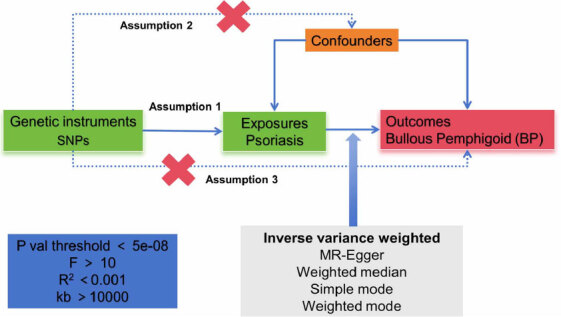
Methods: Genome-wide association study (GWAS) data related to psoriasis and BP were collected. The inverse-variance weighted (IVW) method was primarily applied for our MR analysis; MR-Egger, weighted median, simple mode, and weighted mode methods were also used. Heterogeneity, horizontal pleiotropy, and potential outliers were assessed for the MR analysis results.
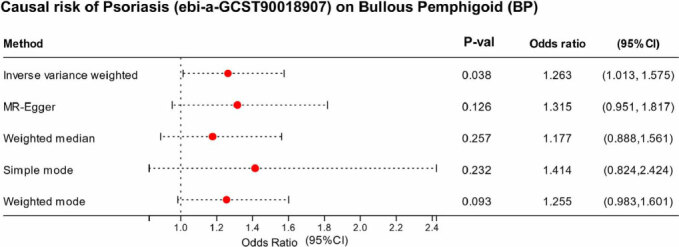
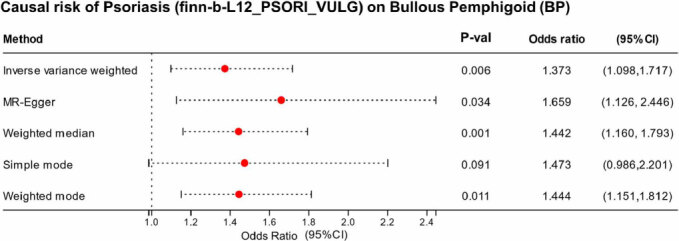
Results: GWAS data for psoriasis (three cohorts) and BP (one cohort) from publicly available trials were selected. Our MR results showed that psoriasis was causally associated with BP, that psoriasis could increase the risk of BP, and that reversed MR showed BP has no causal effect on psoriasis. No heterogeneity or pleiotropy was detected.
Conclusion: These findings provided new evidence of the causal relationship between psoriasis and BP. Our MR suggested that psoriasis is potentially causal to BP, which helps us to improve the treatment strategy for patients with psoriasis. The mechanism remains open for further investigation.



 京公网安备 11010802042870号
京ICP备2023020795号-1
京公网安备 11010802042870号
京ICP备2023020795号-1

 分享
分享
 求助内容:
求助内容: 应助结果提醒方式:
 扫码关注我们
