Wenkai Nie , Xuan Zhao , Yan Zhang , Cheng Zeng , Huiwen Yang , Bing Liu
{"title":"Chlorogenic acid alleviates DNCB-induced atopic dermatitis by inhibiting the Akt1/NF-κB signaling pathway","authors":"Wenkai Nie , Xuan Zhao , Yan Zhang , Cheng Zeng , Huiwen Yang , Bing Liu","doi":"10.1016/j.ejphar.2025.177534","DOIUrl":null,"url":null,"abstract":"<div><h3>Objective</h3><div>Atopic dermatitis (AD) is a prevalent chronic inflammatory skin disease that significantly impacts patients' quality of life. Chlorogenic acid (CGA), a polyphenol present in various dietary sources and plants, has been shown to reduce skin inflammation. However, its efficacy and mechanisms of action in AD have not been thoroughly investigated. This study aimed to evaluate the therapeutic effect of CGA on AD in mice and explored its mechanism.</div></div><div><h3>Methods</h3><div>To establish a BALB/c mouse model of AD induced by 2,4-dinitrochlorobenzene (DNCB) to evaluate the therapeutic potential of CGA. The anti-inflammatory effects of CGA were assessed by measuring IL-1β and IL-6 levels in TNF-α-stimulated HaCaT cells. The phosphorylation levels of PI3K, Akt, Akt1, NF-κB, and IκB-α were analyzed using Western blotting. Molecular docking was conducted to evaluate the binding affinity of CGA to Akt1.</div></div><div><h3>Results</h3><div>Topical application of CGA significantly reduced dermatitis scores, spleen index, epidermal thickness, mast cell infiltration, and skin fibrosis. CGA reversed DNCB-induced increases in IgE, histamine, TNF-α, IL-1β, IL-6, and IL-8 levels. Western blot analysis showed that CGA inhibited the PI3K/Akt and NF-κB signaling pathways. <em>In vitro</em>, CGA exerts its anti-inflammatory effects by inhibiting the Akt1/NF-κB pathway, and the Akt activator (SC79) can counteract this effect. Molecular docking and dynamics simulations suggest that CGA may inhibit Akt1 activity by interacting with specific residues (ALA-50, GLY-37, TYR-326, ASP-323).</div></div><div><h3>Conclusions</h3><div>CGA improves AD by inhibiting the Akt1/NF-κB pathway, suggesting its potential as a natural treatment for AD.</div></div>","PeriodicalId":12004,"journal":{"name":"European journal of pharmacology","volume":"998 ","pages":"Article 177534"},"PeriodicalIF":4.7000,"publicationDate":"2025-03-19","publicationTypes":"Journal Article","fieldsOfStudy":null,"isOpenAccess":false,"openAccessPdf":"","citationCount":"0","resultStr":null,"platform":"Semanticscholar","paperid":null,"PeriodicalName":"European journal of pharmacology","FirstCategoryId":"3","ListUrlMain":"https://www.sciencedirect.com/science/article/pii/S0014299925002882","RegionNum":3,"RegionCategory":"医学","ArticlePicture":[],"TitleCN":null,"AbstractTextCN":null,"PMCID":null,"EPubDate":"","PubModel":"","JCR":"Q1","JCRName":"PHARMACOLOGY & PHARMACY","Score":null,"Total":0}
引用次数: 0
Abstract
Objective
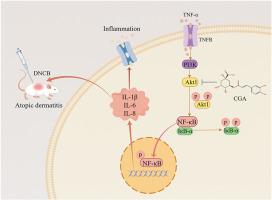
Atopic dermatitis (AD) is a prevalent chronic inflammatory skin disease that significantly impacts patients' quality of life. Chlorogenic acid (CGA), a polyphenol present in various dietary sources and plants, has been shown to reduce skin inflammation. However, its efficacy and mechanisms of action in AD have not been thoroughly investigated. This study aimed to evaluate the therapeutic effect of CGA on AD in mice and explored its mechanism.
Methods
To establish a BALB/c mouse model of AD induced by 2,4-dinitrochlorobenzene (DNCB) to evaluate the therapeutic potential of CGA. The anti-inflammatory effects of CGA were assessed by measuring IL-1β and IL-6 levels in TNF-α-stimulated HaCaT cells. The phosphorylation levels of PI3K, Akt, Akt1, NF-κB, and IκB-α were analyzed using Western blotting. Molecular docking was conducted to evaluate the binding affinity of CGA to Akt1.
Results
Topical application of CGA significantly reduced dermatitis scores, spleen index, epidermal thickness, mast cell infiltration, and skin fibrosis. CGA reversed DNCB-induced increases in IgE, histamine, TNF-α, IL-1β, IL-6, and IL-8 levels. Western blot analysis showed that CGA inhibited the PI3K/Akt and NF-κB signaling pathways. In vitro, CGA exerts its anti-inflammatory effects by inhibiting the Akt1/NF-κB pathway, and the Akt activator (SC79) can counteract this effect. Molecular docking and dynamics simulations suggest that CGA may inhibit Akt1 activity by interacting with specific residues (ALA-50, GLY-37, TYR-326, ASP-323).
Conclusions
CGA improves AD by inhibiting the Akt1/NF-κB pathway, suggesting its potential as a natural treatment for AD.
期刊介绍:
The European Journal of Pharmacology publishes research papers covering all aspects of experimental pharmacology with focus on the mechanism of action of structurally identified compounds affecting biological systems.
The scope includes:
Behavioural pharmacology
Neuropharmacology and analgesia
Cardiovascular pharmacology
Pulmonary, gastrointestinal and urogenital pharmacology
Endocrine pharmacology
Immunopharmacology and inflammation
Molecular and cellular pharmacology
Regenerative pharmacology
Biologicals and biotherapeutics
Translational pharmacology
Nutriceutical pharmacology.



 京公网安备 11010802042870号
京ICP备2023020795号-1
京公网安备 11010802042870号
京ICP备2023020795号-1

 分享
分享
 求助内容:
求助内容: 应助结果提醒方式:
 扫码关注我们
