Shehab Elbeltagi , Mohammed Al-zharani , Fahd A. Nasr , A.M. Ismail , Hagar M. El-Tohamy , Khaled M. Abdelbased , Zienab E. Eldin
{"title":"Multifunctional sorafenib-loaded MXene for enhanced cancer therapy: In vitro and in vivo study based on chemotherapy/photothermal therapy approach","authors":"Shehab Elbeltagi , Mohammed Al-zharani , Fahd A. Nasr , A.M. Ismail , Hagar M. El-Tohamy , Khaled M. Abdelbased , Zienab E. Eldin","doi":"10.1016/j.ijpharm.2025.125492","DOIUrl":null,"url":null,"abstract":"<div><div>Cancer, characterized by uncontrolled cell proliferation, remains one of the deadliest diseases. Multifunctional hybrid nanosystems that combine drugs with photothermal therapy (PTT) offer enhanced tumor treatment options through localized thermal increase and smart drug delivery (SDD). MXene, a 2D inorganic nanomaterial consisting of titanium carbide (Ti<sub>3</sub>C<sub>2</sub>), has garnered significant interest for cancer applications. MXene was combined with the metal–organic framework MOF-UiO-67 to create MX-Uio-67. The anticancer drug sorafenib (SN) was then load onto MX-UiO-67 and coated with chitosan (CS) to form SN-MX-UiO-67@CS aiming to improve chemo-PTT mediated by near-infrared (NIR) laser irradiation. The release of SN from SN-MX-UiO-67@CS was studied at pH 4.6 and pH 7.4 conditions, both with and without NIR, over a period of 96 h. The cumulative release of SN from MX-UiO-67@CS reached 80.16 % at pH 7.4 and 93.77 % at pH 4.6 under NIR irradiation. MTT assay results demonstrated significant cytotoxicity against HepG2 cells, with SN-MX-UiO-67@CS (chemo-PTT) displaying an IC<sub>50</sub> value of 22.4 µg/mL and achieving a necrosis was 36.1 % and apoptosis rate of 50.94 %, highlighting its potential as an effective anticancer agent. Furthermore, in vivo PTT via xenograft model and biodistribution studies were performed in healthy BALB/c mice under NIR. A bio-analytical technique was established utilizing HepG2 cells for the quantitative examination of SN in mice plasma, spleen, liver, heart, kidneys, tumor and lungs. A highly significant difference was observed in the plasma concentration–time curves and pharmacokinetic parameters of SN, SN-MX, and SN-MX-UiO-67following the intravenous administration of SN-MX-UiO-67@CS. Notably, the formulation exhibited higher key pharmacokinetic parameters, involving C<sub>max</sub> and AUC<sub>(0-72).</sub></div></div>","PeriodicalId":14187,"journal":{"name":"International Journal of Pharmaceutics","volume":"674 ","pages":"Article 125492"},"PeriodicalIF":5.2000,"publicationDate":"2025-03-19","publicationTypes":"Journal Article","fieldsOfStudy":null,"isOpenAccess":false,"openAccessPdf":"","citationCount":"0","resultStr":null,"platform":"Semanticscholar","paperid":null,"PeriodicalName":"International Journal of Pharmaceutics","FirstCategoryId":"3","ListUrlMain":"https://www.sciencedirect.com/science/article/pii/S037851732500328X","RegionNum":2,"RegionCategory":"医学","ArticlePicture":[],"TitleCN":null,"AbstractTextCN":null,"PMCID":null,"EPubDate":"","PubModel":"","JCR":"Q1","JCRName":"PHARMACOLOGY & PHARMACY","Score":null,"Total":0}
引用次数: 0
Abstract
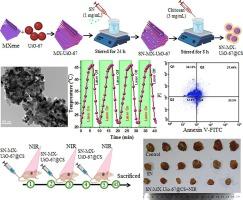
Cancer, characterized by uncontrolled cell proliferation, remains one of the deadliest diseases. Multifunctional hybrid nanosystems that combine drugs with photothermal therapy (PTT) offer enhanced tumor treatment options through localized thermal increase and smart drug delivery (SDD). MXene, a 2D inorganic nanomaterial consisting of titanium carbide (Ti3C2), has garnered significant interest for cancer applications. MXene was combined with the metal–organic framework MOF-UiO-67 to create MX-Uio-67. The anticancer drug sorafenib (SN) was then load onto MX-UiO-67 and coated with chitosan (CS) to form SN-MX-UiO-67@CS aiming to improve chemo-PTT mediated by near-infrared (NIR) laser irradiation. The release of SN from SN-MX-UiO-67@CS was studied at pH 4.6 and pH 7.4 conditions, both with and without NIR, over a period of 96 h. The cumulative release of SN from MX-UiO-67@CS reached 80.16 % at pH 7.4 and 93.77 % at pH 4.6 under NIR irradiation. MTT assay results demonstrated significant cytotoxicity against HepG2 cells, with SN-MX-UiO-67@CS (chemo-PTT) displaying an IC50 value of 22.4 µg/mL and achieving a necrosis was 36.1 % and apoptosis rate of 50.94 %, highlighting its potential as an effective anticancer agent. Furthermore, in vivo PTT via xenograft model and biodistribution studies were performed in healthy BALB/c mice under NIR. A bio-analytical technique was established utilizing HepG2 cells for the quantitative examination of SN in mice plasma, spleen, liver, heart, kidneys, tumor and lungs. A highly significant difference was observed in the plasma concentration–time curves and pharmacokinetic parameters of SN, SN-MX, and SN-MX-UiO-67following the intravenous administration of SN-MX-UiO-67@CS. Notably, the formulation exhibited higher key pharmacokinetic parameters, involving Cmax and AUC(0-72).
期刊介绍:
The International Journal of Pharmaceutics is the third most cited journal in the "Pharmacy & Pharmacology" category out of 366 journals, being the true home for pharmaceutical scientists concerned with the physical, chemical and biological properties of devices and delivery systems for drugs, vaccines and biologicals, including their design, manufacture and evaluation. This includes evaluation of the properties of drugs, excipients such as surfactants and polymers and novel materials. The journal has special sections on pharmaceutical nanotechnology and personalized medicines, and publishes research papers, reviews, commentaries and letters to the editor as well as special issues.



 京公网安备 11010802042870号
京ICP备2023020795号-1
京公网安备 11010802042870号
京ICP备2023020795号-1

 分享
分享
 求助内容:
求助内容: 应助结果提醒方式:
 扫码关注我们
