{"title":"Planning thoracoscopic segmentectomies with 3-dimensional reconstruction software improves outcomes.","authors":"Aljaz Hojski, Mohamed Hassan, Makhmudbek Mallaev, Nikolay Tsvetkov, Brigitta Gahl, Didier Lardinois","doi":"10.1093/icvts/ivaf043","DOIUrl":null,"url":null,"abstract":"<p><strong>Objectives: </strong>We investigated whether preoperatively generated models of the anatomy of the lung using 3-dimensional (3D) reconstruction software based on high-resolution computed tomography scans improve surgical and postoperative outcomes after video-assisted thoracoscopic surgery (VATS) segmentectomies.</p><p><strong>Methods: </strong>We retrospectively collected data from 100 consecutive patients who signed the general research consent form and underwent VATS segmentectomies between 2018 and 2023. The outcomes and complications of the operations planned with the 3D models were compared to the results of those performed without the models. We used propensity modelling and inverse probability of treatment weighting (IPTW) to analyse the data.</p><p><strong>Results: </strong>Thirty-seven of the 100 patients included underwent surgery planned using the 3D models. In the 3D group, complex segmentectomies were performed more frequently (89% vs 38%, P < 0.001), and there were markedly fewer conversions to thoracotomy (P = 0.003). The IPTW analysis showed fewer severe complications (Clavien-Dindo grade III or IV) [post-IPTW odds ratio 0.10 (95% confidence interval 0.01-0.87), P = 0.037], and no Clavien-Dindo grade V complications occurred. Additionally, operative planning using models generated from 3D reconstruction software may influence procedural and postoperative parameters, such as the number of segments removed (1.9 ± 1.0 vs 1.7 ± 0.8, P = 0.40), duration of chest tube placement (3.0 days, interquartile range 2.0-4.0 vs 2.0 days, interquartile range 1.0-3.0, P = 0.060), and stay in the intensive/intermediate care unit.</p><p><strong>Conclusions: </strong>The planning of complex anatomical VATS segmentectomies using 3D models constructed from 3D reconstruction software significantly reduces the need for conversions to thoracotomy and postoperative complications rates. In addition, complex operations are thereby performed safely.</p>","PeriodicalId":73406,"journal":{"name":"Interdisciplinary cardiovascular and thoracic surgery","volume":" ","pages":""},"PeriodicalIF":0.0000,"publicationDate":"2025-03-29","publicationTypes":"Journal Article","fieldsOfStudy":null,"isOpenAccess":false,"openAccessPdf":"https://www.ncbi.nlm.nih.gov/pmc/articles/PMC12011358/pdf/","citationCount":"0","resultStr":null,"platform":"Semanticscholar","paperid":null,"PeriodicalName":"Interdisciplinary cardiovascular and thoracic surgery","FirstCategoryId":"1085","ListUrlMain":"https://doi.org/10.1093/icvts/ivaf043","RegionNum":0,"RegionCategory":null,"ArticlePicture":[],"TitleCN":null,"AbstractTextCN":null,"PMCID":null,"EPubDate":"","PubModel":"","JCR":"0","JCRName":"CARDIAC & CARDIOVASCULAR SYSTEMS","Score":null,"Total":0}
引用次数: 0
Abstract
Objectives: We investigated whether preoperatively generated models of the anatomy of the lung using 3-dimensional (3D) reconstruction software based on high-resolution computed tomography scans improve surgical and postoperative outcomes after video-assisted thoracoscopic surgery (VATS) segmentectomies.
Methods: We retrospectively collected data from 100 consecutive patients who signed the general research consent form and underwent VATS segmentectomies between 2018 and 2023. The outcomes and complications of the operations planned with the 3D models were compared to the results of those performed without the models. We used propensity modelling and inverse probability of treatment weighting (IPTW) to analyse the data.
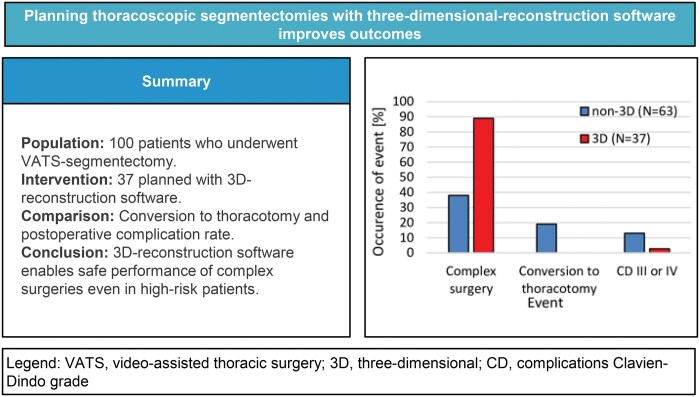
Results: Thirty-seven of the 100 patients included underwent surgery planned using the 3D models. In the 3D group, complex segmentectomies were performed more frequently (89% vs 38%, P < 0.001), and there were markedly fewer conversions to thoracotomy (P = 0.003). The IPTW analysis showed fewer severe complications (Clavien-Dindo grade III or IV) [post-IPTW odds ratio 0.10 (95% confidence interval 0.01-0.87), P = 0.037], and no Clavien-Dindo grade V complications occurred. Additionally, operative planning using models generated from 3D reconstruction software may influence procedural and postoperative parameters, such as the number of segments removed (1.9 ± 1.0 vs 1.7 ± 0.8, P = 0.40), duration of chest tube placement (3.0 days, interquartile range 2.0-4.0 vs 2.0 days, interquartile range 1.0-3.0, P = 0.060), and stay in the intensive/intermediate care unit.
Conclusions: The planning of complex anatomical VATS segmentectomies using 3D models constructed from 3D reconstruction software significantly reduces the need for conversions to thoracotomy and postoperative complications rates. In addition, complex operations are thereby performed safely.



 京公网安备 11010802042870号
京ICP备2023020795号-1
京公网安备 11010802042870号
京ICP备2023020795号-1

 分享
分享

 求助内容:
求助内容: 应助结果提醒方式:
 扫码关注我们
