Feilong Zhang, Deming Zhai, Guo Bai, Junjun Jiang, Qixiang Ye, Xiangyang Ji, Xianming Liu
{"title":"Towards fairness-aware and privacy-preserving enhanced collaborative learning for healthcare","authors":"Feilong Zhang, Deming Zhai, Guo Bai, Junjun Jiang, Qixiang Ye, Xiangyang Ji, Xianming Liu","doi":"10.1038/s41467-025-58055-3","DOIUrl":null,"url":null,"abstract":"<p>The widespread integration of AI algorithms in healthcare has sparked ethical concerns, particularly regarding privacy and fairness. Federated Learning (FL) offers a promising solution to learn from a broad spectrum of patient data without directly accessing individual records, enhancing privacy while facilitating knowledge sharing across distributed data sources. However, healthcare institutions face significant variations in access to crucial computing resources, with resource budgets often linked to demographic and socio-economic factors, exacerbating unfairness in participation. While heterogeneous federated learning methods allow healthcare institutions with varying computational capacities to collaborate, they fail to address the performance gap between resource-limited and resource-rich institutions. As a result, resource-limited institutions may receive suboptimal models, further reinforcing disparities in AI-driven healthcare outcomes. Here, we propose a resource-adaptive framework for collaborative learning that dynamically adjusts to varying computational capacities, ensuring fair participation. Our approach enhances model accuracy, safeguards patient privacy, and promotes equitable access to trustworthy and efficient AI-driven healthcare solutions.</p>","PeriodicalId":19066,"journal":{"name":"Nature Communications","volume":"6 1","pages":""},"PeriodicalIF":15.7000,"publicationDate":"2025-03-23","publicationTypes":"Journal Article","fieldsOfStudy":null,"isOpenAccess":false,"openAccessPdf":"","citationCount":"0","resultStr":null,"platform":"Semanticscholar","paperid":null,"PeriodicalName":"Nature Communications","FirstCategoryId":"103","ListUrlMain":"https://doi.org/10.1038/s41467-025-58055-3","RegionNum":1,"RegionCategory":"综合性期刊","ArticlePicture":[],"TitleCN":null,"AbstractTextCN":null,"PMCID":null,"EPubDate":"","PubModel":"","JCR":"Q1","JCRName":"MULTIDISCIPLINARY SCIENCES","Score":null,"Total":0}
引用次数: 0
Abstract
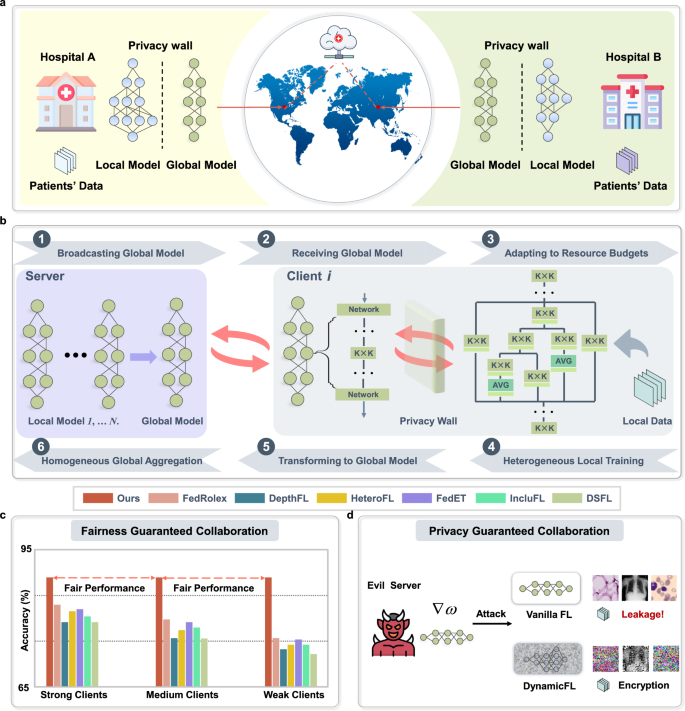
The widespread integration of AI algorithms in healthcare has sparked ethical concerns, particularly regarding privacy and fairness. Federated Learning (FL) offers a promising solution to learn from a broad spectrum of patient data without directly accessing individual records, enhancing privacy while facilitating knowledge sharing across distributed data sources. However, healthcare institutions face significant variations in access to crucial computing resources, with resource budgets often linked to demographic and socio-economic factors, exacerbating unfairness in participation. While heterogeneous federated learning methods allow healthcare institutions with varying computational capacities to collaborate, they fail to address the performance gap between resource-limited and resource-rich institutions. As a result, resource-limited institutions may receive suboptimal models, further reinforcing disparities in AI-driven healthcare outcomes. Here, we propose a resource-adaptive framework for collaborative learning that dynamically adjusts to varying computational capacities, ensuring fair participation. Our approach enhances model accuracy, safeguards patient privacy, and promotes equitable access to trustworthy and efficient AI-driven healthcare solutions.
期刊介绍:
Nature Communications, an open-access journal, publishes high-quality research spanning all areas of the natural sciences. Papers featured in the journal showcase significant advances relevant to specialists in each respective field. With a 2-year impact factor of 16.6 (2022) and a median time of 8 days from submission to the first editorial decision, Nature Communications is committed to rapid dissemination of research findings. As a multidisciplinary journal, it welcomes contributions from biological, health, physical, chemical, Earth, social, mathematical, applied, and engineering sciences, aiming to highlight important breakthroughs within each domain.



 京公网安备 11010802042870号
京ICP备2023020795号-1
京公网安备 11010802042870号
京ICP备2023020795号-1

 分享
分享
 求助内容:
求助内容: 应助结果提醒方式:
 扫码关注我们
