Yun-Hui Hu, Jia-Hao Wang, Yan Chen, Ji-Ping Tang, Zi-Yi Wang and Yong-Jun Yuan
{"title":"Solar driven conversion of agricultural biomass to H2 over few-layer MoS2 modified ultra-small TiO2 nanoparticle photocatalysts†","authors":"Yun-Hui Hu, Jia-Hao Wang, Yan Chen, Ji-Ping Tang, Zi-Yi Wang and Yong-Jun Yuan","doi":"10.1039/D5TA00763A","DOIUrl":null,"url":null,"abstract":"<p >Agricultural biomass is a kind of abundant renewable resource in nature, and the effective conversion of agricultural biomass to chemical fuel is crucial for reducing dependence on fossil fuels, but it has been limited by the absence of appropriate conversion strategies. Here, we report a simple photocatalytic system for rapid conversion of agricultural biomass to H<small><sub>2</sub></small> by using few-layer MoS<small><sub>2</sub></small> modified ultra-small TiO<small><sub>2</sub></small> nanoparticles (MoS<small><sub>2</sub></small>@TiO<small><sub>2</sub></small> NPs) as photocatalysts. In the α-cellulose system, the H<small><sub>2</sub></small> generation rate of the optimized photocatalyst reaches 1653 μmol g<small><sup>−1</sup></small> h<small><sup>−1</sup></small> under 300 W Xe lamp irradiation, and the apparent quantum yield at 380 nm reaches 5.62%. Meanwhile, comparable photocatalytic H<small><sub>2</sub></small> generation activity was achieved from different agricultural biomass sources of rice straw, corn straw, wheat straw, rice husk, soybean straw and corncob, with a maximum H<small><sub>2</sub></small> generation rate of 50 μmol g<small><sup>−1</sup></small> h<small><sup>−1</sup></small> in the corncob system. The high photocatalytic H<small><sub>2</sub></small> production activity of the MoS<small><sub>2</sub></small>@TiO<small><sub>2</sub></small> NP photocatalyst was attributed to the large specific surface area of TiO<small><sub>2</sub></small> NPs and abundant active sites of MoS<small><sub>2</sub></small>, which respectively promote biomass oxidation and the H<small><sub>2</sub></small> generation reaction. This study provides a green approach for agricultural biomass upgrading through a photocatalytic strategy.</p>","PeriodicalId":82,"journal":{"name":"Journal of Materials Chemistry A","volume":" 18","pages":" 13402-13409"},"PeriodicalIF":9.5000,"publicationDate":"2025-03-22","publicationTypes":"Journal Article","fieldsOfStudy":null,"isOpenAccess":false,"openAccessPdf":"","citationCount":"0","resultStr":null,"platform":"Semanticscholar","paperid":null,"PeriodicalName":"Journal of Materials Chemistry A","FirstCategoryId":"88","ListUrlMain":"https://pubs.rsc.org/en/content/articlelanding/2025/ta/d5ta00763a","RegionNum":2,"RegionCategory":"材料科学","ArticlePicture":[],"TitleCN":null,"AbstractTextCN":null,"PMCID":null,"EPubDate":"","PubModel":"","JCR":"Q1","JCRName":"CHEMISTRY, PHYSICAL","Score":null,"Total":0}
引用次数: 0
Abstract
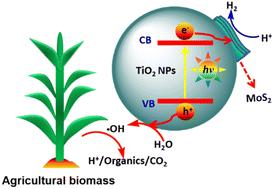
Agricultural biomass is a kind of abundant renewable resource in nature, and the effective conversion of agricultural biomass to chemical fuel is crucial for reducing dependence on fossil fuels, but it has been limited by the absence of appropriate conversion strategies. Here, we report a simple photocatalytic system for rapid conversion of agricultural biomass to H2 by using few-layer MoS2 modified ultra-small TiO2 nanoparticles (MoS2@TiO2 NPs) as photocatalysts. In the α-cellulose system, the H2 generation rate of the optimized photocatalyst reaches 1653 μmol g−1 h−1 under 300 W Xe lamp irradiation, and the apparent quantum yield at 380 nm reaches 5.62%. Meanwhile, comparable photocatalytic H2 generation activity was achieved from different agricultural biomass sources of rice straw, corn straw, wheat straw, rice husk, soybean straw and corncob, with a maximum H2 generation rate of 50 μmol g−1 h−1 in the corncob system. The high photocatalytic H2 production activity of the MoS2@TiO2 NP photocatalyst was attributed to the large specific surface area of TiO2 NPs and abundant active sites of MoS2, which respectively promote biomass oxidation and the H2 generation reaction. This study provides a green approach for agricultural biomass upgrading through a photocatalytic strategy.
期刊介绍:
The Journal of Materials Chemistry A, B & C covers a wide range of high-quality studies in the field of materials chemistry, with each section focusing on specific applications of the materials studied. Journal of Materials Chemistry A emphasizes applications in energy and sustainability, including topics such as artificial photosynthesis, batteries, and fuel cells. Journal of Materials Chemistry B focuses on applications in biology and medicine, while Journal of Materials Chemistry C covers applications in optical, magnetic, and electronic devices. Example topic areas within the scope of Journal of Materials Chemistry A include catalysis, green/sustainable materials, sensors, and water treatment, among others.



 京公网安备 11010802042870号
京ICP备2023020795号-1
京公网安备 11010802042870号
京ICP备2023020795号-1

 分享
分享
 求助内容:
求助内容: 应助结果提醒方式:
 扫码关注我们
