Amit Mondal, Shubham Patel, Rahul Pan, Sandip Kumar Kuila, Riju Dey, Lars Schumacher, Anup Kumar Bera, Rainer Pöttgen, Partha Pratim Jana
{"title":"Chemical Disorder-Driven Cluster Spin Glass in Pseudobinary Co2Zn10.2Mn0.8: An Experimental and Theoretical Study","authors":"Amit Mondal, Shubham Patel, Rahul Pan, Sandip Kumar Kuila, Riju Dey, Lars Schumacher, Anup Kumar Bera, Rainer Pöttgen, Partha Pratim Jana","doi":"10.1021/acs.inorgchem.4c05506","DOIUrl":null,"url":null,"abstract":"The investigation focuses on Mn substitution in Co<sub>2</sub>Zn<sub>11</sub>, prepared by pursuing a solid-state sealed tube method under high vacuum. We report the crystal structure and magnetic properties of Co<sub>2</sub>Zn<sub>10.2</sub>Mn<sub>0.8</sub> in detail. Co<sub>2</sub>Zn<sub>10.2</sub>Mn<sub>0.8</sub> adopts the noncentrosymmetric space group <i>I</i>4̅3<i>m</i> (No. 217), and the distribution of Co, Mn, and Zn atoms is confirmed using X-ray and neutron powder diffraction (NPD) techniques. The magnetic studies reveal cluster glass (CG) formation below the spin-freezing temperature of 23.1 K in Co<sub>2</sub>Zn<sub>10.2</sub>Mn<sub>0.8</sub>, also indicated by the large value of the characteristic relaxation time (τ<sub>0</sub>) of ∼10<sup>–8</sup> s. This large value of τ<sub>0</sub> supports the formation of magnetic clusters. The magnetic moment primarily originates due to the spins of Mn atoms, which is realized from significant differences between majority- and minority-spin channels of Mn 3d states in the projected density of states curves.","PeriodicalId":40,"journal":{"name":"Inorganic Chemistry","volume":"27 1","pages":""},"PeriodicalIF":4.7000,"publicationDate":"2025-03-22","publicationTypes":"Journal Article","fieldsOfStudy":null,"isOpenAccess":false,"openAccessPdf":"","citationCount":"0","resultStr":null,"platform":"Semanticscholar","paperid":null,"PeriodicalName":"Inorganic Chemistry","FirstCategoryId":"92","ListUrlMain":"https://doi.org/10.1021/acs.inorgchem.4c05506","RegionNum":2,"RegionCategory":"化学","ArticlePicture":[],"TitleCN":null,"AbstractTextCN":null,"PMCID":null,"EPubDate":"","PubModel":"","JCR":"Q1","JCRName":"CHEMISTRY, INORGANIC & NUCLEAR","Score":null,"Total":0}
引用次数: 0
Abstract
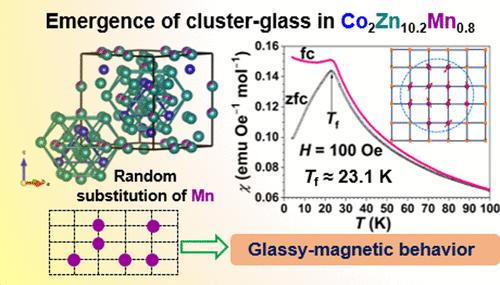
The investigation focuses on Mn substitution in Co2Zn11, prepared by pursuing a solid-state sealed tube method under high vacuum. We report the crystal structure and magnetic properties of Co2Zn10.2Mn0.8 in detail. Co2Zn10.2Mn0.8 adopts the noncentrosymmetric space group I4̅3m (No. 217), and the distribution of Co, Mn, and Zn atoms is confirmed using X-ray and neutron powder diffraction (NPD) techniques. The magnetic studies reveal cluster glass (CG) formation below the spin-freezing temperature of 23.1 K in Co2Zn10.2Mn0.8, also indicated by the large value of the characteristic relaxation time (τ0) of ∼10–8 s. This large value of τ0 supports the formation of magnetic clusters. The magnetic moment primarily originates due to the spins of Mn atoms, which is realized from significant differences between majority- and minority-spin channels of Mn 3d states in the projected density of states curves.
期刊介绍:
Inorganic Chemistry publishes fundamental studies in all phases of inorganic chemistry. Coverage includes experimental and theoretical reports on quantitative studies of structure and thermodynamics, kinetics, mechanisms of inorganic reactions, bioinorganic chemistry, and relevant aspects of organometallic chemistry, solid-state phenomena, and chemical bonding theory. Emphasis is placed on the synthesis, structure, thermodynamics, reactivity, spectroscopy, and bonding properties of significant new and known compounds.



 京公网安备 11010802042870号
京ICP备2023020795号-1
京公网安备 11010802042870号
京ICP备2023020795号-1

 分享
分享
 求助内容:
求助内容: 应助结果提醒方式:
 扫码关注我们
