Juliana F. de Sousa , Jez W. Batista Braga , Ana Cristi Basile Dias
{"title":"Authenticity assessment of commercial natural sweeteners using near- and mid-infrared spectroscopy with DD-SIMCA modeling","authors":"Juliana F. de Sousa , Jez W. Batista Braga , Ana Cristi Basile Dias","doi":"10.1016/j.foodchem.2025.143983","DOIUrl":null,"url":null,"abstract":"<div><div>This study presents a direct method to verify the purity and authenticity of erythritol, xylitol, and stevia using near- and mid-infrared spectroscopy combined with a DD-SIMCA classification model. The model was enhanced with virtual samples created by adding PCA residuals and noise, improving robustness and accuracy. The validation was performed using independent sample sets, including commercial natural sweeteners and samples adulterated with saccharin, sucrose, acesulfame, and silicon dioxide. For xylitol, efficiency rates (EFR) of 97 % (NIR) and 95 % (MIR) were achieved, while erythritol achieved EFRs of 96 % (NIR) and 98 % (MIR). Conversely, stevia exhibited significant variation in its spectral profile across different brands and batches due to the natural variability of steviol glycosides and extraction conditions. Consequently, the EFR for stevia reached only 61 % (NIR) and 90 % (MIR). This approach offers a fast and accurate alternative for verifying the authenticity of natural sweeteners supporting quality control and anti-adulteration efforts.</div></div>","PeriodicalId":318,"journal":{"name":"Food Chemistry","volume":"481 ","pages":"Article 143983"},"PeriodicalIF":9.8000,"publicationDate":"2025-03-22","publicationTypes":"Journal Article","fieldsOfStudy":null,"isOpenAccess":false,"openAccessPdf":"","citationCount":"0","resultStr":null,"platform":"Semanticscholar","paperid":null,"PeriodicalName":"Food Chemistry","FirstCategoryId":"97","ListUrlMain":"https://www.sciencedirect.com/science/article/pii/S0308814625012348","RegionNum":1,"RegionCategory":"农林科学","ArticlePicture":[],"TitleCN":null,"AbstractTextCN":null,"PMCID":null,"EPubDate":"","PubModel":"","JCR":"Q1","JCRName":"CHEMISTRY, APPLIED","Score":null,"Total":0}
引用次数: 0
Abstract
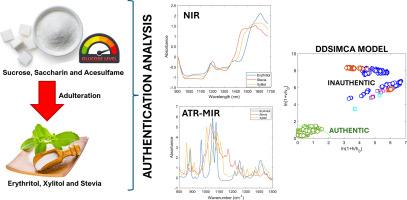
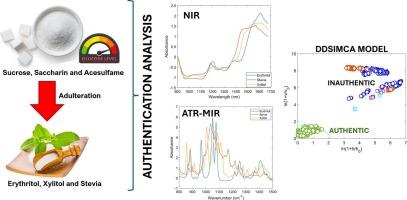
This study presents a direct method to verify the purity and authenticity of erythritol, xylitol, and stevia using near- and mid-infrared spectroscopy combined with a DD-SIMCA classification model. The model was enhanced with virtual samples created by adding PCA residuals and noise, improving robustness and accuracy. The validation was performed using independent sample sets, including commercial natural sweeteners and samples adulterated with saccharin, sucrose, acesulfame, and silicon dioxide. For xylitol, efficiency rates (EFR) of 97 % (NIR) and 95 % (MIR) were achieved, while erythritol achieved EFRs of 96 % (NIR) and 98 % (MIR). Conversely, stevia exhibited significant variation in its spectral profile across different brands and batches due to the natural variability of steviol glycosides and extraction conditions. Consequently, the EFR for stevia reached only 61 % (NIR) and 90 % (MIR). This approach offers a fast and accurate alternative for verifying the authenticity of natural sweeteners supporting quality control and anti-adulteration efforts.
期刊介绍:
Food Chemistry publishes original research papers dealing with the advancement of the chemistry and biochemistry of foods or the analytical methods/ approach used. All papers should focus on the novelty of the research carried out.



 京公网安备 11010802042870号
京ICP备2023020795号-1
京公网安备 11010802042870号
京ICP备2023020795号-1

 分享
分享
 求助内容:
求助内容: 应助结果提醒方式:
 扫码关注我们
