Sophie V. Morse , Sarah Rimer , Grainne Geoghegan , Manaal Shah , Nicholas Chan , Ceren Yalcin , Maria Afonso Pereira , Lucia Rohfleisch , Neema Nkontchou , Samuel Winiarski , Jamie Ee , Aurna Maitra , Tiffany G. Chan , Magdalena Sastre , James J. Choi
{"title":"Biological effects of rapid short pulses of focused ultrasound for drug delivery to the brain","authors":"Sophie V. Morse , Sarah Rimer , Grainne Geoghegan , Manaal Shah , Nicholas Chan , Ceren Yalcin , Maria Afonso Pereira , Lucia Rohfleisch , Neema Nkontchou , Samuel Winiarski , Jamie Ee , Aurna Maitra , Tiffany G. Chan , Magdalena Sastre , James J. Choi","doi":"10.1016/j.jconrel.2025.113646","DOIUrl":null,"url":null,"abstract":"<div><div>Focused ultrasound in combination with intravenously injected microbubbles offers a non-invasive and localised method to deliver drugs across the blood-brain barrier, enabling targeted treatment of brain disorders. Recently, we have shown that applying sequences of Rapid Short-Pulses (RaSP; 5 μs pulses emitted at 1.25 kHz grouped into 10 ms bursts) of ultrasound can deliver drugs with an improved efficacy and safety profile compared with traditionally-used longer pulses (> 10 ms). In this study, we examined the extent to which RaSP sequences allowed the extravasation of endogenous blood proteins, including albumin and immunoglobulin, as well as T cells, into the brain parenchyma. We also investigated the effect of RaSP ultrasound treatments on synaptic connectivity, and the distribution and excretion of fluorescently-labelled 3 kDa dextran delivered to the brain with RaSP. The left hippocampus of mice was sonicated with either a RaSP sequence (5 μs at 1.25 kHz in groups of 10 ms at 0.5 Hz) or a long pulse sequence (10 ms at 0.5 Hz), at 0.35, 0.53 and 0.71 MPa with a 1-MHz center frequency. Significantly less albumin was detected in RaSP-treated brains immediately after treatment and was cleared within 10 min compared to those treated with long pulses, while immunoglobulin was hardly detected in RaSP-treated brains at 0, 10 or 20 min after treatment. No T cells were detected in RaSP-treated brains at 0.35, 0.53 or 0.71 MPa after 0 or 2 h. In long pulse samples, however, T cells did extravasate when using the two higher acoustic pressures, 0.53 and 0.71 MPa, immediately after treatment. Quantification of dendritic spine area revealed no differences between RaSP-treated hippocampi compared to untreated contralateral hippocampi and control mice following three weekly ultrasound treatments. Finally, fluorescently-labelled dextran increasingly moved towards blood vessels and away from the parenchyma once delivered to the brain with both RaSP and long pulse sequences. Uptake of dextran within cells decreased over time with both sequences, and long pulses lead to a larger number of vessels with dextran uptake. This study highlights that RaSP ultrasound sequences can deliver molecules across the blood-brain barrier with minimal extravasation of endogenous proteins and no T cell infiltration, while preserving dendritic spine integrity, thus offering an improved safety profile.</div></div>","PeriodicalId":15450,"journal":{"name":"Journal of Controlled Release","volume":"382 ","pages":"Article 113646"},"PeriodicalIF":11.5000,"publicationDate":"2025-06-10","publicationTypes":"Journal Article","fieldsOfStudy":null,"isOpenAccess":false,"openAccessPdf":"","citationCount":"0","resultStr":null,"platform":"Semanticscholar","paperid":null,"PeriodicalName":"Journal of Controlled Release","FirstCategoryId":"3","ListUrlMain":"https://www.sciencedirect.com/science/article/pii/S0168365925002664","RegionNum":1,"RegionCategory":"医学","ArticlePicture":[],"TitleCN":null,"AbstractTextCN":null,"PMCID":null,"EPubDate":"2025/3/22 0:00:00","PubModel":"Epub","JCR":"Q1","JCRName":"CHEMISTRY, MULTIDISCIPLINARY","Score":null,"Total":0}
引用次数: 0
Abstract
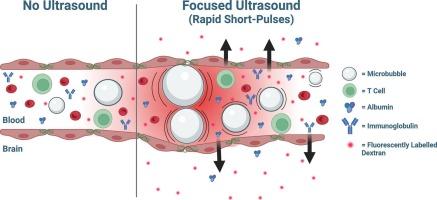
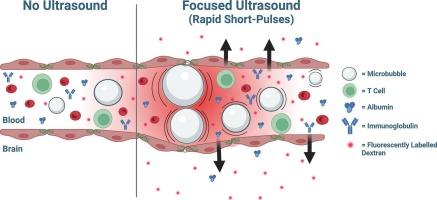
Focused ultrasound in combination with intravenously injected microbubbles offers a non-invasive and localised method to deliver drugs across the blood-brain barrier, enabling targeted treatment of brain disorders. Recently, we have shown that applying sequences of Rapid Short-Pulses (RaSP; 5 μs pulses emitted at 1.25 kHz grouped into 10 ms bursts) of ultrasound can deliver drugs with an improved efficacy and safety profile compared with traditionally-used longer pulses (> 10 ms). In this study, we examined the extent to which RaSP sequences allowed the extravasation of endogenous blood proteins, including albumin and immunoglobulin, as well as T cells, into the brain parenchyma. We also investigated the effect of RaSP ultrasound treatments on synaptic connectivity, and the distribution and excretion of fluorescently-labelled 3 kDa dextran delivered to the brain with RaSP. The left hippocampus of mice was sonicated with either a RaSP sequence (5 μs at 1.25 kHz in groups of 10 ms at 0.5 Hz) or a long pulse sequence (10 ms at 0.5 Hz), at 0.35, 0.53 and 0.71 MPa with a 1-MHz center frequency. Significantly less albumin was detected in RaSP-treated brains immediately after treatment and was cleared within 10 min compared to those treated with long pulses, while immunoglobulin was hardly detected in RaSP-treated brains at 0, 10 or 20 min after treatment. No T cells were detected in RaSP-treated brains at 0.35, 0.53 or 0.71 MPa after 0 or 2 h. In long pulse samples, however, T cells did extravasate when using the two higher acoustic pressures, 0.53 and 0.71 MPa, immediately after treatment. Quantification of dendritic spine area revealed no differences between RaSP-treated hippocampi compared to untreated contralateral hippocampi and control mice following three weekly ultrasound treatments. Finally, fluorescently-labelled dextran increasingly moved towards blood vessels and away from the parenchyma once delivered to the brain with both RaSP and long pulse sequences. Uptake of dextran within cells decreased over time with both sequences, and long pulses lead to a larger number of vessels with dextran uptake. This study highlights that RaSP ultrasound sequences can deliver molecules across the blood-brain barrier with minimal extravasation of endogenous proteins and no T cell infiltration, while preserving dendritic spine integrity, thus offering an improved safety profile.
期刊介绍:
The Journal of Controlled Release (JCR) proudly serves as the Official Journal of the Controlled Release Society and the Japan Society of Drug Delivery System.
Dedicated to the broad field of delivery science and technology, JCR publishes high-quality research articles covering drug delivery systems and all facets of formulations. This includes the physicochemical and biological properties of drugs, design and characterization of dosage forms, release mechanisms, in vivo testing, and formulation research and development across pharmaceutical, diagnostic, agricultural, environmental, cosmetic, and food industries.
Priority is given to manuscripts that contribute to the fundamental understanding of principles or demonstrate the advantages of novel technologies in terms of safety and efficacy over current clinical standards. JCR strives to be a leading platform for advancements in delivery science and technology.



 京公网安备 11010802042870号
京ICP备2023020795号-1
京公网安备 11010802042870号
京ICP备2023020795号-1

 分享
分享
 求助内容:
求助内容: 应助结果提醒方式:
 扫码关注我们
