Ge Sun , Ying Wu , Jiekai Li , Mingjie Yang , Hang Xu , Yiping Li , Peilin Tong , Rong Shao , Yingbin Liu , Xianming Kong
{"title":"Quercetin liposomes conjugated with hyaluronidase: An efficient drug delivery system to block pancreatic cancer","authors":"Ge Sun , Ying Wu , Jiekai Li , Mingjie Yang , Hang Xu , Yiping Li , Peilin Tong , Rong Shao , Yingbin Liu , Xianming Kong","doi":"10.1016/j.jconrel.2025.113642","DOIUrl":null,"url":null,"abstract":"<div><div>Pancreatic cancer characterized with intense hydraulic tissue in tumor extracellular matrix (ECM) resists most of chemotherapeutic drugs. Increased levels of hyaluronic acid (HA) represent the primary component of the hydraulic tissue, rendering tumors protective from drug targeting. Quercetin (Que), a natural flavonoid, has the ability to inhibit tumor cell growth in a number of cancers; however, its poor water solubility and low bioavailability largely limit its application in cancer therapy. Hence, we developed an efficient drug delivery system by encapsulation of Que. into liposomes and conjugation with hyaluronidase (HAase) at liposome surface, termed as HQL. In the presence of HAase, HQL were predominantly accumulated at tumor with enhanced permeability and retention effect. Treatment of xenografted tumor mice with HQL gave rise to suppressed tumor growth, while no toxic effects were observed in mice. HQL demonstrated the strong ability to inhibit cell proliferation, promote cell apoptosis, and induce arrest at G2/M cell cycle in pancreatic cancer lines, three-dimensional cultured cell spheroids and pancreatic ductal adenocarcinoma (PDAC)-derived organoids. Mechanistically, HQL downregulated expression of cell cycle-associated protein (CCNB1, CDK1 and PLK1) and cell apoptosis-associated factors PI3K/AKT and Bcl-2. In summary, HQL degraded HA in the tumor microenvironment to enhance nano-particle penetration and inhibited tumor cell growth, eliciting efficacy of anti-tumor therapy. Thereof, HQL may provide a novel efficient drug delivery approach for the adjuvant treatment of pancreatic cancer.</div></div>","PeriodicalId":15450,"journal":{"name":"Journal of Controlled Release","volume":"382 ","pages":"Article 113642"},"PeriodicalIF":11.5000,"publicationDate":"2025-06-10","publicationTypes":"Journal Article","fieldsOfStudy":null,"isOpenAccess":false,"openAccessPdf":"","citationCount":"0","resultStr":null,"platform":"Semanticscholar","paperid":null,"PeriodicalName":"Journal of Controlled Release","FirstCategoryId":"3","ListUrlMain":"https://www.sciencedirect.com/science/article/pii/S0168365925002627","RegionNum":1,"RegionCategory":"医学","ArticlePicture":[],"TitleCN":null,"AbstractTextCN":null,"PMCID":null,"EPubDate":"2025/3/22 0:00:00","PubModel":"Epub","JCR":"Q1","JCRName":"CHEMISTRY, MULTIDISCIPLINARY","Score":null,"Total":0}
引用次数: 0
Abstract
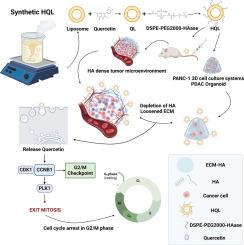
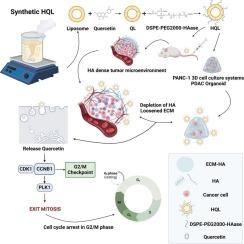
Pancreatic cancer characterized with intense hydraulic tissue in tumor extracellular matrix (ECM) resists most of chemotherapeutic drugs. Increased levels of hyaluronic acid (HA) represent the primary component of the hydraulic tissue, rendering tumors protective from drug targeting. Quercetin (Que), a natural flavonoid, has the ability to inhibit tumor cell growth in a number of cancers; however, its poor water solubility and low bioavailability largely limit its application in cancer therapy. Hence, we developed an efficient drug delivery system by encapsulation of Que. into liposomes and conjugation with hyaluronidase (HAase) at liposome surface, termed as HQL. In the presence of HAase, HQL were predominantly accumulated at tumor with enhanced permeability and retention effect. Treatment of xenografted tumor mice with HQL gave rise to suppressed tumor growth, while no toxic effects were observed in mice. HQL demonstrated the strong ability to inhibit cell proliferation, promote cell apoptosis, and induce arrest at G2/M cell cycle in pancreatic cancer lines, three-dimensional cultured cell spheroids and pancreatic ductal adenocarcinoma (PDAC)-derived organoids. Mechanistically, HQL downregulated expression of cell cycle-associated protein (CCNB1, CDK1 and PLK1) and cell apoptosis-associated factors PI3K/AKT and Bcl-2. In summary, HQL degraded HA in the tumor microenvironment to enhance nano-particle penetration and inhibited tumor cell growth, eliciting efficacy of anti-tumor therapy. Thereof, HQL may provide a novel efficient drug delivery approach for the adjuvant treatment of pancreatic cancer.
期刊介绍:
The Journal of Controlled Release (JCR) proudly serves as the Official Journal of the Controlled Release Society and the Japan Society of Drug Delivery System.
Dedicated to the broad field of delivery science and technology, JCR publishes high-quality research articles covering drug delivery systems and all facets of formulations. This includes the physicochemical and biological properties of drugs, design and characterization of dosage forms, release mechanisms, in vivo testing, and formulation research and development across pharmaceutical, diagnostic, agricultural, environmental, cosmetic, and food industries.
Priority is given to manuscripts that contribute to the fundamental understanding of principles or demonstrate the advantages of novel technologies in terms of safety and efficacy over current clinical standards. JCR strives to be a leading platform for advancements in delivery science and technology.



 京公网安备 11010802042870号
京ICP备2023020795号-1
京公网安备 11010802042870号
京ICP备2023020795号-1

 分享
分享
 求助内容:
求助内容: 应助结果提醒方式:
 扫码关注我们
