Hu Zheng , Xinyi Xu , Rong Fan , Mei Huang , Shiyong Huang , Guangyong Zeng , Jianquan Luo , Yinhua Wan
{"title":"Multi-membrane integrated ultrafiltration process for fractionation and purification of low molecular-weight dextrans from acidic hydrolysate","authors":"Hu Zheng , Xinyi Xu , Rong Fan , Mei Huang , Shiyong Huang , Guangyong Zeng , Jianquan Luo , Yinhua Wan","doi":"10.1016/j.ces.2025.121568","DOIUrl":null,"url":null,"abstract":"<div><div>Traditional separation can hardly provide low-molecular-weight (LMW) dextrans with a narrow molecular weight distribution (polydispersity index ≤ 1.4) for pharma-industry. This study revealed the challenges of fine separation of LMW dextrans using membrane technology by investigating the influences of fouling on dextran’s penetrating pattern across the membrane using a model system with pre−depositing dextran. Subsequently, a control strategy was used to develop a cascade membrane process for high-efficient separation. The formation of a gel layer from retained dextran altered the rejection of different molecules. This issue was addressed by to regulating fouling with diafiltration, thereby enhancing separation efficiency and accuracy. Ultimately, the membrane cascade system with M1/M2/M5 successfully separated the industrial acidic hydrolysate in 3 fractions (at 2 bar), in which the 6.3-kDa fraction reached a MW distribution of 1.4 with recovery >90 %. This process enables precise MW control, demonstrating scalable production of high-purity dextrans aligned with pharmacopeial standards.</div></div>","PeriodicalId":271,"journal":{"name":"Chemical Engineering Science","volume":"311 ","pages":"Article 121568"},"PeriodicalIF":4.3000,"publicationDate":"2025-06-01","publicationTypes":"Journal Article","fieldsOfStudy":null,"isOpenAccess":false,"openAccessPdf":"","citationCount":"0","resultStr":null,"platform":"Semanticscholar","paperid":null,"PeriodicalName":"Chemical Engineering Science","FirstCategoryId":"5","ListUrlMain":"https://www.sciencedirect.com/science/article/pii/S0009250925003914","RegionNum":2,"RegionCategory":"工程技术","ArticlePicture":[],"TitleCN":null,"AbstractTextCN":null,"PMCID":null,"EPubDate":"2025/3/22 0:00:00","PubModel":"Epub","JCR":"Q2","JCRName":"ENGINEERING, CHEMICAL","Score":null,"Total":0}
引用次数: 0
Abstract
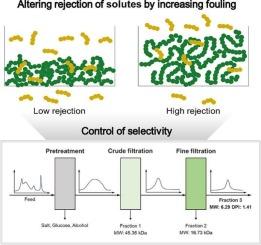
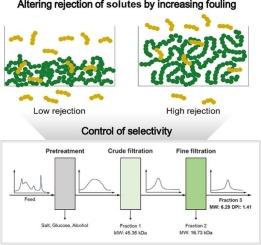
Traditional separation can hardly provide low-molecular-weight (LMW) dextrans with a narrow molecular weight distribution (polydispersity index ≤ 1.4) for pharma-industry. This study revealed the challenges of fine separation of LMW dextrans using membrane technology by investigating the influences of fouling on dextran’s penetrating pattern across the membrane using a model system with pre−depositing dextran. Subsequently, a control strategy was used to develop a cascade membrane process for high-efficient separation. The formation of a gel layer from retained dextran altered the rejection of different molecules. This issue was addressed by to regulating fouling with diafiltration, thereby enhancing separation efficiency and accuracy. Ultimately, the membrane cascade system with M1/M2/M5 successfully separated the industrial acidic hydrolysate in 3 fractions (at 2 bar), in which the 6.3-kDa fraction reached a MW distribution of 1.4 with recovery >90 %. This process enables precise MW control, demonstrating scalable production of high-purity dextrans aligned with pharmacopeial standards.
期刊介绍:
Chemical engineering enables the transformation of natural resources and energy into useful products for society. It draws on and applies natural sciences, mathematics and economics, and has developed fundamental engineering science that underpins the discipline.
Chemical Engineering Science (CES) has been publishing papers on the fundamentals of chemical engineering since 1951. CES is the platform where the most significant advances in the discipline have ever since been published. Chemical Engineering Science has accompanied and sustained chemical engineering through its development into the vibrant and broad scientific discipline it is today.



 京公网安备 11010802042870号
京ICP备2023020795号-1
京公网安备 11010802042870号
京ICP备2023020795号-1

 分享
分享
 求助内容:
求助内容: 应助结果提醒方式:
 扫码关注我们
