Vediyappan Thirumal, Bathula Babu, Jinho Kim, Kisoo Yoo, Seung Hwan Lee
{"title":"Iron Phosphate–Carbon Nanofiber Composite for High-Performance Asymmetric Hybrid Supercapacitors","authors":"Vediyappan Thirumal, Bathula Babu, Jinho Kim, Kisoo Yoo, Seung Hwan Lee","doi":"10.1016/j.jallcom.2025.179956","DOIUrl":null,"url":null,"abstract":"A composite of iron phosphate (FeP) and carbon nanofibers (CNFs) was synthesized using a facile <u>hydrothermal</u> technique. The surface morphologies of the FeP and FeP–CNF nanocomposites were characterized through field-emission scanning electron microscopy and high-resolution transmission electron microscopy. The crystallinity and functional groups of the materials were identified using X-ray diffraction and Fourier transform infrared spectroscopy. Furthermore, the binding energies and electronic bonding states of the FeP–CNF composites were analyzed using X-ray photoelectron spectroscopy. The electrochemical performance of FeP and FeP–CNF as active materials for supercapacitors was investigated by fabricating three- and two-electrode systems. Their performance was evaluated through cyclic voltammetry, galvanostatic charge–discharge measurements, and electrochemical impedance spectroscopy. Two-electrode asymmetric devices, FeP//AC and FeP–CNF//AC, were tested within a voltage range of 0–1.6<!-- --> <!-- -->V using a 3<!-- --> <!-- -->M KOH aqueous electrolyte. The maximum specific capacitances of the electrodes were 59.90 and 120.11<!-- --> <!-- -->F/g at 1<!-- --> <!-- -->A/g for FeP//AC and FeP–CNF//AC, respectively. Both asymmetric devices demonstrated excellent cycling stability and capacitance retention over 10,000 cycles at 5<!-- --> <!-- -->A/g. The FeP–CNF-based asymmetric supercapacitor performed particularly well, underscoring its prospects for high-energy storage applications in advanced energy storage systems.","PeriodicalId":344,"journal":{"name":"Journal of Alloys and Compounds","volume":"57 1","pages":""},"PeriodicalIF":6.3000,"publicationDate":"2025-03-23","publicationTypes":"Journal Article","fieldsOfStudy":null,"isOpenAccess":false,"openAccessPdf":"","citationCount":"0","resultStr":null,"platform":"Semanticscholar","paperid":null,"PeriodicalName":"Journal of Alloys and Compounds","FirstCategoryId":"88","ListUrlMain":"https://doi.org/10.1016/j.jallcom.2025.179956","RegionNum":2,"RegionCategory":"材料科学","ArticlePicture":[],"TitleCN":null,"AbstractTextCN":null,"PMCID":null,"EPubDate":"","PubModel":"","JCR":"Q2","JCRName":"CHEMISTRY, PHYSICAL","Score":null,"Total":0}
引用次数: 0
Abstract
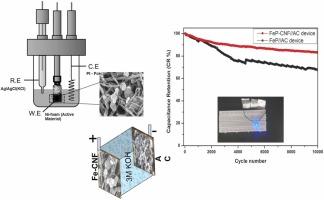
A composite of iron phosphate (FeP) and carbon nanofibers (CNFs) was synthesized using a facile hydrothermal technique. The surface morphologies of the FeP and FeP–CNF nanocomposites were characterized through field-emission scanning electron microscopy and high-resolution transmission electron microscopy. The crystallinity and functional groups of the materials were identified using X-ray diffraction and Fourier transform infrared spectroscopy. Furthermore, the binding energies and electronic bonding states of the FeP–CNF composites were analyzed using X-ray photoelectron spectroscopy. The electrochemical performance of FeP and FeP–CNF as active materials for supercapacitors was investigated by fabricating three- and two-electrode systems. Their performance was evaluated through cyclic voltammetry, galvanostatic charge–discharge measurements, and electrochemical impedance spectroscopy. Two-electrode asymmetric devices, FeP//AC and FeP–CNF//AC, were tested within a voltage range of 0–1.6 V using a 3 M KOH aqueous electrolyte. The maximum specific capacitances of the electrodes were 59.90 and 120.11 F/g at 1 A/g for FeP//AC and FeP–CNF//AC, respectively. Both asymmetric devices demonstrated excellent cycling stability and capacitance retention over 10,000 cycles at 5 A/g. The FeP–CNF-based asymmetric supercapacitor performed particularly well, underscoring its prospects for high-energy storage applications in advanced energy storage systems.
期刊介绍:
The Journal of Alloys and Compounds is intended to serve as an international medium for the publication of work on solid materials comprising compounds as well as alloys. Its great strength lies in the diversity of discipline which it encompasses, drawing together results from materials science, solid-state chemistry and physics.



 京公网安备 11010802042870号
京ICP备2023020795号-1
京公网安备 11010802042870号
京ICP备2023020795号-1

 分享
分享
 求助内容:
求助内容: 应助结果提醒方式:
 扫码关注我们
