{"title":"Tracking nutritional and quality changes in frozen pork: A 12-month study using 7 categories of meat parameters and VIS/NIR spectroscopy","authors":"Xi Tang, Hui Xiao, Ting Luo, Jiacheng Wei, Ruiqiu He, Junhui Duan, Shijun Xiao, Nengshui Ding, Lusheng Huang, Zhiyan Zhang","doi":"10.1016/j.foodchem.2025.144003","DOIUrl":null,"url":null,"abstract":"<div><div>Frozen pork stocks are critical for stabilizing food security and prices, but assessing nutritional and physicochemical changes during freezing remains challenging. This study conducted a 12-month frozen storage experiment at −20 °C on 50 pigs' longissimus muscles, quantifying changes in 62 meat quality components in 7 categories, including thawing loss, myoglobin, fatty acids, amino acids, and deterioration indicators. The Prophet model suggests pork retains good quality for 1–2 years under proper freezing, with significant deterioration appearing after 4 years. Phenotypic correlations across dimensions reveal key interactions and abnormalities, such as arachidonic acid (C20:4n6) and methionine (Met) deviating from their respective clusters. Using VIS/NIRS and nine machine learning algorithms, a storage time classification model achieved 85.8 % accuracy with SpecimIQ transmission spectra and AdaBoost. These findings demonstrate the potential of VIS/NIRS in food safety and processing, providing a practical solution for precise storage duration identification and valuable insights for managing frozen pork reserves.</div></div>","PeriodicalId":318,"journal":{"name":"Food Chemistry","volume":"481 ","pages":"Article 144003"},"PeriodicalIF":9.8000,"publicationDate":"2025-07-30","publicationTypes":"Journal Article","fieldsOfStudy":null,"isOpenAccess":false,"openAccessPdf":"","citationCount":"0","resultStr":null,"platform":"Semanticscholar","paperid":null,"PeriodicalName":"Food Chemistry","FirstCategoryId":"97","ListUrlMain":"https://www.sciencedirect.com/science/article/pii/S0308814625012543","RegionNum":1,"RegionCategory":"农林科学","ArticlePicture":[],"TitleCN":null,"AbstractTextCN":null,"PMCID":null,"EPubDate":"2025/3/22 0:00:00","PubModel":"Epub","JCR":"Q1","JCRName":"CHEMISTRY, APPLIED","Score":null,"Total":0}
引用次数: 0
Abstract
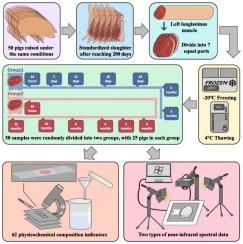
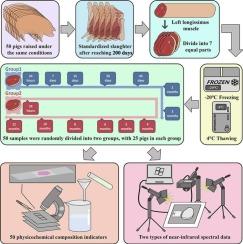
Frozen pork stocks are critical for stabilizing food security and prices, but assessing nutritional and physicochemical changes during freezing remains challenging. This study conducted a 12-month frozen storage experiment at −20 °C on 50 pigs' longissimus muscles, quantifying changes in 62 meat quality components in 7 categories, including thawing loss, myoglobin, fatty acids, amino acids, and deterioration indicators. The Prophet model suggests pork retains good quality for 1–2 years under proper freezing, with significant deterioration appearing after 4 years. Phenotypic correlations across dimensions reveal key interactions and abnormalities, such as arachidonic acid (C20:4n6) and methionine (Met) deviating from their respective clusters. Using VIS/NIRS and nine machine learning algorithms, a storage time classification model achieved 85.8 % accuracy with SpecimIQ transmission spectra and AdaBoost. These findings demonstrate the potential of VIS/NIRS in food safety and processing, providing a practical solution for precise storage duration identification and valuable insights for managing frozen pork reserves.
期刊介绍:
Food Chemistry publishes original research papers dealing with the advancement of the chemistry and biochemistry of foods or the analytical methods/ approach used. All papers should focus on the novelty of the research carried out.



 京公网安备 11010802042870号
京ICP备2023020795号-1
京公网安备 11010802042870号
京ICP备2023020795号-1

 分享
分享
 求助内容:
求助内容: 应助结果提醒方式:
 扫码关注我们
