{"title":"Reducing the Interfacial Diffusion Driving Force to Achieve Diffusion-Resistant Bonding in Mg3Sb1.5Bi0.5-Based Thermoelectric Devices","authors":"Mingxing Guo, Aojie Zhang, Chao Wu, Wenhao Fan*, Qiang Zhang and Shaoping Chen*, ","doi":"10.1021/acsaem.5c00122","DOIUrl":null,"url":null,"abstract":"<p >The n-type Mg<sub>3</sub>(Sb,Bi)<sub>2</sub>-based thermoelectric materials are promising candidates for medium-temperature power generation due to their low cost, nontoxicity, and high performance. However, their large-scale application in thermoelectric devices is significantly hindered by poor long-term stability, resulting from electrode interface degradation. Effective contact interfaces in thermoelectric devices require high bonding strength, low interfacial resistivity, and exceptional stability. Therefore, the development of efficient and reliable thermoelectric interface materials is crucial for the practical application of these devices. Conventional approaches to forming interfacial barrier layers mainly rely on thermodynamic equilibrium, which often overlook the critical roles of interfacial reactions and diffusion kinetics. In this study, molecular dynamics simulations were employed to uncover the underlying mechanisms responsible for the high stability of the Mg<sub>2</sub>Ni barrier layer and its interface with thermoelectric materials. The Mg<sub>2</sub>Ni/Mg<sub>3.21</sub>Sb<sub>1.5</sub>Bi<sub>0.5</sub>Y<sub>0.04</sub> thermoelectric device exhibited excellent performance, with a low contact resistance of 11 μΩ·cm<sup>2</sup>, a high output power density of 1.2 W·cm<sup>–2</sup>, and an energy conversion efficiency of 5% at a temperature difference of Δ<i>T</i> = 373 K. This strategy is applicable to other thermoelectric materials, offering valuable insights for designing barrier layers in diverse thermoelectric systems.</p>","PeriodicalId":4,"journal":{"name":"ACS Applied Energy Materials","volume":"8 6","pages":"3837–3845 3837–3845"},"PeriodicalIF":5.5000,"publicationDate":"2025-03-13","publicationTypes":"Journal Article","fieldsOfStudy":null,"isOpenAccess":false,"openAccessPdf":"","citationCount":"0","resultStr":null,"platform":"Semanticscholar","paperid":null,"PeriodicalName":"ACS Applied Energy Materials","FirstCategoryId":"88","ListUrlMain":"https://pubs.acs.org/doi/10.1021/acsaem.5c00122","RegionNum":3,"RegionCategory":"材料科学","ArticlePicture":[],"TitleCN":null,"AbstractTextCN":null,"PMCID":null,"EPubDate":"","PubModel":"","JCR":"Q2","JCRName":"CHEMISTRY, PHYSICAL","Score":null,"Total":0}
引用次数: 0
Abstract
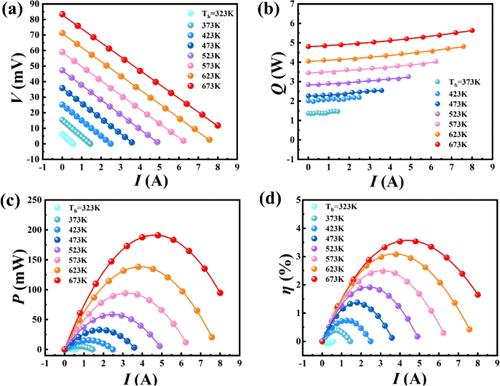
The n-type Mg3(Sb,Bi)2-based thermoelectric materials are promising candidates for medium-temperature power generation due to their low cost, nontoxicity, and high performance. However, their large-scale application in thermoelectric devices is significantly hindered by poor long-term stability, resulting from electrode interface degradation. Effective contact interfaces in thermoelectric devices require high bonding strength, low interfacial resistivity, and exceptional stability. Therefore, the development of efficient and reliable thermoelectric interface materials is crucial for the practical application of these devices. Conventional approaches to forming interfacial barrier layers mainly rely on thermodynamic equilibrium, which often overlook the critical roles of interfacial reactions and diffusion kinetics. In this study, molecular dynamics simulations were employed to uncover the underlying mechanisms responsible for the high stability of the Mg2Ni barrier layer and its interface with thermoelectric materials. The Mg2Ni/Mg3.21Sb1.5Bi0.5Y0.04 thermoelectric device exhibited excellent performance, with a low contact resistance of 11 μΩ·cm2, a high output power density of 1.2 W·cm–2, and an energy conversion efficiency of 5% at a temperature difference of ΔT = 373 K. This strategy is applicable to other thermoelectric materials, offering valuable insights for designing barrier layers in diverse thermoelectric systems.
期刊介绍:
ACS Applied Energy Materials is an interdisciplinary journal publishing original research covering all aspects of materials, engineering, chemistry, physics and biology relevant to energy conversion and storage. The journal is devoted to reports of new and original experimental and theoretical research of an applied nature that integrate knowledge in the areas of materials, engineering, physics, bioscience, and chemistry into important energy applications.



 京公网安备 11010802042870号
京ICP备2023020795号-1
京公网安备 11010802042870号
京ICP备2023020795号-1

 分享
分享
 求助内容:
求助内容: 应助结果提醒方式:
 扫码关注我们
