Xiaoqian Du , Junjun Zhang , Xuanyu Zhou , Mengyuan Zhang , Nailiang Wang , Xiu Lin , Pengfei Zhang , Zhenghong Luo
{"title":"Boosting the efficient alkaline seawater oxygen evolution reaction of iron oxide hydroxide via plasma-induced oxygen defect engineering†","authors":"Xiaoqian Du , Junjun Zhang , Xuanyu Zhou , Mengyuan Zhang , Nailiang Wang , Xiu Lin , Pengfei Zhang , Zhenghong Luo","doi":"10.1039/d5gc00368g","DOIUrl":null,"url":null,"abstract":"<div><div>Obtaining hydrogen through direct decomposition of seawater is highly significant for alleviating the increasing shortage of freshwater resources. Nonetheless, a major obstacle to the oxidation of saltwater is the severe corrosion of anodes by Cl<sup>−</sup> ions. In this work, a wet chemical technique and argon plasma treatment were used to obtain defect-rich FeOOH/SS electrodes for the OER in a basic electrolyte and simulated seawater. The findings from EPR and XAFS showed that a significant number of oxygen vacancies were generated through the plasma treatment. These vacancies promoted the activation of lattice oxygen during the oxidation of water. The findings showed that plentiful oxygen vacancies in P-FeOOH/SS provided a substantial number of active sites and facilitated efficient electron transfer, both of which greatly increased OER activity. Notably, when the electrolyte was simulated seawater (1.0 M KOH and 0.5 M NaCl), the overpotential reached 278 mV at 10 mA cm<sup>−2</sup>. Under these conditions, the Tafel slope was measured at 32.66 mV dec<sup>−1</sup>. Furthermore, the stability was maintained at 50 mA cm<sup>−2</sup> for more than 100 hours. Theoretical calculations showed that the high catalytic activity was primarily due to the positive effects of oxygen defects on the electron density and the d-band center of the active site. This research presented a straightforward approach for the development of efficacious defect-rich electrodes for alkaline seawater electrolysis.</div></div>","PeriodicalId":78,"journal":{"name":"Green Chemistry","volume":"27 13","pages":"Pages 3515-3523"},"PeriodicalIF":9.2000,"publicationDate":"2025-03-07","publicationTypes":"Journal Article","fieldsOfStudy":null,"isOpenAccess":false,"openAccessPdf":"","citationCount":"0","resultStr":null,"platform":"Semanticscholar","paperid":null,"PeriodicalName":"Green Chemistry","FirstCategoryId":"92","ListUrlMain":"https://www.sciencedirect.com/org/science/article/pii/S1463926225001608","RegionNum":1,"RegionCategory":"化学","ArticlePicture":[],"TitleCN":null,"AbstractTextCN":null,"PMCID":null,"EPubDate":"","PubModel":"","JCR":"Q1","JCRName":"CHEMISTRY, MULTIDISCIPLINARY","Score":null,"Total":0}
引用次数: 0
Abstract
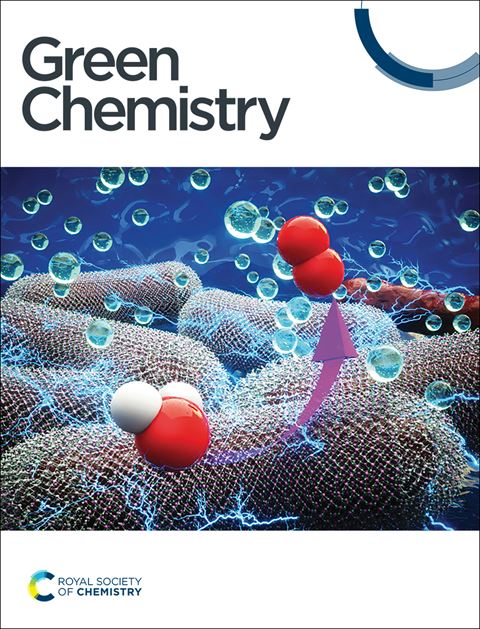
Obtaining hydrogen through direct decomposition of seawater is highly significant for alleviating the increasing shortage of freshwater resources. Nonetheless, a major obstacle to the oxidation of saltwater is the severe corrosion of anodes by Cl− ions. In this work, a wet chemical technique and argon plasma treatment were used to obtain defect-rich FeOOH/SS electrodes for the OER in a basic electrolyte and simulated seawater. The findings from EPR and XAFS showed that a significant number of oxygen vacancies were generated through the plasma treatment. These vacancies promoted the activation of lattice oxygen during the oxidation of water. The findings showed that plentiful oxygen vacancies in P-FeOOH/SS provided a substantial number of active sites and facilitated efficient electron transfer, both of which greatly increased OER activity. Notably, when the electrolyte was simulated seawater (1.0 M KOH and 0.5 M NaCl), the overpotential reached 278 mV at 10 mA cm−2. Under these conditions, the Tafel slope was measured at 32.66 mV dec−1. Furthermore, the stability was maintained at 50 mA cm−2 for more than 100 hours. Theoretical calculations showed that the high catalytic activity was primarily due to the positive effects of oxygen defects on the electron density and the d-band center of the active site. This research presented a straightforward approach for the development of efficacious defect-rich electrodes for alkaline seawater electrolysis.
通过海水直接分解获取氢气,对于缓解日益紧张的淡水资源具有重要意义。然而,海水氧化的一个主要障碍是Cl−离子对阳极的严重腐蚀。在本工作中,采用湿化学技术和氩等离子体处理在碱性电解质和模拟海水中获得了用于OER的富缺陷FeOOH/SS电极。EPR和XAFS的结果表明,等离子体处理产生了大量的氧空位。这些空位在水的氧化过程中促进了晶格氧的活化。结果表明,P-FeOOH/SS中大量的氧空位提供了大量的活性位点,促进了有效的电子转移,这两者都大大提高了OER活性。当电解液为模拟海水(1.0 M KOH和0.5 M NaCl)时,过电位在10 mA cm−2时达到278 mV。在此条件下,测得的Tafel斜率为32.66 mV dec−1。此外,稳定性在50 mA cm−2下保持超过100小时。理论计算表明,高催化活性主要是由于氧缺陷对活性位点的电子密度和d带中心的积极影响。本研究为开发有效的碱性海水电解富缺陷电极提供了一条简单的途径。
期刊介绍:
Green Chemistry is a journal that provides a unique forum for the publication of innovative research on the development of alternative green and sustainable technologies. The scope of Green Chemistry is based on the definition proposed by Anastas and Warner (Green Chemistry: Theory and Practice, P T Anastas and J C Warner, Oxford University Press, Oxford, 1998), which defines green chemistry as the utilisation of a set of principles that reduces or eliminates the use or generation of hazardous substances in the design, manufacture and application of chemical products. Green Chemistry aims to reduce the environmental impact of the chemical enterprise by developing a technology base that is inherently non-toxic to living things and the environment. The journal welcomes submissions on all aspects of research relating to this endeavor and publishes original and significant cutting-edge research that is likely to be of wide general appeal. For a work to be published, it must present a significant advance in green chemistry, including a comparison with existing methods and a demonstration of advantages over those methods.




 京公网安备 11010802042870号
京ICP备2023020795号-1
京公网安备 11010802042870号
京ICP备2023020795号-1

 分享
分享
 求助内容:
求助内容: 应助结果提醒方式:
 扫码关注我们
