Tianhu Li, Zhen Yang, Yang Ang, Yingying Zhao, Yanan Zhang, Zhengbo Liu, Hao Sun, Yinping Chang, Mingyu Du, Xianping Cheng, Jinghan Sun, Erbao Liu
{"title":"Genome-wide association study identifies elite alleles of FLA2 and FLA9 controlling flag leaf angle in rice.","authors":"Tianhu Li, Zhen Yang, Yang Ang, Yingying Zhao, Yanan Zhang, Zhengbo Liu, Hao Sun, Yinping Chang, Mingyu Du, Xianping Cheng, Jinghan Sun, Erbao Liu","doi":"10.1186/s12864-025-11487-z","DOIUrl":null,"url":null,"abstract":"<p><strong>Background: </strong>In hybrid rice seed production, rice varieties with a small flag leaf angle (FLA) experience obstacles to cross-pollination at the early heading stage, and farmers usually need to remove flag leaves to achieve artificial pollination. Therefore, the cultivation of rice varieties with large FLAs can not only save a substantial amount of labour in the leaf-cutting process during artificial pollination but also accelerate the mechanization of hybrid rice seed production.</p><p><strong>Results: </strong>In this study, 431 rice accessions were included in a genome-wide association study (GWAS) to identify quantitative trait loci (QTLs) and the superior haplotypes for rice FLA in 2022 and 2023. The aim of the study was to identify new QTLs and provide germplasm resources for the genetic improvement of rice FLA. The population exhibited rich phenotypic variation in FLA in both years. The FLA GWAS was performed with more than 3 million single-nucleotide polymorphisms (SNPs), and eight QTLs associated with FLA were detected; of these, six QTLs located on rice chromosomes 1, 2, 8 and 9 were novel and detected in both years. In addition, these QTLs were analysed by haplotype analysis and functional annotation, and FLA2 and FLA9, which encode xyloglucan fucosyltransferase and cytokinin-O-glucosyltransferase 2, respectively, were identified as candidate genes for FLA regulation in rice. Quantitative real-time polymerase chain reaction (qRT‒PCR) results validated FLA2 and FLA9 as candidate genes. The results of this study showed that the elite alleles of FLA2 and FLA9 can increase FLA in rice. Excellent parents for FLA improvement were predicted through pyramiding breeding.</p><p><strong>Conclusions: </strong>A total of six new QTLs and two candidate genes (FLA2 and FLA9) were identified by a GWAS of 431 rice accessions over two years. The elite alleles and excellent parents predicted in our study can provide important information for the functional analysis of rice FLA-related genes and improvement through pyramiding breeding.</p>","PeriodicalId":9030,"journal":{"name":"BMC Genomics","volume":"26 1","pages":"280"},"PeriodicalIF":3.7000,"publicationDate":"2025-03-21","publicationTypes":"Journal Article","fieldsOfStudy":null,"isOpenAccess":false,"openAccessPdf":"https://www.ncbi.nlm.nih.gov/pmc/articles/PMC11927237/pdf/","citationCount":"0","resultStr":null,"platform":"Semanticscholar","paperid":null,"PeriodicalName":"BMC Genomics","FirstCategoryId":"99","ListUrlMain":"https://doi.org/10.1186/s12864-025-11487-z","RegionNum":2,"RegionCategory":"生物学","ArticlePicture":[],"TitleCN":null,"AbstractTextCN":null,"PMCID":null,"EPubDate":"","PubModel":"","JCR":"Q2","JCRName":"BIOTECHNOLOGY & APPLIED MICROBIOLOGY","Score":null,"Total":0}
引用次数: 0
Abstract
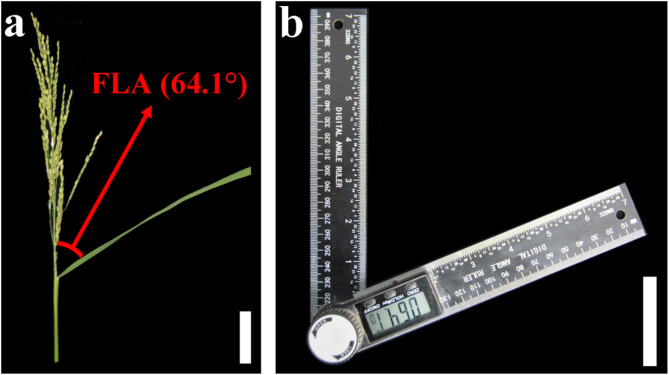
Background: In hybrid rice seed production, rice varieties with a small flag leaf angle (FLA) experience obstacles to cross-pollination at the early heading stage, and farmers usually need to remove flag leaves to achieve artificial pollination. Therefore, the cultivation of rice varieties with large FLAs can not only save a substantial amount of labour in the leaf-cutting process during artificial pollination but also accelerate the mechanization of hybrid rice seed production.
Results: In this study, 431 rice accessions were included in a genome-wide association study (GWAS) to identify quantitative trait loci (QTLs) and the superior haplotypes for rice FLA in 2022 and 2023. The aim of the study was to identify new QTLs and provide germplasm resources for the genetic improvement of rice FLA. The population exhibited rich phenotypic variation in FLA in both years. The FLA GWAS was performed with more than 3 million single-nucleotide polymorphisms (SNPs), and eight QTLs associated with FLA were detected; of these, six QTLs located on rice chromosomes 1, 2, 8 and 9 were novel and detected in both years. In addition, these QTLs were analysed by haplotype analysis and functional annotation, and FLA2 and FLA9, which encode xyloglucan fucosyltransferase and cytokinin-O-glucosyltransferase 2, respectively, were identified as candidate genes for FLA regulation in rice. Quantitative real-time polymerase chain reaction (qRT‒PCR) results validated FLA2 and FLA9 as candidate genes. The results of this study showed that the elite alleles of FLA2 and FLA9 can increase FLA in rice. Excellent parents for FLA improvement were predicted through pyramiding breeding.
Conclusions: A total of six new QTLs and two candidate genes (FLA2 and FLA9) were identified by a GWAS of 431 rice accessions over two years. The elite alleles and excellent parents predicted in our study can provide important information for the functional analysis of rice FLA-related genes and improvement through pyramiding breeding.
背景:在杂交水稻制种中,旗叶角小的水稻品种在抽穗期早期异花授粉存在障碍,农民通常需要去除旗叶来实现人工授粉。因此,培育具有大FLAs的水稻品种,不仅可以节省人工授粉切叶过程中的大量劳动力,而且可以加快杂交水稻制种机械化的进程。结果:利用431份水稻材料进行全基因组关联研究(GWAS),鉴定了2022年和2023年水稻FLA的数量性状位点(qtl)和优势单倍型。本研究旨在鉴定新的qtl,为水稻FLA的遗传改良提供种质资源。种群在两年内均表现出丰富的FLA表型变异。FLA GWAS检测了超过300万个单核苷酸多态性(snp),检测到8个与FLA相关的qtl;其中,位于水稻第1、2、8和9号染色体上的6个qtl是新发现的,在两年中都检测到了。此外,对这些qtl进行了单倍型分析和功能注释,鉴定出分别编码木葡聚糖聚焦转移酶和细胞分裂素- o -葡萄糖基转移酶2的FLA2和fl9为水稻FLA调控的候选基因。实时定量聚合酶链反应(qRT-PCR)结果证实了FLA2和fl9为候选基因。本研究结果表明,FLA2和fl9的精英等位基因可以增加水稻的FLA。通过金字塔育种预测了优良亲本。结论:通过对431份水稻材料2年的GWAS分析,共鉴定出6个新的qtl和2个候选基因(FLA2和FLA9)。本研究预测的优秀等位基因和优秀亲本可为水稻fla相关基因的功能分析和金字塔育种改良提供重要信息。
期刊介绍:
BMC Genomics is an open access, peer-reviewed journal that considers articles on all aspects of genome-scale analysis, functional genomics, and proteomics.
BMC Genomics is part of the BMC series which publishes subject-specific journals focused on the needs of individual research communities across all areas of biology and medicine. We offer an efficient, fair and friendly peer review service, and are committed to publishing all sound science, provided that there is some advance in knowledge presented by the work.





 京公网安备 11010802042870号
京ICP备2023020795号-1
京公网安备 11010802042870号
京ICP备2023020795号-1

 分享
分享
 求助内容:
求助内容: 应助结果提醒方式:
 扫码关注我们
