{"title":"Comparison of P2Y12 inhibitors and aspirin in secondary prevention of coronary events: a meta-analysis of RCTs.","authors":"Zhitao Wang, Shanshan Zhu, Jiajia Zhu, Zhengli Jiang, Yu Ren","doi":"10.1186/s12872-025-04668-x","DOIUrl":null,"url":null,"abstract":"<p><strong>Objective: </strong>This systematic review and meta-analysis compared the efficacy and safety of P2Y12 inhibitors versus aspirin monotherapy for secondary prevention in patients with coronary heart disease (CAD), providing evidence for clinical decision-making.</p><p><strong>Methods: </strong>Following the PRISMA and AMSTAR2 guidelines, a comprehensive literature search was conducted in PubMed, EMBASE, Web of Science, and the Cochrane Library to identify randomized controlled trials (RCTs) comparing P2Y12 inhibitors and aspirin monotherapy in CAD patients. The inclusion criteria focused on RCTs comparing P2Y12 inhibitors (clopidogrel, ticagrelor, and prasugrel) with aspirin. Studies that were non-randomized, did not focus on monotherapies with these agents, involved patients under 18 years old, or included non-CAD patients were excluded. The primary outcomes included myocardial infarction (MI) and stroke, while secondary outcomes comprised gastrointestinal complications, major bleeding, and mortality. The Cochrane Risk of Bias tool was used to assess the risk of bias. A random-effects model was applied to calculate risk ratios (RR) with 95% confidence intervals (CI), and sensitivity analyses were conducted to evaluate the robustness of the findings.</p><p><strong>Results: </strong>A total of 31,956 patients were included in the meta-analysis. P2Y12 inhibitors significantly reduced the risk of myocardial infarction (RR: 0.77, 95% CI: 0.67 to 0.89, I² = 0%, P < 0.001) and hemorrhagic stroke risk (RR: 0.53, 95% CI: 0.30 to 0.92, I² = 20.2%, P = 0.025). No statistically significant difference was observed in major bleeding (RR: 0.96, 95% CI: 0.71 to 1.30, I² = 63.8%, P = 0.814) or all-cause mortality (RR: 0.99, 95% CI: 0.85 to 1.15, I² = 30.3%, P = 0.877). Heterogeneity was assessed, and sensitivity analysis confirmed the robustness of the primary findings.</p><p><strong>Conclusions: </strong>Compared with aspirin, P2Y12 inhibitors reduce risk of myocardial infarction and hemorrhagic stroke in the secondary prevention of CAD. However, there is no significant differences in major bleeding or all-cause mortality. Further research, including subgroup analyses and studies in diverse populations, is needed to validate these findings and explore genetic factors that may influence treatment outcomes.</p>","PeriodicalId":9195,"journal":{"name":"BMC Cardiovascular Disorders","volume":"25 1","pages":"207"},"PeriodicalIF":2.3000,"publicationDate":"2025-03-21","publicationTypes":"Journal Article","fieldsOfStudy":null,"isOpenAccess":false,"openAccessPdf":"https://www.ncbi.nlm.nih.gov/pmc/articles/PMC11927196/pdf/","citationCount":"0","resultStr":null,"platform":"Semanticscholar","paperid":null,"PeriodicalName":"BMC Cardiovascular Disorders","FirstCategoryId":"3","ListUrlMain":"https://doi.org/10.1186/s12872-025-04668-x","RegionNum":3,"RegionCategory":"医学","ArticlePicture":[],"TitleCN":null,"AbstractTextCN":null,"PMCID":null,"EPubDate":"","PubModel":"","JCR":"Q3","JCRName":"CARDIAC & CARDIOVASCULAR SYSTEMS","Score":null,"Total":0}
引用次数: 0
Abstract
Objective: This systematic review and meta-analysis compared the efficacy and safety of P2Y12 inhibitors versus aspirin monotherapy for secondary prevention in patients with coronary heart disease (CAD), providing evidence for clinical decision-making.
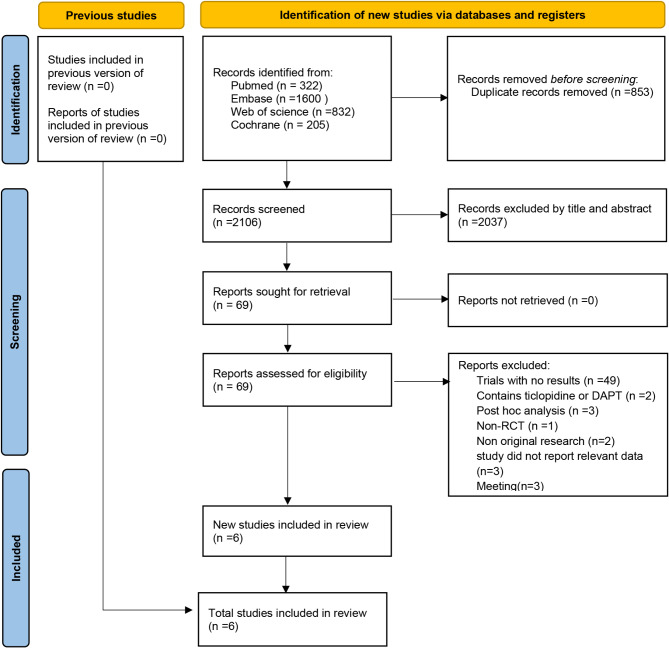
Methods: Following the PRISMA and AMSTAR2 guidelines, a comprehensive literature search was conducted in PubMed, EMBASE, Web of Science, and the Cochrane Library to identify randomized controlled trials (RCTs) comparing P2Y12 inhibitors and aspirin monotherapy in CAD patients. The inclusion criteria focused on RCTs comparing P2Y12 inhibitors (clopidogrel, ticagrelor, and prasugrel) with aspirin. Studies that were non-randomized, did not focus on monotherapies with these agents, involved patients under 18 years old, or included non-CAD patients were excluded. The primary outcomes included myocardial infarction (MI) and stroke, while secondary outcomes comprised gastrointestinal complications, major bleeding, and mortality. The Cochrane Risk of Bias tool was used to assess the risk of bias. A random-effects model was applied to calculate risk ratios (RR) with 95% confidence intervals (CI), and sensitivity analyses were conducted to evaluate the robustness of the findings.
Results: A total of 31,956 patients were included in the meta-analysis. P2Y12 inhibitors significantly reduced the risk of myocardial infarction (RR: 0.77, 95% CI: 0.67 to 0.89, I² = 0%, P < 0.001) and hemorrhagic stroke risk (RR: 0.53, 95% CI: 0.30 to 0.92, I² = 20.2%, P = 0.025). No statistically significant difference was observed in major bleeding (RR: 0.96, 95% CI: 0.71 to 1.30, I² = 63.8%, P = 0.814) or all-cause mortality (RR: 0.99, 95% CI: 0.85 to 1.15, I² = 30.3%, P = 0.877). Heterogeneity was assessed, and sensitivity analysis confirmed the robustness of the primary findings.
Conclusions: Compared with aspirin, P2Y12 inhibitors reduce risk of myocardial infarction and hemorrhagic stroke in the secondary prevention of CAD. However, there is no significant differences in major bleeding or all-cause mortality. Further research, including subgroup analyses and studies in diverse populations, is needed to validate these findings and explore genetic factors that may influence treatment outcomes.
期刊介绍:
BMC Cardiovascular Disorders is an open access, peer-reviewed journal that considers articles on all aspects of the prevention, diagnosis and management of disorders of the heart and circulatory system, as well as related molecular and cell biology, genetics, pathophysiology, epidemiology, and controlled trials.





 京公网安备 11010802042870号
京ICP备2023020795号-1
京公网安备 11010802042870号
京ICP备2023020795号-1

 分享
分享
 求助内容:
求助内容: 应助结果提醒方式:
 扫码关注我们
