Artificial Intelligence-Based Virtual Assistant for the Diagnostic Approach of Chronic Ataxias

IF 7.6 1区 医学 Q1 CLINICAL NEUROLOGY Movement Disorders Pub Date : 2025-03-22 DOI:10.1002/mds.30168
Lucas Alessandro MD, Nicolas Bianciotti MS, Luciana Salama MS, Santiago Volmaro MS, Veronica Navarrine MS, Lucia Ameghino MD, Julieta Arena MD, Santiago Bestoso MD, Veronica Bruno MD, MPH, Sergio Castillo Torres MD, Mauricio Chamorro MD, Blas Couto MD, Tomas De La Riestra MD, Florencia Echeverria MD, Juan Genco MD, Federico Gonzalez del Boca MD, Marlene Guarnaschelli MD, Juan Carlos Giugni MD, Alfredo Laffue MD, Viviana Martinez Villota MD, Alex Medina Escobar MD, Mauricio Paez Maggio MD, Sebastian Rauek MD, Sergio Rodriguez Quiroga MD, Marcela Tela MD, Carolina Villa MD, Olivia Sanguinetti BSE, Marcelo Kauffman MD, PhD, Diego Fernandez Slezak PhD, Mauricio F. Farez MD, MPH, Malco Rossi MD, PhD
{"title":"Artificial Intelligence-Based Virtual Assistant for the Diagnostic Approach of Chronic Ataxias","authors":"Lucas Alessandro MD,&nbsp;Nicolas Bianciotti MS,&nbsp;Luciana Salama MS,&nbsp;Santiago Volmaro MS,&nbsp;Veronica Navarrine MS,&nbsp;Lucia Ameghino MD,&nbsp;Julieta Arena MD,&nbsp;Santiago Bestoso MD,&nbsp;Veronica Bruno MD, MPH,&nbsp;Sergio Castillo Torres MD,&nbsp;Mauricio Chamorro MD,&nbsp;Blas Couto MD,&nbsp;Tomas De La Riestra MD,&nbsp;Florencia Echeverria MD,&nbsp;Juan Genco MD,&nbsp;Federico Gonzalez del Boca MD,&nbsp;Marlene Guarnaschelli MD,&nbsp;Juan Carlos Giugni MD,&nbsp;Alfredo Laffue MD,&nbsp;Viviana Martinez Villota MD,&nbsp;Alex Medina Escobar MD,&nbsp;Mauricio Paez Maggio MD,&nbsp;Sebastian Rauek MD,&nbsp;Sergio Rodriguez Quiroga MD,&nbsp;Marcela Tela MD,&nbsp;Carolina Villa MD,&nbsp;Olivia Sanguinetti BSE,&nbsp;Marcelo Kauffman MD, PhD,&nbsp;Diego Fernandez Slezak PhD,&nbsp;Mauricio F. Farez MD, MPH,&nbsp;Malco Rossi MD, PhD","doi":"10.1002/mds.30168","DOIUrl":null,"url":null,"abstract":"<div>\n \n \n <section>\n \n <h3> Background</h3>\n \n <p>Chronic ataxias, a complex group of over 300 diseases, pose significant diagnostic challenges because of their clinical and genetic heterogeneity. Here, we propose that artificial intelligence (AI) can aid in the identification and understanding of these disorders through the utilization of a smart virtual assistant.</p>\n </section>\n \n <section>\n \n <h3> Objectives</h3>\n \n <p>The aim is to develop and validate an AI-powered virtual assistant for diagnosing chronic ataxias.</p>\n </section>\n \n <section>\n \n <h3> Methods</h3>\n \n <p>A non-commercial virtual assistant was developed using advanced algorithms, decision trees, and large language models. In the validation process, 453 clinical cases from the literature were selected from 151 causes of chronic ataxia. The diagnostic accuracy was compared with that of 21 neurologists specializing in movement disorders and GPT-4. Usability regarding time and number of questions needed were also evaluated.</p>\n </section>\n \n <section>\n \n <h3> Results</h3>\n \n <p>The virtual assistant accuracy was 90.9%, higher than neurologists (18.3%), and GPT-4 (19.4%). It also significantly outperformed in causes of ataxia distributed by age, inheritance, frequency, associated clinical manifestations, and treatment availability. Neurologists and GPT-4 mentioned 110 incorrect diagnoses, 83.6% of which were made by GPT-4, which also generated seven data hallucinations. The virtual assistant required an average of 14 questions and 1.5 minutes to generate a list of differential diagnoses, significantly faster than the neurologists (mean, 19.4 minutes).</p>\n </section>\n \n <section>\n \n <h3> Conclusions</h3>\n \n <p>The virtual assistant proved to be accurate and easy fast-use for the diagnosis of chronic ataxias, potentially serving as a support tool in neurological consultation. This diagnostic approach could also be expanded to other neurological and non-neurological diseases. © 2025 International Parkinson and Movement Disorder Society.</p>\n </section>\n </div>","PeriodicalId":213,"journal":{"name":"Movement Disorders","volume":"40 5","pages":"906-916"},"PeriodicalIF":7.6000,"publicationDate":"2025-03-22","publicationTypes":"Journal Article","fieldsOfStudy":null,"isOpenAccess":false,"openAccessPdf":"","citationCount":"0","resultStr":null,"platform":"Semanticscholar","paperid":null,"PeriodicalName":"Movement Disorders","FirstCategoryId":"3","ListUrlMain":"https://movementdisorders.onlinelibrary.wiley.com/doi/10.1002/mds.30168","RegionNum":1,"RegionCategory":"医学","ArticlePicture":[],"TitleCN":null,"AbstractTextCN":null,"PMCID":null,"EPubDate":"","PubModel":"","JCR":"Q1","JCRName":"CLINICAL NEUROLOGY","Score":null,"Total":0}
引用次数: 0

Abstract

Background

Chronic ataxias, a complex group of over 300 diseases, pose significant diagnostic challenges because of their clinical and genetic heterogeneity. Here, we propose that artificial intelligence (AI) can aid in the identification and understanding of these disorders through the utilization of a smart virtual assistant.

Objectives

The aim is to develop and validate an AI-powered virtual assistant for diagnosing chronic ataxias.

Methods

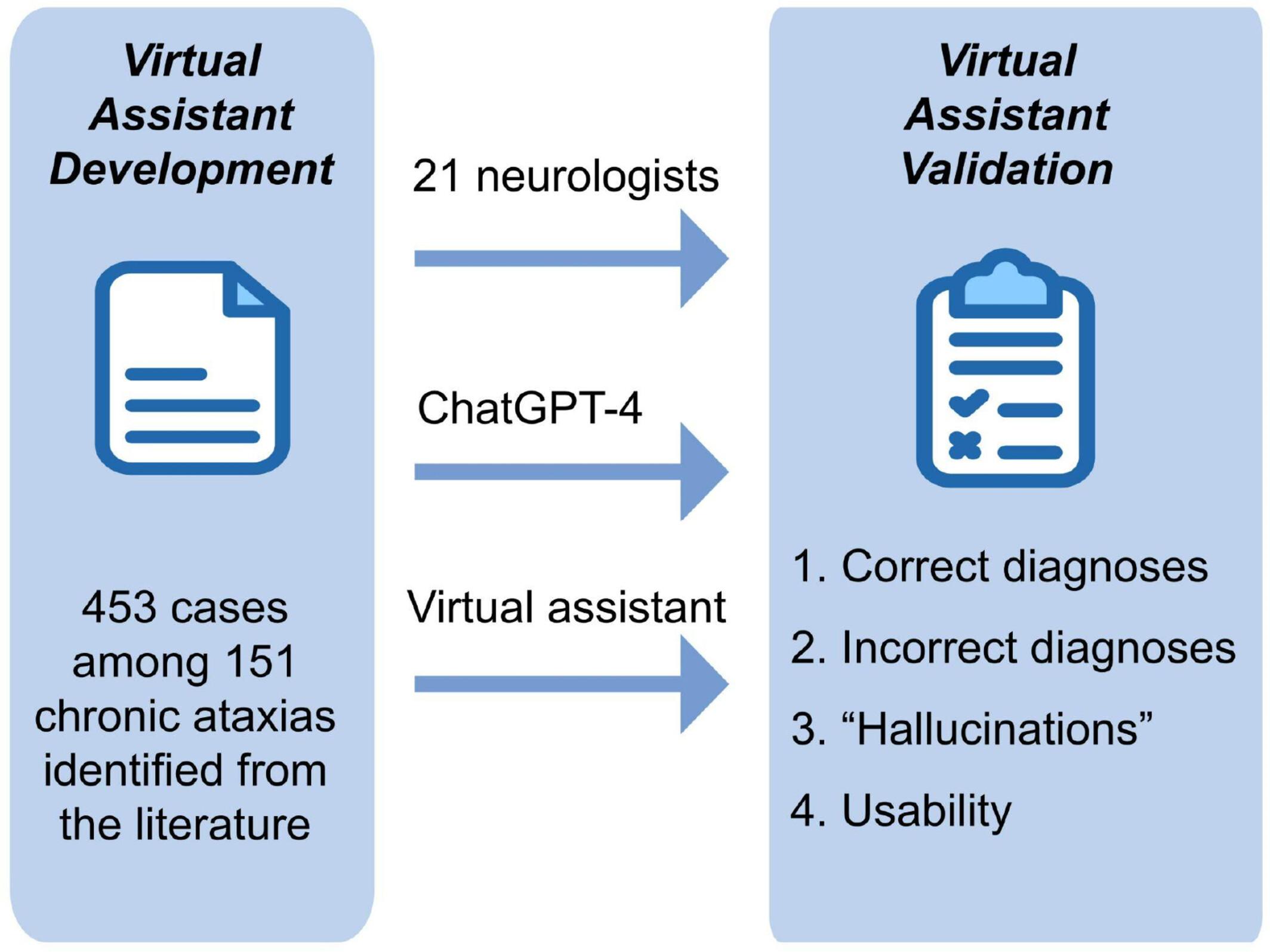
A non-commercial virtual assistant was developed using advanced algorithms, decision trees, and large language models. In the validation process, 453 clinical cases from the literature were selected from 151 causes of chronic ataxia. The diagnostic accuracy was compared with that of 21 neurologists specializing in movement disorders and GPT-4. Usability regarding time and number of questions needed were also evaluated.

Results

The virtual assistant accuracy was 90.9%, higher than neurologists (18.3%), and GPT-4 (19.4%). It also significantly outperformed in causes of ataxia distributed by age, inheritance, frequency, associated clinical manifestations, and treatment availability. Neurologists and GPT-4 mentioned 110 incorrect diagnoses, 83.6% of which were made by GPT-4, which also generated seven data hallucinations. The virtual assistant required an average of 14 questions and 1.5 minutes to generate a list of differential diagnoses, significantly faster than the neurologists (mean, 19.4 minutes).

Conclusions

The virtual assistant proved to be accurate and easy fast-use for the diagnosis of chronic ataxias, potentially serving as a support tool in neurological consultation. This diagnostic approach could also be expanded to other neurological and non-neurological diseases. © 2025 International Parkinson and Movement Disorder Society.

Abstract Image

Abstract Image

Abstract Image

Abstract Image

查看原文
分享 分享
微信好友 朋友圈 QQ好友 复制链接
本刊更多论文
基于人工智能的慢性共济失调诊断方法虚拟助手。
背景:慢性共济失调是一组复杂的超过300种疾病,由于其临床和遗传异质性,给诊断带来了重大挑战。在这里,我们建议人工智能(AI)可以通过使用智能虚拟助手来帮助识别和理解这些疾病。目的:目的是开发和验证一个人工智能驱动的虚拟助手诊断慢性共济失调。方法:利用先进的算法、决策树和大型语言模型开发了一个非商业虚拟助手。在验证过程中,从151例慢性共济失调的病因中选择文献中的453例临床病例。将其诊断准确性与21名专门从事运动障碍和GPT-4的神经科医生的诊断准确性进行比较。关于时间和所需问题数量的可用性也进行了评估。结果:虚拟助手的准确率为90.9%,高于神经科医生(18.3%)和GPT-4(19.4%)。它在由年龄、遗传、频率、相关临床表现和治疗可用性分布的共济失调病因方面也明显优于其他疾病。神经科医生和GPT-4共提到110个错误诊断,其中83.6%是由GPT-4做出的,同时还产生了7个数据幻觉。虚拟助手平均需要14个问题和1.5分钟来生成鉴别诊断列表,比神经科医生(平均19.4分钟)快得多。结论:该虚拟助手诊断慢性共济失调准确、简便、快捷,可作为神经内科会诊的辅助工具。这种诊断方法也可以扩展到其他神经和非神经疾病。©2025国际帕金森和运动障碍学会。
本文章由计算机程序翻译,如有差异,请以英文原文为准。
求助全文
约1分钟内获得全文 去求助
来源期刊
Movement Disorders
Movement Disorders 医学-临床神经学
CiteScore
13.30
自引率
8.10%
发文量
371
审稿时长
12 months
期刊介绍: Movement Disorders publishes a variety of content types including Reviews, Viewpoints, Full Length Articles, Historical Reports, Brief Reports, and Letters. The journal considers original manuscripts on topics related to the diagnosis, therapeutics, pharmacology, biochemistry, physiology, etiology, genetics, and epidemiology of movement disorders. Appropriate topics include Parkinsonism, Chorea, Tremors, Dystonia, Myoclonus, Tics, Tardive Dyskinesia, Spasticity, and Ataxia.
期刊最新文献
Ex Vivo LRRK2 Activation in Asian G2385R and R1628P Variant Carriers and Idiopathic Parkinson's Disease. Indirect Striatal Projection Neurons Drive a D2 Receptor-Dependent Pathway to Dyskinesia and Dystonia. Glymphatic Dysfunction, Brain Damage, and Clinical Disability in Spinocerebellar Ataxia Type 3. Deep Brain Stimulation for Dystonia and Epilepsy in Alternating Hemiplegia of Childhood. The Global Parkinson's Disease Genetics (GP2) Genome Browser.
×
引用
GB/T 7714-2015
复制
MLA
复制
APA
复制
导出至
BibTeX EndNote RefMan NoteFirst NoteExpress
×
×
提示
您的信息不完整,为了账户安全,请先补充。
现在去补充
×
提示
您因"违规操作"
具体请查看互助需知
我知道了
×
提示
现在去查看 取消
×
提示
确定
0
微信
客服QQ
Book学术公众号 扫码关注我们
反馈
×
意见反馈
请填写您的意见或建议
请填写您的手机或邮箱
已复制链接
已复制链接
快去分享给好友吧!
我知道了
×
扫码分享
扫码分享
Book学术官方微信
Book学术文献互助
Book学术文献互助群
群 号:604180095
Book学术
文献互助 智能选刊 最新文献 互助须知 联系我们:info@booksci.cn
Book学术提供免费学术资源搜索服务,方便国内外学者检索中英文文献。致力于提供最便捷和优质的服务体验。
Copyright © 2023 Book学术 All rights reserved.
ghs 京公网安备 11010802042870号 京ICP备2023020795号-1