Parental neighbourhood perceptions and active commuting to school in children according to their sex using a self-organised map approach: a cross-sectional study.
Javier Molina-García, Xavier García-Massó, Cristina Menescardi, Isaac Estevan, Ana Queralt
{"title":"Parental neighbourhood perceptions and active commuting to school in children according to their sex using a self-organised map approach: a cross-sectional study.","authors":"Javier Molina-García, Xavier García-Massó, Cristina Menescardi, Isaac Estevan, Ana Queralt","doi":"10.1186/s12889-025-22309-y","DOIUrl":null,"url":null,"abstract":"<p><strong>Background: </strong>Built environment attributes can facilitate or represent barriers to active commuting to and from school (ACS). Even though parental perceptions of the built environment and their influence on ACS in children have been extensively studied, there is very limited evidence as to whether these perceptions can vary based on the sex of children. Hence, the present study aimed to analyse the relationships between parental neighbourhood perceptions and ACS, differentiating between boys and girls.</p><p><strong>Methods: </strong>This cross-sectional study was conducted in Valencia, Spain. The sample comprised 808 children and one of their parents. Parent-perceived neighbourhood environment, ACS, and socio-demographic data were self-reported through a questionnaire using validated scales. Self-organising map (SOM) analysis was used to describe the interrelationships between parental perceptions and child profiles. These analyses were carried out separately in boys and girls.</p><p><strong>Results: </strong>Parents of daughters perceived their neighbourhoods as less safe from crime compared to parents of sons. The number of ACS trips was similar between boys and girls. The clustering of the SOM outcomes resulted in seven clusters, both in boys and girls. However, cluster membership had significant effects on ACS in boys, but not in girls. Globally, in the group of boys, the highest ACS levels were positively correlated with the most supportive built environments in terms of residential density, land use mix, recreational facilities, accessibility and walking facilities, traffic safety, pedestrian infrastructure, safety from crime, and aesthetics. However, some of these factors had low scores in clusters with high ACS levels (e.g., low levels of accessibility and walking facilities, and land use mix).</p><p><strong>Conclusions: </strong>These findings support the idea that ACS behaviour depends on the interaction of diverse built environment factors. Our results also suggest that parental perceptions had different effects according to the sex of the child, with ACS in boys being more influenced by these perceptions. In the case of girls, it is possible that ACS interventions should emphasise generating child-friendly social environments in addition to strategies to improve the built environment. Future interventions to encourage ACS should consider these sex-specific differences and address parental concerns through improved infrastructure and safety measures.</p>","PeriodicalId":9039,"journal":{"name":"BMC Public Health","volume":"25 1","pages":"1089"},"PeriodicalIF":3.6000,"publicationDate":"2025-03-21","publicationTypes":"Journal Article","fieldsOfStudy":null,"isOpenAccess":false,"openAccessPdf":"https://www.ncbi.nlm.nih.gov/pmc/articles/PMC11929284/pdf/","citationCount":"0","resultStr":null,"platform":"Semanticscholar","paperid":null,"PeriodicalName":"BMC Public Health","FirstCategoryId":"3","ListUrlMain":"https://doi.org/10.1186/s12889-025-22309-y","RegionNum":2,"RegionCategory":"医学","ArticlePicture":[],"TitleCN":null,"AbstractTextCN":null,"PMCID":null,"EPubDate":"","PubModel":"","JCR":"Q1","JCRName":"PUBLIC, ENVIRONMENTAL & OCCUPATIONAL HEALTH","Score":null,"Total":0}
引用次数: 0
Abstract
Background: Built environment attributes can facilitate or represent barriers to active commuting to and from school (ACS). Even though parental perceptions of the built environment and their influence on ACS in children have been extensively studied, there is very limited evidence as to whether these perceptions can vary based on the sex of children. Hence, the present study aimed to analyse the relationships between parental neighbourhood perceptions and ACS, differentiating between boys and girls.
Methods: This cross-sectional study was conducted in Valencia, Spain. The sample comprised 808 children and one of their parents. Parent-perceived neighbourhood environment, ACS, and socio-demographic data were self-reported through a questionnaire using validated scales. Self-organising map (SOM) analysis was used to describe the interrelationships between parental perceptions and child profiles. These analyses were carried out separately in boys and girls.
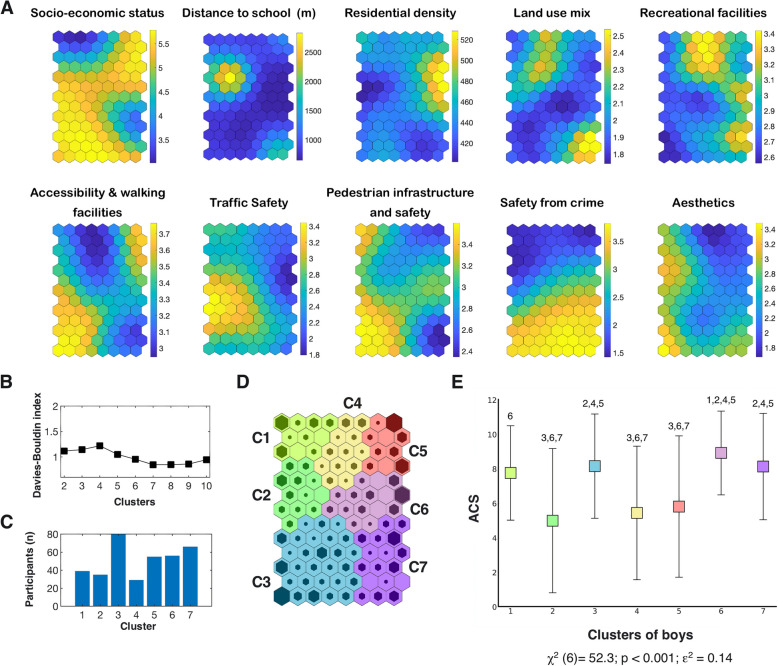
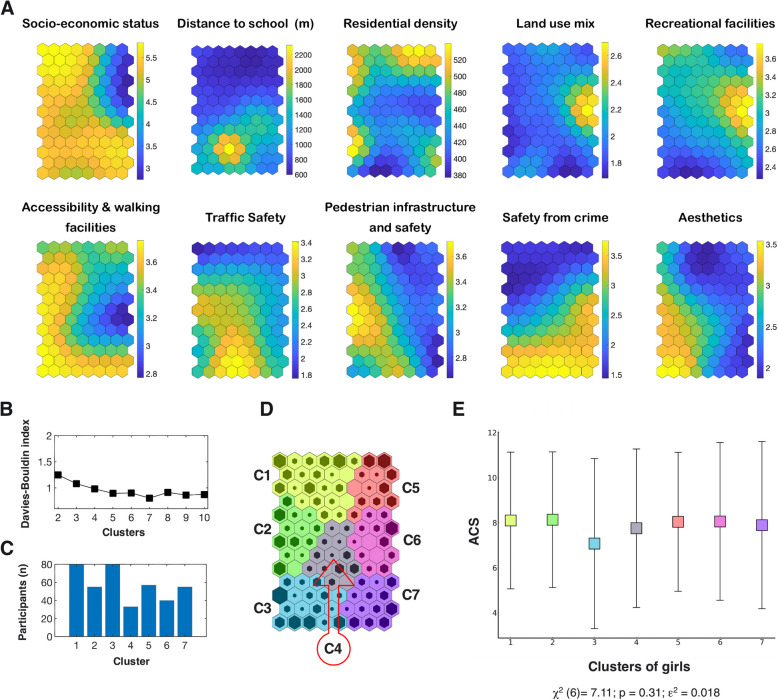
Results: Parents of daughters perceived their neighbourhoods as less safe from crime compared to parents of sons. The number of ACS trips was similar between boys and girls. The clustering of the SOM outcomes resulted in seven clusters, both in boys and girls. However, cluster membership had significant effects on ACS in boys, but not in girls. Globally, in the group of boys, the highest ACS levels were positively correlated with the most supportive built environments in terms of residential density, land use mix, recreational facilities, accessibility and walking facilities, traffic safety, pedestrian infrastructure, safety from crime, and aesthetics. However, some of these factors had low scores in clusters with high ACS levels (e.g., low levels of accessibility and walking facilities, and land use mix).
Conclusions: These findings support the idea that ACS behaviour depends on the interaction of diverse built environment factors. Our results also suggest that parental perceptions had different effects according to the sex of the child, with ACS in boys being more influenced by these perceptions. In the case of girls, it is possible that ACS interventions should emphasise generating child-friendly social environments in addition to strategies to improve the built environment. Future interventions to encourage ACS should consider these sex-specific differences and address parental concerns through improved infrastructure and safety measures.
期刊介绍:
BMC Public Health is an open access, peer-reviewed journal that considers articles on the epidemiology of disease and the understanding of all aspects of public health. The journal has a special focus on the social determinants of health, the environmental, behavioral, and occupational correlates of health and disease, and the impact of health policies, practices and interventions on the community.



 京公网安备 11010802042870号
京ICP备2023020795号-1
京公网安备 11010802042870号
京ICP备2023020795号-1

 分享
分享
 求助内容:
求助内容: 应助结果提醒方式:
 扫码关注我们
