Jason DeBruin, Thomas Aref, Sara Tirado Tolosa, Rebecca Hensley, Haley Underwood, Michael McGuire, Chinmay Soman, Grace Nystrom, Emma Parkinson, Catherine Li, Stephen Patrick Moose, Girish Chowdhary
{"title":"Breaking the field phenotyping bottleneck in maize with autonomous robots.","authors":"Jason DeBruin, Thomas Aref, Sara Tirado Tolosa, Rebecca Hensley, Haley Underwood, Michael McGuire, Chinmay Soman, Grace Nystrom, Emma Parkinson, Catherine Li, Stephen Patrick Moose, Girish Chowdhary","doi":"10.1038/s42003-025-07890-7","DOIUrl":null,"url":null,"abstract":"<p><p>Understanding phenotypic plasticity in maize (Zea mays L.) is a current grand challenge for continued crop improvement. Measuring the interactive effects of genetics, environmental factors, and management practices (GxExM) on crop performance is time-consuming, expensive, and a major bottleneck to yield advancement. We demonstrate that an autonomous robotic platform, capable of collecting biologically relevant and commonly measured phenotypes, within a maize canopy at high-throughput, low-cost, and high-volume is now a reality. Field teams used TerraSentia autonomous ground robots developed by EarthSense, Inc. (Champaign, IL) to capture data using a suite of low-cost sensors from nearly 200,000 experimental units, located at 142 unique research fields in the USA and Canada, across five years. Computer vision and machine learning algorithms, developed by EarthSense, Inc., analyzed these in-canopy multi-sensor data to deliver ground-truth validated plant height, ear height, stem diameter, and leaf area index at multiple time points during each season. The robot measured these phenotypes with high accuracy and reliability, at scales sufficient to dissect interactions between genotypes and nitrogen rates in several environments. The results show that within-row, autonomous field robots hold great promise to increase GxExM understanding and decrease the amount of human labor required for plant phenotyping.</p>","PeriodicalId":10552,"journal":{"name":"Communications Biology","volume":"8 1","pages":"467"},"PeriodicalIF":5.1000,"publicationDate":"2025-03-21","publicationTypes":"Journal Article","fieldsOfStudy":null,"isOpenAccess":false,"openAccessPdf":"https://www.ncbi.nlm.nih.gov/pmc/articles/PMC11928528/pdf/","citationCount":"0","resultStr":null,"platform":"Semanticscholar","paperid":null,"PeriodicalName":"Communications Biology","FirstCategoryId":"99","ListUrlMain":"https://doi.org/10.1038/s42003-025-07890-7","RegionNum":1,"RegionCategory":"生物学","ArticlePicture":[],"TitleCN":null,"AbstractTextCN":null,"PMCID":null,"EPubDate":"","PubModel":"","JCR":"Q1","JCRName":"BIOLOGY","Score":null,"Total":0}
引用次数: 0
Abstract
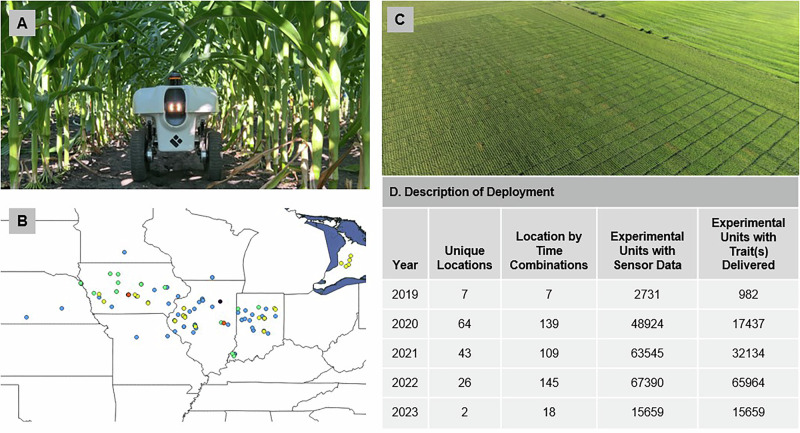
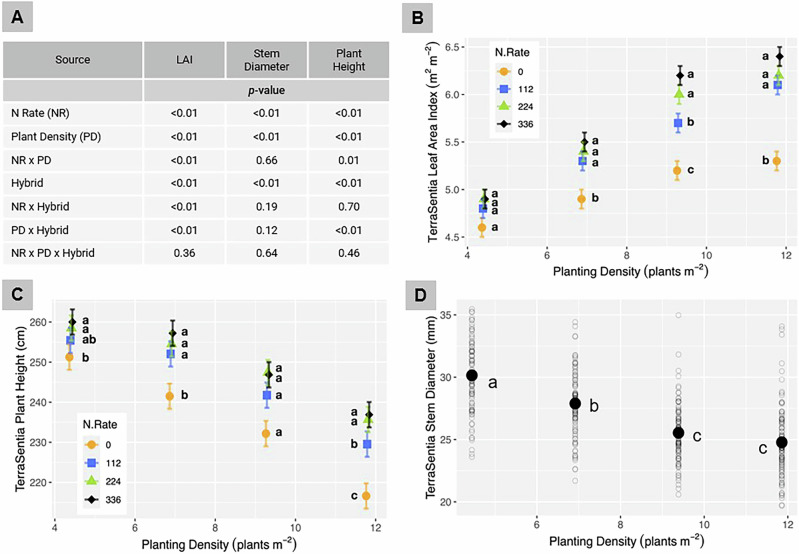
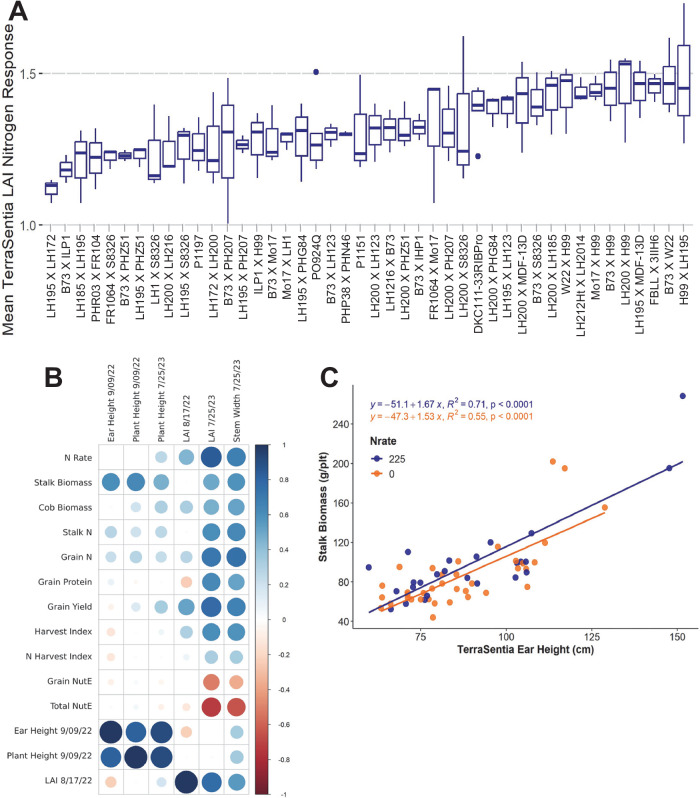
Understanding phenotypic plasticity in maize (Zea mays L.) is a current grand challenge for continued crop improvement. Measuring the interactive effects of genetics, environmental factors, and management practices (GxExM) on crop performance is time-consuming, expensive, and a major bottleneck to yield advancement. We demonstrate that an autonomous robotic platform, capable of collecting biologically relevant and commonly measured phenotypes, within a maize canopy at high-throughput, low-cost, and high-volume is now a reality. Field teams used TerraSentia autonomous ground robots developed by EarthSense, Inc. (Champaign, IL) to capture data using a suite of low-cost sensors from nearly 200,000 experimental units, located at 142 unique research fields in the USA and Canada, across five years. Computer vision and machine learning algorithms, developed by EarthSense, Inc., analyzed these in-canopy multi-sensor data to deliver ground-truth validated plant height, ear height, stem diameter, and leaf area index at multiple time points during each season. The robot measured these phenotypes with high accuracy and reliability, at scales sufficient to dissect interactions between genotypes and nitrogen rates in several environments. The results show that within-row, autonomous field robots hold great promise to increase GxExM understanding and decrease the amount of human labor required for plant phenotyping.
期刊介绍:
Communications Biology is an open access journal from Nature Research publishing high-quality research, reviews and commentary in all areas of the biological sciences. Research papers published by the journal represent significant advances bringing new biological insight to a specialized area of research.




 京公网安备 11010802042870号
京ICP备2023020795号-1
京公网安备 11010802042870号
京ICP备2023020795号-1

 分享
分享
 求助内容:
求助内容: 应助结果提醒方式:
 扫码关注我们
