Leaf Conditioning and Shredder Activity Shape Microbial Dynamics on Fine Particulate Organic Matter Produced During Decomposition of Different Leaf Litter in Streams.
Pratiksha Acharya, Mourine J Yegon, Leonie Haferkemper, Benjamin Misteli, Christian Griebler, Simon Vitecek, Katrin Attermeyer
{"title":"Leaf Conditioning and Shredder Activity Shape Microbial Dynamics on Fine Particulate Organic Matter Produced During Decomposition of Different Leaf Litter in Streams.","authors":"Pratiksha Acharya, Mourine J Yegon, Leonie Haferkemper, Benjamin Misteli, Christian Griebler, Simon Vitecek, Katrin Attermeyer","doi":"10.1007/s00248-025-02515-2","DOIUrl":null,"url":null,"abstract":"<p><p>Leaf litter decomposition (LLD) is a key ecosystem function where invertebrate shredders produce large amounts of fine particulate organic matter (FPOM) that serves as a substrate for microbial assemblages. Here, we explore the shredder-produced FPOM composition and activity of FPOM-associated microbial communities in response to different leaf species and their conditioning. In a laboratory experiment, we fed leaves of different elemental compositions (alder, beech and maple), conditioned under oxic or anoxic conditions, to caddisfly larvae (Sericostoma sp.). We hypothesized differences in FPOM elemental and fatty acid composition and FPOM-associated microbial activity among the leaf species, conditioning, and two types of shredder-produced FPOM, i.e. shredded leaves and faecal pellets. Our results suggest that leaf conditioning and shredder activity play pivotal roles in shaping FPOM composition and FPOM-associated microbial activity. We observed lower C/N ratios with high-C/N litter (beech and maple leaves) after conditioning and no change in the elemental composition of the faecal pellets compared to the leaves. However, we observed differences in microbial fatty acid proportions and composition on leaves and faecal pellets with significantly higher fractions of bacterial fatty acids on faecal pellets than on leaves. We also noted a significant impact of leaf conditioning on the microbial activity of shredded leaves and faecal pellets, with a higher microbial growth efficiency observed on faecal pellets compared to ingested leaves. These findings highlight the crucial influence of leaf species and conditioning on the activity of shredder-produced FPOM, emphasizing the complex interplay between leaf properties and fate and microbial processes in streams.</p>","PeriodicalId":18708,"journal":{"name":"Microbial Ecology","volume":"88 1","pages":"18"},"PeriodicalIF":4.0000,"publicationDate":"2025-03-22","publicationTypes":"Journal Article","fieldsOfStudy":null,"isOpenAccess":false,"openAccessPdf":"https://www.ncbi.nlm.nih.gov/pmc/articles/PMC11928410/pdf/","citationCount":"0","resultStr":null,"platform":"Semanticscholar","paperid":null,"PeriodicalName":"Microbial Ecology","FirstCategoryId":"99","ListUrlMain":"https://doi.org/10.1007/s00248-025-02515-2","RegionNum":3,"RegionCategory":"生物学","ArticlePicture":[],"TitleCN":null,"AbstractTextCN":null,"PMCID":null,"EPubDate":"","PubModel":"","JCR":"Q2","JCRName":"ECOLOGY","Score":null,"Total":0}
引用次数: 0
Abstract
Leaf litter decomposition (LLD) is a key ecosystem function where invertebrate shredders produce large amounts of fine particulate organic matter (FPOM) that serves as a substrate for microbial assemblages. Here, we explore the shredder-produced FPOM composition and activity of FPOM-associated microbial communities in response to different leaf species and their conditioning. In a laboratory experiment, we fed leaves of different elemental compositions (alder, beech and maple), conditioned under oxic or anoxic conditions, to caddisfly larvae (Sericostoma sp.). We hypothesized differences in FPOM elemental and fatty acid composition and FPOM-associated microbial activity among the leaf species, conditioning, and two types of shredder-produced FPOM, i.e. shredded leaves and faecal pellets. Our results suggest that leaf conditioning and shredder activity play pivotal roles in shaping FPOM composition and FPOM-associated microbial activity. We observed lower C/N ratios with high-C/N litter (beech and maple leaves) after conditioning and no change in the elemental composition of the faecal pellets compared to the leaves. However, we observed differences in microbial fatty acid proportions and composition on leaves and faecal pellets with significantly higher fractions of bacterial fatty acids on faecal pellets than on leaves. We also noted a significant impact of leaf conditioning on the microbial activity of shredded leaves and faecal pellets, with a higher microbial growth efficiency observed on faecal pellets compared to ingested leaves. These findings highlight the crucial influence of leaf species and conditioning on the activity of shredder-produced FPOM, emphasizing the complex interplay between leaf properties and fate and microbial processes in streams.
期刊介绍:
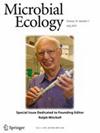
The journal Microbial Ecology was founded more than 50 years ago by Dr. Ralph Mitchell, Gordon McKay Professor of Applied Biology at Harvard University in Cambridge, MA. The journal has evolved to become a premier location for the presentation of manuscripts that represent advances in the field of microbial ecology. The journal has become a dedicated international forum for the presentation of high-quality scientific investigations of how microorganisms interact with their environment, with each other and with their hosts. Microbial Ecology offers articles of original research in full paper and note formats, as well as brief reviews and topical position papers.





 京公网安备 11010802042870号
京ICP备2023020795号-1
京公网安备 11010802042870号
京ICP备2023020795号-1

 分享
分享
 求助内容:
求助内容: 应助结果提醒方式:
 扫码关注我们
