Mousa Barboura, Ahed Assaf, William Borghol, Amin Yousef, Rain Alkhalil, Nourta Barboura, Ahmad Zahi AlChawwaf
{"title":"Hyperpigmented mycosis fungoides with histological spongiosis in a 61-year-old Syrian male: a case report.","authors":"Mousa Barboura, Ahed Assaf, William Borghol, Amin Yousef, Rain Alkhalil, Nourta Barboura, Ahmad Zahi AlChawwaf","doi":"10.1186/s13256-025-05169-3","DOIUrl":null,"url":null,"abstract":"<p><strong>Background: </strong>Mycosis fungoides is a type of cutaneous T-cell malignancy that gives different skin manifestations. Hyperpigmented mycosis fungoides is a very rare type of mycosis fungoides that presents with hyperpigmented patches and macules on the skin, it is reported to affect patients in their 30s, with only few cases reported to date. In this article, we present a unique case of hyperpigmented mycosis fungoides in which histological examination of the skin biopsy showed spongiosis, which is a rare histologic manifestation in mycosis fungoides, which makes the case more exceptional.</p><p><strong>Case presentation: </strong>A 61-year-old Syrian male presented to the dermatology clinic complaining of a persistent pigmented itchy lesion on the right side of the trunk and right thigh. Histological examination of the skin biopsy showed parakeratosic hyperkeratosic epidermis with spongiosis and deposition of melanophages, immunohistochemistry showed CD3<sup>+</sup>, CD4<sup>-</sup>, CD8<sup>+</sup>, and CD20<sup>-</sup>, and our patient was diagnosed with hyperpigmented mycosis fungoides, and subsequently treated with psoralen and ultraviolet A therapy, a very good improvement was noted, and the prognosis was excellent.</p><p><strong>Conclusion: </strong>Although hyperpigmented mycosis fungoides is an extremely rare condition, clinical practitioners should consider it as a diagnosis that may be encountered when approaching a persistent pigmented skin lesion to provide correct clinical orientation and avoid confusion with differential diagnoses. The diagnosis of hyperpigmented mycosis fungoides should not be excluded based only on the age. Skin biopsy and immunohistochemistry are the irreplaceable investigations to diagnose hyperpigmented mycosis fungoides. Spongiosis, although rare in mycosis fungoides, should not rule out the diagnosis of hyperpigmented mycosis fungoides.</p>","PeriodicalId":16236,"journal":{"name":"Journal of Medical Case Reports","volume":"19 1","pages":"134"},"PeriodicalIF":0.8000,"publicationDate":"2025-03-21","publicationTypes":"Journal Article","fieldsOfStudy":null,"isOpenAccess":false,"openAccessPdf":"https://www.ncbi.nlm.nih.gov/pmc/articles/PMC11929238/pdf/","citationCount":"0","resultStr":null,"platform":"Semanticscholar","paperid":null,"PeriodicalName":"Journal of Medical Case Reports","FirstCategoryId":"1085","ListUrlMain":"https://doi.org/10.1186/s13256-025-05169-3","RegionNum":0,"RegionCategory":null,"ArticlePicture":[],"TitleCN":null,"AbstractTextCN":null,"PMCID":null,"EPubDate":"","PubModel":"","JCR":"Q3","JCRName":"MEDICINE, GENERAL & INTERNAL","Score":null,"Total":0}
引用次数: 0
Abstract
Background: Mycosis fungoides is a type of cutaneous T-cell malignancy that gives different skin manifestations. Hyperpigmented mycosis fungoides is a very rare type of mycosis fungoides that presents with hyperpigmented patches and macules on the skin, it is reported to affect patients in their 30s, with only few cases reported to date. In this article, we present a unique case of hyperpigmented mycosis fungoides in which histological examination of the skin biopsy showed spongiosis, which is a rare histologic manifestation in mycosis fungoides, which makes the case more exceptional.
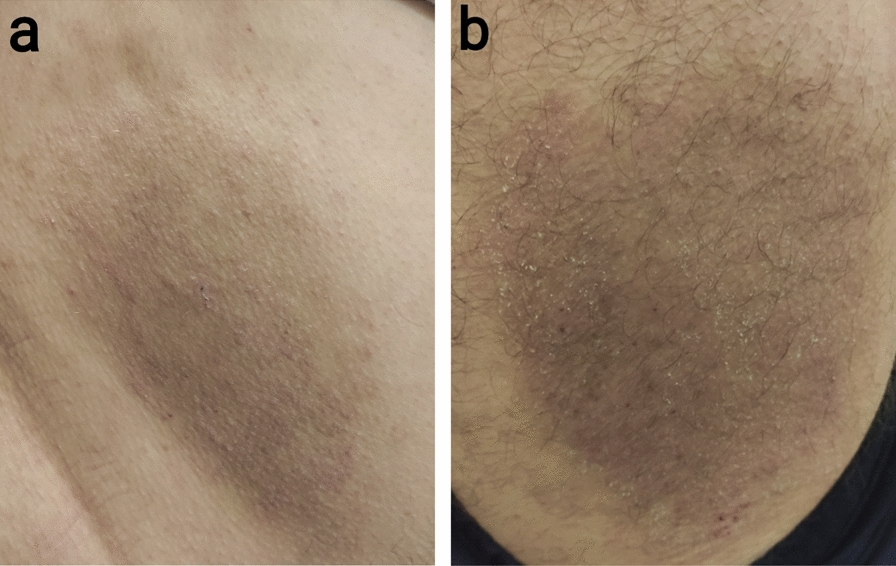
Case presentation: A 61-year-old Syrian male presented to the dermatology clinic complaining of a persistent pigmented itchy lesion on the right side of the trunk and right thigh. Histological examination of the skin biopsy showed parakeratosic hyperkeratosic epidermis with spongiosis and deposition of melanophages, immunohistochemistry showed CD3+, CD4-, CD8+, and CD20-, and our patient was diagnosed with hyperpigmented mycosis fungoides, and subsequently treated with psoralen and ultraviolet A therapy, a very good improvement was noted, and the prognosis was excellent.
Conclusion: Although hyperpigmented mycosis fungoides is an extremely rare condition, clinical practitioners should consider it as a diagnosis that may be encountered when approaching a persistent pigmented skin lesion to provide correct clinical orientation and avoid confusion with differential diagnoses. The diagnosis of hyperpigmented mycosis fungoides should not be excluded based only on the age. Skin biopsy and immunohistochemistry are the irreplaceable investigations to diagnose hyperpigmented mycosis fungoides. Spongiosis, although rare in mycosis fungoides, should not rule out the diagnosis of hyperpigmented mycosis fungoides.
期刊介绍:
JMCR is an open access, peer-reviewed online journal that will consider any original case report that expands the field of general medical knowledge. Reports should show one of the following: 1. Unreported or unusual side effects or adverse interactions involving medications 2. Unexpected or unusual presentations of a disease 3. New associations or variations in disease processes 4. Presentations, diagnoses and/or management of new and emerging diseases 5. An unexpected association between diseases or symptoms 6. An unexpected event in the course of observing or treating a patient 7. Findings that shed new light on the possible pathogenesis of a disease or an adverse effect





 京公网安备 11010802042870号
京ICP备2023020795号-1
京公网安备 11010802042870号
京ICP备2023020795号-1

 分享
分享
 求助内容:
求助内容: 应助结果提醒方式:
 扫码关注我们
