Attitude and practice of family physicians towards physical examination of patients of the opposite gender in primary health care centres in the Kingdom of Bahrain: a qualitative exploratory study.
Batool AlHejairi, Khalid Afifi, Haya Rashed, Ghadeer Aman, Mai Zaber, Basheer Makarem, Afif Ben Salah, Mohamed Shaikh Ali, Jamil Ahmed
{"title":"Attitude and practice of family physicians towards physical examination of patients of the opposite gender in primary health care centres in the Kingdom of Bahrain: a qualitative exploratory study.","authors":"Batool AlHejairi, Khalid Afifi, Haya Rashed, Ghadeer Aman, Mai Zaber, Basheer Makarem, Afif Ben Salah, Mohamed Shaikh Ali, Jamil Ahmed","doi":"10.1186/s12875-025-02776-3","DOIUrl":null,"url":null,"abstract":"<p><strong>Background: </strong>Physician attitudes towards patients of opposite genders may determine a lack of comprehensive care during patient encounters in primary care, and this has not been previously documented in the Arab Gulf region. This study investigated the attitudes and practices of family physicians about physical examinations of patients of the opposite gender in the Kingdom of Bahrain, specifically identifying barriers to performing physical examinations on patients of the opposite gender.</p><p><strong>Method: </strong>Qualitative exploratory, in-depth interviews were conducted with 15 board-certified Bahraini family physicians at nine primary health care centres from all five regions of the Kingdom of Bahrain. The participants were selected by a purposive sampling designed to include all physicians eligible as per inclusion criteria. A semi-structured interview guide was used for the interviews in English (appendix.1). Interviews were recorded and transcribed verbatim. The data were analysed by thematic analysis.</p><p><strong>Results: </strong>The study revealed four distinct and interrelated themes, including: 1) Influencers affect the practice of performing physical examinations on patients of opposite genders; 2) Effective communication and rapport-building with patients of the opposite gender before physical examination; 3) Physicians collaborate in the physical examination of patients of the opposite gender when needed; 4) Importance of a functional chaperone system in the primary health care centres to provide optimal care.</p><p><strong>Conclusions: </strong>Family physicians identified cultural, religious, and medico-legal barriers to performing physical examinations on opposite-gender patients. They reported adapting to these challenges by finding workarounds, such as referring patients to physicians of the same gender or using a chaperone system. To address these challenges effectively, establishing a regular chaperone system and trainings on examination techniques may enhance physicians' skills and confidence in conducting physical examinations on opposite-gender patients.</p>","PeriodicalId":72428,"journal":{"name":"BMC primary care","volume":"26 1","pages":"77"},"PeriodicalIF":2.6000,"publicationDate":"2025-03-21","publicationTypes":"Journal Article","fieldsOfStudy":null,"isOpenAccess":false,"openAccessPdf":"https://www.ncbi.nlm.nih.gov/pmc/articles/PMC11927145/pdf/","citationCount":"0","resultStr":null,"platform":"Semanticscholar","paperid":null,"PeriodicalName":"BMC primary care","FirstCategoryId":"1085","ListUrlMain":"https://doi.org/10.1186/s12875-025-02776-3","RegionNum":0,"RegionCategory":null,"ArticlePicture":[],"TitleCN":null,"AbstractTextCN":null,"PMCID":null,"EPubDate":"","PubModel":"","JCR":"Q2","JCRName":"MEDICINE, GENERAL & INTERNAL","Score":null,"Total":0}
引用次数: 0
Abstract
Background: Physician attitudes towards patients of opposite genders may determine a lack of comprehensive care during patient encounters in primary care, and this has not been previously documented in the Arab Gulf region. This study investigated the attitudes and practices of family physicians about physical examinations of patients of the opposite gender in the Kingdom of Bahrain, specifically identifying barriers to performing physical examinations on patients of the opposite gender.
Method: Qualitative exploratory, in-depth interviews were conducted with 15 board-certified Bahraini family physicians at nine primary health care centres from all five regions of the Kingdom of Bahrain. The participants were selected by a purposive sampling designed to include all physicians eligible as per inclusion criteria. A semi-structured interview guide was used for the interviews in English (appendix.1). Interviews were recorded and transcribed verbatim. The data were analysed by thematic analysis.
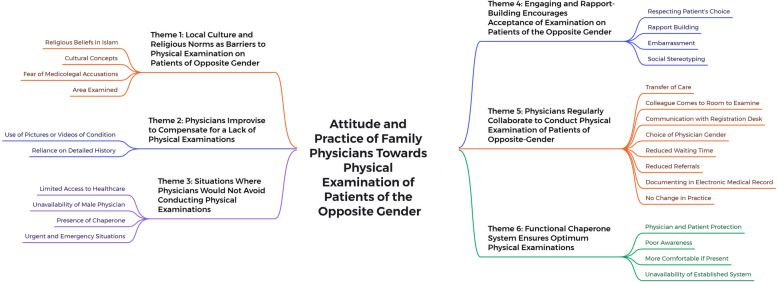
Results: The study revealed four distinct and interrelated themes, including: 1) Influencers affect the practice of performing physical examinations on patients of opposite genders; 2) Effective communication and rapport-building with patients of the opposite gender before physical examination; 3) Physicians collaborate in the physical examination of patients of the opposite gender when needed; 4) Importance of a functional chaperone system in the primary health care centres to provide optimal care.
Conclusions: Family physicians identified cultural, religious, and medico-legal barriers to performing physical examinations on opposite-gender patients. They reported adapting to these challenges by finding workarounds, such as referring patients to physicians of the same gender or using a chaperone system. To address these challenges effectively, establishing a regular chaperone system and trainings on examination techniques may enhance physicians' skills and confidence in conducting physical examinations on opposite-gender patients.



 京公网安备 11010802042870号
京ICP备2023020795号-1
京公网安备 11010802042870号
京ICP备2023020795号-1

 分享
分享

 求助内容:
求助内容: 应助结果提醒方式:
 扫码关注我们
