Francisca Werlinger, Enrique Francés-Poveda, Oscar A. Douglas-Gallardo, Marta Navarro, Oleksandra S. Trofymchuk, Felipe de la Cruz-Martinez, Juan Tejeda, Javier Martínez, Agustín Lara-Sánchez
{"title":"Amino Acids as Catalysts for the Regioselective Rearrangement of Epoxides into Ketones","authors":"Francisca Werlinger, Enrique Francés-Poveda, Oscar A. Douglas-Gallardo, Marta Navarro, Oleksandra S. Trofymchuk, Felipe de la Cruz-Martinez, Juan Tejeda, Javier Martínez, Agustín Lara-Sánchez","doi":"10.1021/acs.joc.4c03070","DOIUrl":null,"url":null,"abstract":"The combination of a natural amino acid (AA) (<span>l</span>-Glu, <span>l</span>-Tyr, and <span>l</span>-Lys) and tetrabutylammonium iodide was efficiently employed as a catalytic framework for the Meinwald rearrangement of various epoxides into their respective ketones under microwave irradiation and solvent-free conditions. The designed catalytic system has shown a good catalytic performance in the conversion of epoxides with different functional groups. The reaction is regioselective toward ketone formation, and these have been obtained in good to excellent yields. <span>l</span>-Glu was found to be the most active AA for this catalytic transformation. A mechanistic proposal, supported by computational simulations, is also provided to reinforce our experimental findings. The suggested reaction mechanism was obtained by computing the minimum energy path at the density functional theory level through the climbing-image nudged elastic band method. A localized molecular orbital analysis based on intrinsic bond orbitals was also performed to better understand the catalytic role of the AA -TBAI combination along the computed reaction path. A key role of both the carboxylic moiety and the iodide anion was identified in different reaction steps of our proposed mechanism, facilitating hydride transposition to form the final product.","PeriodicalId":57,"journal":{"name":"Journal of Organic Chemistry","volume":"3 1","pages":""},"PeriodicalIF":3.6000,"publicationDate":"2025-03-24","publicationTypes":"Journal Article","fieldsOfStudy":null,"isOpenAccess":false,"openAccessPdf":"","citationCount":"0","resultStr":null,"platform":"Semanticscholar","paperid":null,"PeriodicalName":"Journal of Organic Chemistry","FirstCategoryId":"1","ListUrlMain":"https://doi.org/10.1021/acs.joc.4c03070","RegionNum":2,"RegionCategory":"化学","ArticlePicture":[],"TitleCN":null,"AbstractTextCN":null,"PMCID":null,"EPubDate":"","PubModel":"","JCR":"Q1","JCRName":"CHEMISTRY, ORGANIC","Score":null,"Total":0}
引用次数: 0
Abstract
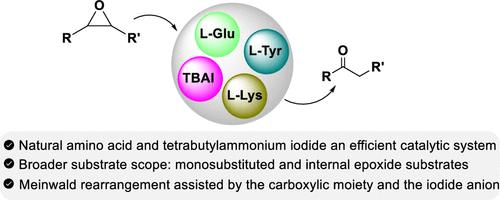
The combination of a natural amino acid (AA) (l-Glu, l-Tyr, and l-Lys) and tetrabutylammonium iodide was efficiently employed as a catalytic framework for the Meinwald rearrangement of various epoxides into their respective ketones under microwave irradiation and solvent-free conditions. The designed catalytic system has shown a good catalytic performance in the conversion of epoxides with different functional groups. The reaction is regioselective toward ketone formation, and these have been obtained in good to excellent yields. l-Glu was found to be the most active AA for this catalytic transformation. A mechanistic proposal, supported by computational simulations, is also provided to reinforce our experimental findings. The suggested reaction mechanism was obtained by computing the minimum energy path at the density functional theory level through the climbing-image nudged elastic band method. A localized molecular orbital analysis based on intrinsic bond orbitals was also performed to better understand the catalytic role of the AA -TBAI combination along the computed reaction path. A key role of both the carboxylic moiety and the iodide anion was identified in different reaction steps of our proposed mechanism, facilitating hydride transposition to form the final product.
期刊介绍:
Journal of Organic Chemistry welcomes original contributions of fundamental research in all branches of the theory and practice of organic chemistry. In selecting manuscripts for publication, the editors place emphasis on the quality and novelty of the work, as well as the breadth of interest to the organic chemistry community.



 京公网安备 11010802042870号
京ICP备2023020795号-1
京公网安备 11010802042870号
京ICP备2023020795号-1

 分享
分享
 求助内容:
求助内容: 应助结果提醒方式:
 扫码关注我们
