Yong Han, Huiqing Yang, Qingrui Zhang and Tifeng Jiao
{"title":"Enhancement of sulfate radicals degrading phenol in water by an external electric field: a study by DFT calculations†","authors":"Yong Han, Huiqing Yang, Qingrui Zhang and Tifeng Jiao","doi":"10.1039/D4CP04800H","DOIUrl":null,"url":null,"abstract":"<p >This study investigates the effect of an external electric field (EF) on the oxidative properties of sulfate radicals (SRs) generated from activated persulfate during the degradation of phenol by discharge plasma. In this paper, density functional theory (DFT) was employed to explore the variations in the reaction rate of phenol degradation by SRs under the influence of an external EF. Additionally, free energy barriers, spin densities, dipole moments (DMs), frontier molecular orbitals, and electrostatic potentials on van der Waals (vdW) surfaces were analyzed to elucidate the mechanisms driving the changes in reaction rate. It was found that discharge plasma with the +<em>X</em>-axis EF increased the degradation rate of phenol, while the degradation rate declines when the −<em>X</em>-axis EF is applied. As the strength of the +<em>X</em>-axis EF increased, a corresponding decrease in the free energy barrier and HOMO–LUMO gap was observed, alongside increases in the DM, spin density, and electrostatic potential. It can be concluded that the application of the +<em>X</em>-axis EF decreases the thermal stability of the phenol degradation system while enhancing electrostatic interactions, thereby leading to an increase in reactivity.</p>","PeriodicalId":99,"journal":{"name":"Physical Chemistry Chemical Physics","volume":" 16","pages":" 8148-8157"},"PeriodicalIF":2.9000,"publicationDate":"2025-03-24","publicationTypes":"Journal Article","fieldsOfStudy":null,"isOpenAccess":false,"openAccessPdf":"","citationCount":"0","resultStr":null,"platform":"Semanticscholar","paperid":null,"PeriodicalName":"Physical Chemistry Chemical Physics","FirstCategoryId":"92","ListUrlMain":"https://pubs.rsc.org/en/content/articlelanding/2025/cp/d4cp04800h","RegionNum":3,"RegionCategory":"化学","ArticlePicture":[],"TitleCN":null,"AbstractTextCN":null,"PMCID":null,"EPubDate":"","PubModel":"","JCR":"Q3","JCRName":"CHEMISTRY, PHYSICAL","Score":null,"Total":0}
引用次数: 0
Abstract
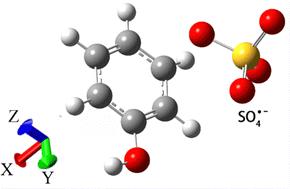
This study investigates the effect of an external electric field (EF) on the oxidative properties of sulfate radicals (SRs) generated from activated persulfate during the degradation of phenol by discharge plasma. In this paper, density functional theory (DFT) was employed to explore the variations in the reaction rate of phenol degradation by SRs under the influence of an external EF. Additionally, free energy barriers, spin densities, dipole moments (DMs), frontier molecular orbitals, and electrostatic potentials on van der Waals (vdW) surfaces were analyzed to elucidate the mechanisms driving the changes in reaction rate. It was found that discharge plasma with the +X-axis EF increased the degradation rate of phenol, while the degradation rate declines when the −X-axis EF is applied. As the strength of the +X-axis EF increased, a corresponding decrease in the free energy barrier and HOMO–LUMO gap was observed, alongside increases in the DM, spin density, and electrostatic potential. It can be concluded that the application of the +X-axis EF decreases the thermal stability of the phenol degradation system while enhancing electrostatic interactions, thereby leading to an increase in reactivity.
期刊介绍:
Physical Chemistry Chemical Physics (PCCP) is an international journal co-owned by 19 physical chemistry and physics societies from around the world. This journal publishes original, cutting-edge research in physical chemistry, chemical physics and biophysical chemistry. To be suitable for publication in PCCP, articles must include significant innovation and/or insight into physical chemistry; this is the most important criterion that reviewers and Editors will judge against when evaluating submissions.
The journal has a broad scope and welcomes contributions spanning experiment, theory, computation and data science. Topical coverage includes spectroscopy, dynamics, kinetics, statistical mechanics, thermodynamics, electrochemistry, catalysis, surface science, quantum mechanics, quantum computing and machine learning. Interdisciplinary research areas such as polymers and soft matter, materials, nanoscience, energy, surfaces/interfaces, and biophysical chemistry are welcomed if they demonstrate significant innovation and/or insight into physical chemistry. Joined experimental/theoretical studies are particularly appreciated when complementary and based on up-to-date approaches.




 京公网安备 11010802042870号
京ICP备2023020795号-1
京公网安备 11010802042870号
京ICP备2023020795号-1

 分享
分享
 求助内容:
求助内容: 应助结果提醒方式:
 扫码关注我们
