{"title":"Synergistic upcycling of Pt/Pd and graphite from city mines for highly efficient seawater hydrogen evolution catalysis†","authors":"Wenhan Cheng, Shuichang Liu, Qingsong Jiang, Songhe Yang, Yangzi Shangguan, Jian Hu, Jiaxin Liang, Shengyao Jin, Weixu Zhong, Xiangyang Lou and Hong Chen","doi":"10.1039/D5TA00055F","DOIUrl":null,"url":null,"abstract":"<p >Seawater electrolysis presents a promising approach for the sustainable production of green hydrogen. However, developing low-cost and highly stable electrocatalysts remains a critical challenge. Herein, we developed a waste materialization strategy to directly construct a novel Pt/Pd@SOG electrocatalyst from a recycled automobile catalyst and graphite anode. The as-fabricated catalyst exhibited superior performance in alkaline seawater electrolysis, delivering a low overpotential of 195 mV and 333 mV at current densities of 10 mA cm<small><sup>−2</sup></small> and 100 mA cm<small><sup>−2</sup></small> for the hydrogen evolution reaction (HER), respectively, outperforming commercial Pt/C (228 mV and 372 mV). A state-of-the-art turnover frequency (TOF) of 43.745 s<small><sup>−1</sup></small> was achieved. Additionally, the catalyst demonstrated exceptional stability at a current density of 100 mA cm<small><sup>−2</sup></small> for over 192 hours. A comprehensive characterization and mechanistic study reveals that the graphene-based material provides a fast electron transport pathway and guarantees excellent electron conductivity to the catalytic active center, while the d–d orbital coupling between Pt and Pd within the as-synthesized Pt/Pd@SOG significantly lowers the energy barrier for electron transfer during catalytic reaction and stabilizes the adsorption of intermediates at the Pt sites, thus promoting the HER. This research demonstrates a rapid valorization pathway for synergistically materializing multiple city mine wastes for advanced seawater electrocatalysts, which synergistically addresses the critical element cycling challenge and paves the way for sustainable energy catalysis.</p>","PeriodicalId":82,"journal":{"name":"Journal of Materials Chemistry A","volume":" 18","pages":" 13457-13468"},"PeriodicalIF":9.5000,"publicationDate":"2025-03-24","publicationTypes":"Journal Article","fieldsOfStudy":null,"isOpenAccess":false,"openAccessPdf":"","citationCount":"0","resultStr":null,"platform":"Semanticscholar","paperid":null,"PeriodicalName":"Journal of Materials Chemistry A","FirstCategoryId":"88","ListUrlMain":"https://pubs.rsc.org/en/content/articlelanding/2025/ta/d5ta00055f","RegionNum":2,"RegionCategory":"材料科学","ArticlePicture":[],"TitleCN":null,"AbstractTextCN":null,"PMCID":null,"EPubDate":"","PubModel":"","JCR":"Q1","JCRName":"CHEMISTRY, PHYSICAL","Score":null,"Total":0}
引用次数: 0
Abstract
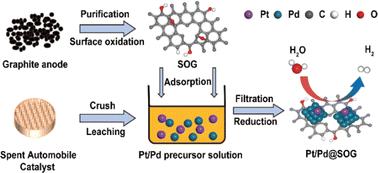
Seawater electrolysis presents a promising approach for the sustainable production of green hydrogen. However, developing low-cost and highly stable electrocatalysts remains a critical challenge. Herein, we developed a waste materialization strategy to directly construct a novel Pt/Pd@SOG electrocatalyst from a recycled automobile catalyst and graphite anode. The as-fabricated catalyst exhibited superior performance in alkaline seawater electrolysis, delivering a low overpotential of 195 mV and 333 mV at current densities of 10 mA cm−2 and 100 mA cm−2 for the hydrogen evolution reaction (HER), respectively, outperforming commercial Pt/C (228 mV and 372 mV). A state-of-the-art turnover frequency (TOF) of 43.745 s−1 was achieved. Additionally, the catalyst demonstrated exceptional stability at a current density of 100 mA cm−2 for over 192 hours. A comprehensive characterization and mechanistic study reveals that the graphene-based material provides a fast electron transport pathway and guarantees excellent electron conductivity to the catalytic active center, while the d–d orbital coupling between Pt and Pd within the as-synthesized Pt/Pd@SOG significantly lowers the energy barrier for electron transfer during catalytic reaction and stabilizes the adsorption of intermediates at the Pt sites, thus promoting the HER. This research demonstrates a rapid valorization pathway for synergistically materializing multiple city mine wastes for advanced seawater electrocatalysts, which synergistically addresses the critical element cycling challenge and paves the way for sustainable energy catalysis.
海水电解为无限生产绿色氢提供了一条潜在的途径。然而,开发低成本和高稳定性的电催化剂仍然是一个关键的挑战。在此,我们开发了一种废物物化策略,以回收的汽车催化剂和石墨阳极直接构建新型Pt/Pd@SOG电催化剂。制备的催化剂在碱性海水电解中表现出优异的性能,在10 mA cm⁻²和100 mA cm⁻²的电流密度下,其过电位分别为195 mV和333 mV,优于商业Pt/C (228 mV和372 mV)。最先进的43.745秒的高周转频率(TOF)已经交付。此外,该催化剂在100毫安厘米(⁻²)的电流密度下表现出超过192小时的稳定性。综合表征和机理研究表明,石墨烯基材料提供了快速的电子传递途径,保证了优异的电子传导至催化活性中心,而在合成的Pt/Pd@SOG中,Pt和Pd之间的d-d轨道耦合显著降低了催化反应中电子转移的能垒,稳定了中间体在Pt位点的吸附,从而促进了HER反应。本研究为先进海水电催化剂提供了多种城市矿山废弃物协同物化的快速增值途径,协同解决了关键元素循环挑战,为可持续能源催化铺平了道路。
期刊介绍:
The Journal of Materials Chemistry A, B & C covers a wide range of high-quality studies in the field of materials chemistry, with each section focusing on specific applications of the materials studied. Journal of Materials Chemistry A emphasizes applications in energy and sustainability, including topics such as artificial photosynthesis, batteries, and fuel cells. Journal of Materials Chemistry B focuses on applications in biology and medicine, while Journal of Materials Chemistry C covers applications in optical, magnetic, and electronic devices. Example topic areas within the scope of Journal of Materials Chemistry A include catalysis, green/sustainable materials, sensors, and water treatment, among others.



 京公网安备 11010802042870号
京ICP备2023020795号-1
京公网安备 11010802042870号
京ICP备2023020795号-1

 分享
分享
 求助内容:
求助内容: 应助结果提醒方式:
 扫码关注我们
