{"title":"Microbiota-reprogrammed phosphatidylcholine inactivates cytotoxic CD8 T cells through UFMylation via exosomal SerpinB9 in multiple myeloma","authors":"Wei Yan, Xue Shi, Yun Zhao, Xiaoyu Liu, Xueming Jia, Le Gao, Jiahe Yuan, Aijun Liao, Hiroshi Yasui, Xiaobin Wang, Xiaotian Wang, Rui Zhang, Huihan Wang","doi":"10.1038/s41467-025-57966-5","DOIUrl":null,"url":null,"abstract":"<p>Gut microbiome influences tumorigenesis and tumor progression through regulating the tumor microenvironment (TME) and modifying blood metabolites. However, the mechanisms by which gut microbiome and blood metabolites regulate the TME in multiple myeloma (MM) remain unclear. By employing16S rRNA gene sequencing coupled with metagenomics and ultra-performance liquid chromatography coupled with quadrupole time-of-flight mass spectrometry, we find that <i>Lachnospiraceae</i> are high and phosphatidylcholine (PC) are low in MM patients. We further show that <i>Lachnospiraceae</i> inhibits PC production from MM cells and enhances cytotoxic CD8 T cell function. Mechanistically, PC promotes Sb9 mRNA maturation in MM cells by LIN28A/B via lysophosphatidic acid, thus enhances exosamal Sb9 production. Exosamal Sb9 then reduces GZMB expression by suppressing tumor protein p53 (TP53) UFMylation via the competitive binding of TP53 with the ubiquitin-fold modifier conjugating enzyme 1 in CD8 T cells. We thus show that <i>Lachnospiraceae</i> and PC may be potential therapeutic targets for MM treatment.</p>","PeriodicalId":19066,"journal":{"name":"Nature Communications","volume":"20 1","pages":""},"PeriodicalIF":15.7000,"publicationDate":"2025-03-24","publicationTypes":"Journal Article","fieldsOfStudy":null,"isOpenAccess":false,"openAccessPdf":"","citationCount":"0","resultStr":null,"platform":"Semanticscholar","paperid":null,"PeriodicalName":"Nature Communications","FirstCategoryId":"103","ListUrlMain":"https://doi.org/10.1038/s41467-025-57966-5","RegionNum":1,"RegionCategory":"综合性期刊","ArticlePicture":[],"TitleCN":null,"AbstractTextCN":null,"PMCID":null,"EPubDate":"","PubModel":"","JCR":"Q1","JCRName":"MULTIDISCIPLINARY SCIENCES","Score":null,"Total":0}
引用次数: 0
Abstract
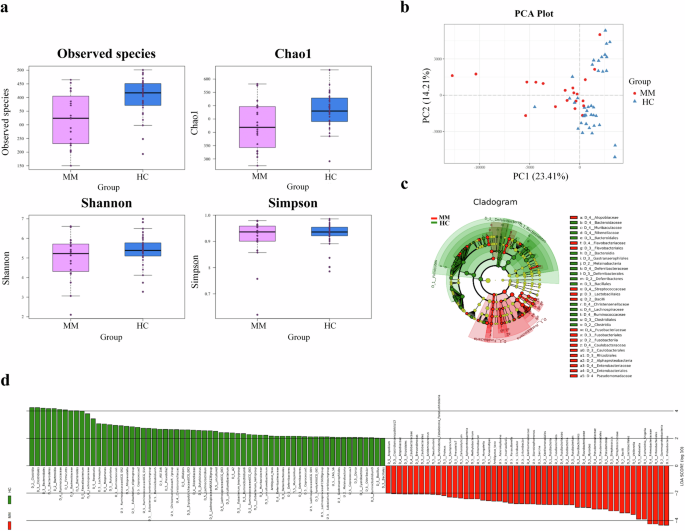
Gut microbiome influences tumorigenesis and tumor progression through regulating the tumor microenvironment (TME) and modifying blood metabolites. However, the mechanisms by which gut microbiome and blood metabolites regulate the TME in multiple myeloma (MM) remain unclear. By employing16S rRNA gene sequencing coupled with metagenomics and ultra-performance liquid chromatography coupled with quadrupole time-of-flight mass spectrometry, we find that Lachnospiraceae are high and phosphatidylcholine (PC) are low in MM patients. We further show that Lachnospiraceae inhibits PC production from MM cells and enhances cytotoxic CD8 T cell function. Mechanistically, PC promotes Sb9 mRNA maturation in MM cells by LIN28A/B via lysophosphatidic acid, thus enhances exosamal Sb9 production. Exosamal Sb9 then reduces GZMB expression by suppressing tumor protein p53 (TP53) UFMylation via the competitive binding of TP53 with the ubiquitin-fold modifier conjugating enzyme 1 in CD8 T cells. We thus show that Lachnospiraceae and PC may be potential therapeutic targets for MM treatment.
期刊介绍:
Nature Communications, an open-access journal, publishes high-quality research spanning all areas of the natural sciences. Papers featured in the journal showcase significant advances relevant to specialists in each respective field. With a 2-year impact factor of 16.6 (2022) and a median time of 8 days from submission to the first editorial decision, Nature Communications is committed to rapid dissemination of research findings. As a multidisciplinary journal, it welcomes contributions from biological, health, physical, chemical, Earth, social, mathematical, applied, and engineering sciences, aiming to highlight important breakthroughs within each domain.




 京公网安备 11010802042870号
京ICP备2023020795号-1
京公网安备 11010802042870号
京ICP备2023020795号-1

 分享
分享
 求助内容:
求助内容: 应助结果提醒方式:
 扫码关注我们
