Jianjian Zhou, Yang Wang, Lihong Shi, Yan Liu, Xucong Zhou, Jianchun Li, Huimin Ma, Jin Zhou
{"title":"Visual Diagnosis of Drug-Induced Pulmonary Fibrosis Based on a Mitochondrial Viscosity-Activated Red Fluorescent Probe","authors":"Jianjian Zhou, Yang Wang, Lihong Shi, Yan Liu, Xucong Zhou, Jianchun Li, Huimin Ma, Jin Zhou","doi":"10.1021/acs.analchem.4c06786","DOIUrl":null,"url":null,"abstract":"Idiopathic pulmonary fibrosis (IPF) is a chronic, progressive, and irreversible fatal disease, the prevalence of which has been increasing in recent years. Nonradiographic and noninvasive early diagnosis of pulmonary fibrosis could improve prognosis but is a formidable challenge. As one of the fundamental microenvironmental parameters, viscosity is relevant to various pathological states, such as acute inflammation. Nevertheless, the potential biological roles of viscosity during the IPF process have been relatively underexplored. To address this issue, herein, we developed a new viscosity-responsive probe (<b>JZ-2</b>), which displayed high sensitivity and selectivity for viscosity, as well as excellent characteristics for targeting mitochondria. <b>JZ-2</b> was successfully applied to map the changes in mitochondrial viscosity in cells caused by various stimuli, such as nystatin and lipopolysaccharide. Besides, <b>JZ-2</b> was capable of differentiating cancer cells from normal cells and even tissues. More importantly, <b>JZ-2</b> has been demonstrated to be sufficiently sensitive for tumor detection and early identification of IPF in vivo, revealing a significant increase in the viscosity of lung fibrosis tissues. Thus, <b>JZ-2</b> is expected to be a swift and reliable diagnostic modality for the prediction of IPF progression in clinical settings.","PeriodicalId":27,"journal":{"name":"Analytical Chemistry","volume":"59 1","pages":""},"PeriodicalIF":6.7000,"publicationDate":"2025-03-23","publicationTypes":"Journal Article","fieldsOfStudy":null,"isOpenAccess":false,"openAccessPdf":"","citationCount":"0","resultStr":null,"platform":"Semanticscholar","paperid":null,"PeriodicalName":"Analytical Chemistry","FirstCategoryId":"92","ListUrlMain":"https://doi.org/10.1021/acs.analchem.4c06786","RegionNum":1,"RegionCategory":"化学","ArticlePicture":[],"TitleCN":null,"AbstractTextCN":null,"PMCID":null,"EPubDate":"","PubModel":"","JCR":"Q1","JCRName":"CHEMISTRY, ANALYTICAL","Score":null,"Total":0}
引用次数: 0
Abstract
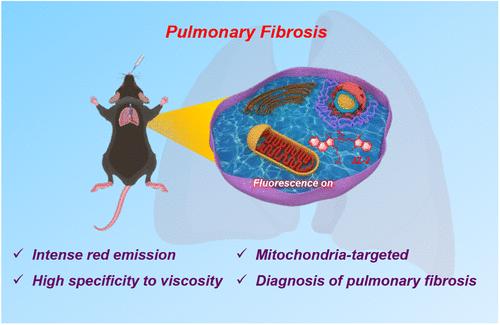
Idiopathic pulmonary fibrosis (IPF) is a chronic, progressive, and irreversible fatal disease, the prevalence of which has been increasing in recent years. Nonradiographic and noninvasive early diagnosis of pulmonary fibrosis could improve prognosis but is a formidable challenge. As one of the fundamental microenvironmental parameters, viscosity is relevant to various pathological states, such as acute inflammation. Nevertheless, the potential biological roles of viscosity during the IPF process have been relatively underexplored. To address this issue, herein, we developed a new viscosity-responsive probe (JZ-2), which displayed high sensitivity and selectivity for viscosity, as well as excellent characteristics for targeting mitochondria. JZ-2 was successfully applied to map the changes in mitochondrial viscosity in cells caused by various stimuli, such as nystatin and lipopolysaccharide. Besides, JZ-2 was capable of differentiating cancer cells from normal cells and even tissues. More importantly, JZ-2 has been demonstrated to be sufficiently sensitive for tumor detection and early identification of IPF in vivo, revealing a significant increase in the viscosity of lung fibrosis tissues. Thus, JZ-2 is expected to be a swift and reliable diagnostic modality for the prediction of IPF progression in clinical settings.
期刊介绍:
Analytical Chemistry, a peer-reviewed research journal, focuses on disseminating new and original knowledge across all branches of analytical chemistry. Fundamental articles may explore general principles of chemical measurement science and need not directly address existing or potential analytical methodology. They can be entirely theoretical or report experimental results. Contributions may cover various phases of analytical operations, including sampling, bioanalysis, electrochemistry, mass spectrometry, microscale and nanoscale systems, environmental analysis, separations, spectroscopy, chemical reactions and selectivity, instrumentation, imaging, surface analysis, and data processing. Papers discussing known analytical methods should present a significant, original application of the method, a notable improvement, or results on an important analyte.




 京公网安备 11010802042870号
京ICP备2023020795号-1
京公网安备 11010802042870号
京ICP备2023020795号-1

 分享
分享
 求助内容:
求助内容: 应助结果提醒方式:
 扫码关注我们
