Wenjun Jiang, Zixu Hu, Liang Zhou, Muhammad Tayyab, Jinlong Zhang, Yongdi Liu, Juying Lei
{"title":"Enhanced Photocatalytic Hydrogen Production by Constructing Ca-Doped ZnIn₂S₄: Modulation of Internal Electric Field and H Adsorption/Desorption","authors":"Wenjun Jiang, Zixu Hu, Liang Zhou, Muhammad Tayyab, Jinlong Zhang, Yongdi Liu, Juying Lei","doi":"10.1016/j.jallcom.2025.179985","DOIUrl":null,"url":null,"abstract":"Developing efficient photocatalysts for hydrogen production remains a significant challenge due to limitations in charge carrier dynamics and surface reaction efficiency. ZnIn<sub>2</sub>S<sub>4</sub>, a promising visible-light-responsive photocatalyst, often suffers from rapid recombination of photogenerated carriers and suboptimal surface reactions. In this study, Ca-doped ZnIn<sub>2</sub>S<sub>4</sub> was synthesized via a one-step hydrothermal method, demonstrating significantly improved hydrogen production performance. The doping of Ca enhances the internal electric field, facilitating the efficient separation and migration of photo-generated charge carriers. Additionally, Ca doping modifies the electronic structure around S active sites, weakening the S-H<sub>ads</sub> bond and promoting H desorption, thereby optimizing the hydrogen production reaction pathway. The Ca-doped ZnIn<sub>2</sub>S<sub>4</sub> photocatalyst achieved a hydrogen production rate of 661.32 μmol/g/h, approximately 2.4 times that of the pristine ZnIn<sub>2</sub>S<sub>4</sub> (259.39 μmol/g/h). This study demonstrates that Ca doping not only enhances charge carrier dynamics but also precisely adjusts surface properties, providing an effective strategy for developing high-performance photocatalysts for sustainable hydrogen production.","PeriodicalId":344,"journal":{"name":"Journal of Alloys and Compounds","volume":"183 1","pages":""},"PeriodicalIF":6.3000,"publicationDate":"2025-03-24","publicationTypes":"Journal Article","fieldsOfStudy":null,"isOpenAccess":false,"openAccessPdf":"","citationCount":"0","resultStr":null,"platform":"Semanticscholar","paperid":null,"PeriodicalName":"Journal of Alloys and Compounds","FirstCategoryId":"88","ListUrlMain":"https://doi.org/10.1016/j.jallcom.2025.179985","RegionNum":2,"RegionCategory":"材料科学","ArticlePicture":[],"TitleCN":null,"AbstractTextCN":null,"PMCID":null,"EPubDate":"","PubModel":"","JCR":"Q2","JCRName":"CHEMISTRY, PHYSICAL","Score":null,"Total":0}
引用次数: 0
Abstract
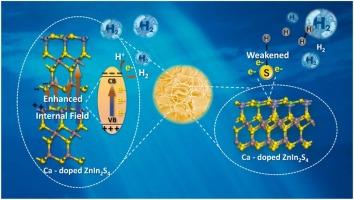
Developing efficient photocatalysts for hydrogen production remains a significant challenge due to limitations in charge carrier dynamics and surface reaction efficiency. ZnIn2S4, a promising visible-light-responsive photocatalyst, often suffers from rapid recombination of photogenerated carriers and suboptimal surface reactions. In this study, Ca-doped ZnIn2S4 was synthesized via a one-step hydrothermal method, demonstrating significantly improved hydrogen production performance. The doping of Ca enhances the internal electric field, facilitating the efficient separation and migration of photo-generated charge carriers. Additionally, Ca doping modifies the electronic structure around S active sites, weakening the S-Hads bond and promoting H desorption, thereby optimizing the hydrogen production reaction pathway. The Ca-doped ZnIn2S4 photocatalyst achieved a hydrogen production rate of 661.32 μmol/g/h, approximately 2.4 times that of the pristine ZnIn2S4 (259.39 μmol/g/h). This study demonstrates that Ca doping not only enhances charge carrier dynamics but also precisely adjusts surface properties, providing an effective strategy for developing high-performance photocatalysts for sustainable hydrogen production.
期刊介绍:
The Journal of Alloys and Compounds is intended to serve as an international medium for the publication of work on solid materials comprising compounds as well as alloys. Its great strength lies in the diversity of discipline which it encompasses, drawing together results from materials science, solid-state chemistry and physics.



 京公网安备 11010802042870号
京ICP备2023020795号-1
京公网安备 11010802042870号
京ICP备2023020795号-1

 分享
分享
 求助内容:
求助内容: 应助结果提醒方式:
 扫码关注我们
