Jian Zhou, Qing Wang, Gongkui Cheng, Wei Shen, Richard N. Zare, Xiaoyan Sun
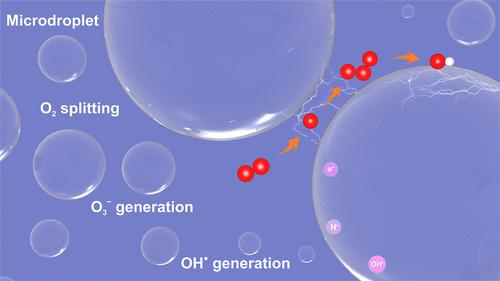
{"title":"Charged Water Microdroplets Enable Dissociation of Surrounding Dioxygen","authors":"Jian Zhou, Qing Wang, Gongkui Cheng, Wei Shen, Richard N. Zare, Xiaoyan Sun","doi":"10.1021/jacs.4c12740","DOIUrl":null,"url":null,"abstract":"The cleavage of dioxygen (O<sub>2</sub>) into its atomic constituents typically requires harsh conditions and metal catalysts. We present a remarkable discovery demonstrating that dioxygen can be activated, dissociated, and subsequently transformed into the ozone anion (O<sub>3</sub><sup>–</sup>) without any catalyst at the air–water interface in charged microdroplet sprays. Using online mass spectrometry, we directly detected the dioxygen splitting products O<sub>3</sub><sup>–</sup> and H<sub>2</sub>O·O<sub>3</sub><sup>–</sup> in microdroplets. The high electric field at the air–water interface, along with microlightning between oppositely charged water microdroplets, induces an electrical discharge responsible for the O–O bond cleavage, leading to the formation of reactive oxygen species (ROS). Isotope labeling experiments further reveal that various ROS, i.e., ·OH, CO<sub>3</sub><sup>–</sup>, and HCO<sub>4</sub><sup>–</sup>, can be generated through the reaction of dioxygen splitting products with water or CO<sub>2</sub>. This study introduces a sustainable pathway for molecular oxygen utilization and offers new insights into ROS generation in microdroplets.","PeriodicalId":49,"journal":{"name":"Journal of the American Chemical Society","volume":"28 1","pages":""},"PeriodicalIF":15.6000,"publicationDate":"2025-03-24","publicationTypes":"Journal Article","fieldsOfStudy":null,"isOpenAccess":false,"openAccessPdf":"","citationCount":"0","resultStr":null,"platform":"Semanticscholar","paperid":null,"PeriodicalName":"Journal of the American Chemical Society","FirstCategoryId":"92","ListUrlMain":"https://doi.org/10.1021/jacs.4c12740","RegionNum":1,"RegionCategory":"化学","ArticlePicture":[],"TitleCN":null,"AbstractTextCN":null,"PMCID":null,"EPubDate":"","PubModel":"","JCR":"Q1","JCRName":"CHEMISTRY, MULTIDISCIPLINARY","Score":null,"Total":0}
引用次数: 0
Abstract
The cleavage of dioxygen (O2) into its atomic constituents typically requires harsh conditions and metal catalysts. We present a remarkable discovery demonstrating that dioxygen can be activated, dissociated, and subsequently transformed into the ozone anion (O3–) without any catalyst at the air–water interface in charged microdroplet sprays. Using online mass spectrometry, we directly detected the dioxygen splitting products O3– and H2O·O3– in microdroplets. The high electric field at the air–water interface, along with microlightning between oppositely charged water microdroplets, induces an electrical discharge responsible for the O–O bond cleavage, leading to the formation of reactive oxygen species (ROS). Isotope labeling experiments further reveal that various ROS, i.e., ·OH, CO3–, and HCO4–, can be generated through the reaction of dioxygen splitting products with water or CO2. This study introduces a sustainable pathway for molecular oxygen utilization and offers new insights into ROS generation in microdroplets.
期刊介绍:
The flagship journal of the American Chemical Society, known as the Journal of the American Chemical Society (JACS), has been a prestigious publication since its establishment in 1879. It holds a preeminent position in the field of chemistry and related interdisciplinary sciences. JACS is committed to disseminating cutting-edge research papers, covering a wide range of topics, and encompasses approximately 19,000 pages of Articles, Communications, and Perspectives annually. With a weekly publication frequency, JACS plays a vital role in advancing the field of chemistry by providing essential research.



 京公网安备 11010802042870号
京ICP备2023020795号-1
京公网安备 11010802042870号
京ICP备2023020795号-1

 分享
分享
 求助内容:
求助内容: 应助结果提醒方式:
 扫码关注我们
