{"title":"Efficient Synthesis of Sequence-Defined Oligomers through Orthogonal CuAAC and IrAAC Reactions","authors":"Tingting Qiu, Ningning Song, Shengtao Ding","doi":"10.1021/acs.macromol.4c03204","DOIUrl":null,"url":null,"abstract":"Abiotic sequence-defined polymers hold tremendous promise for applications in nanotechnology, materials science, biomedicine, and data storage. Yet, their synthesis often demands complex, iterative procedures involving multiple deprotection or activation steps. To address this challenge, we present a highly efficient “AB + AC” orthogonal coupling strategy that integrates copper-catalyzed azide–alkyne cycloaddition (CuAAC) and iridium-catalyzed AAC (IrAAC). This approach leverages the exceptional chemoselectivity of each reaction to construct sequence-defined oligotriazoles without the need for protecting groups. Notably, by employing distinct terminal alkyne and thioalkyne substrates, our method enables precise, stepwise elongation of macromolecular chains on a gram scale, even when incorporating diverse functional monomers, underscoring its practicality for large-scale applications. Comprehensive analyses via size exclusion chromatography, mass spectrometry, and nuclear magnetic resonance techniques confirm the high purity and structural accuracy of the resulting oligomers. Moreover, the clear fragmentation patterns observed in tandem mass spectrometry (MS/MS) highlight the suitability of these triazole-rich architectures for high-fidelity data encoding, thereby paving the way for advanced applications in high-density information storage. Overall, this work not only expands the synthetic toolbox for creating precision polymers but also offers a robust platform for the development of next-generation materials with tunable properties and broad technological relevance.","PeriodicalId":51,"journal":{"name":"Macromolecules","volume":"57 1","pages":""},"PeriodicalIF":5.2000,"publicationDate":"2025-03-24","publicationTypes":"Journal Article","fieldsOfStudy":null,"isOpenAccess":false,"openAccessPdf":"","citationCount":"0","resultStr":null,"platform":"Semanticscholar","paperid":null,"PeriodicalName":"Macromolecules","FirstCategoryId":"92","ListUrlMain":"https://doi.org/10.1021/acs.macromol.4c03204","RegionNum":1,"RegionCategory":"化学","ArticlePicture":[],"TitleCN":null,"AbstractTextCN":null,"PMCID":null,"EPubDate":"","PubModel":"","JCR":"Q1","JCRName":"POLYMER SCIENCE","Score":null,"Total":0}
引用次数: 0
Abstract
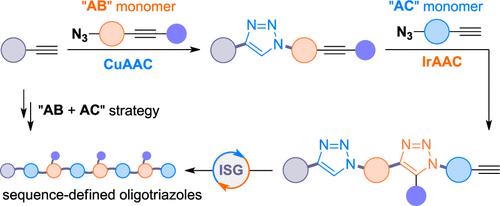
Abiotic sequence-defined polymers hold tremendous promise for applications in nanotechnology, materials science, biomedicine, and data storage. Yet, their synthesis often demands complex, iterative procedures involving multiple deprotection or activation steps. To address this challenge, we present a highly efficient “AB + AC” orthogonal coupling strategy that integrates copper-catalyzed azide–alkyne cycloaddition (CuAAC) and iridium-catalyzed AAC (IrAAC). This approach leverages the exceptional chemoselectivity of each reaction to construct sequence-defined oligotriazoles without the need for protecting groups. Notably, by employing distinct terminal alkyne and thioalkyne substrates, our method enables precise, stepwise elongation of macromolecular chains on a gram scale, even when incorporating diverse functional monomers, underscoring its practicality for large-scale applications. Comprehensive analyses via size exclusion chromatography, mass spectrometry, and nuclear magnetic resonance techniques confirm the high purity and structural accuracy of the resulting oligomers. Moreover, the clear fragmentation patterns observed in tandem mass spectrometry (MS/MS) highlight the suitability of these triazole-rich architectures for high-fidelity data encoding, thereby paving the way for advanced applications in high-density information storage. Overall, this work not only expands the synthetic toolbox for creating precision polymers but also offers a robust platform for the development of next-generation materials with tunable properties and broad technological relevance.
期刊介绍:
Macromolecules publishes original, fundamental, and impactful research on all aspects of polymer science. Topics of interest include synthesis (e.g., controlled polymerizations, polymerization catalysis, post polymerization modification, new monomer structures and polymer architectures, and polymerization mechanisms/kinetics analysis); phase behavior, thermodynamics, dynamic, and ordering/disordering phenomena (e.g., self-assembly, gelation, crystallization, solution/melt/solid-state characteristics); structure and properties (e.g., mechanical and rheological properties, surface/interfacial characteristics, electronic and transport properties); new state of the art characterization (e.g., spectroscopy, scattering, microscopy, rheology), simulation (e.g., Monte Carlo, molecular dynamics, multi-scale/coarse-grained modeling), and theoretical methods. Renewable/sustainable polymers, polymer networks, responsive polymers, electro-, magneto- and opto-active macromolecules, inorganic polymers, charge-transporting polymers (ion-containing, semiconducting, and conducting), nanostructured polymers, and polymer composites are also of interest. Typical papers published in Macromolecules showcase important and innovative concepts, experimental methods/observations, and theoretical/computational approaches that demonstrate a fundamental advance in the understanding of polymers.



 京公网安备 11010802042870号
京ICP备2023020795号-1
京公网安备 11010802042870号
京ICP备2023020795号-1

 分享
分享
 求助内容:
求助内容: 应助结果提醒方式:
 扫码关注我们
