Hammad Ahmed, Muhammad Afnan Ansari, Rong Yan, Xianzhong Chen
{"title":"Customizing Multicolored Orbital Angular Momentum Combs","authors":"Hammad Ahmed, Muhammad Afnan Ansari, Rong Yan, Xianzhong Chen","doi":"10.1021/acs.nanolett.5c00467","DOIUrl":null,"url":null,"abstract":"Current orbital angular momentum (OAM) combs generating technology is hindered by bulky optical systems, limited control, and lack of multicolored information, impeding system integration and practical applications. We present a metasurface approach to realizing multicolored OAM comb engineering along the light propagation direction. The OAM combs are measured based on the intensity of bright spots in the generated intensity patterns that correspond to the weights of the OAM modes. Three OAM combs with different colors are generated at different observation planes. The positioning of transition points along the azimuthal direction is the key to shaping the OAM distribution of the generated beams. OAM combs with customized mode spacings and broad OAM spectra are obtained. Our approach provides a compact platform to realize OAM combs with multidimensional information in the domains of the OAM spectra, frequency, and space, which can significantly enhance the information capacity for potential applications in optical communications.","PeriodicalId":53,"journal":{"name":"Nano Letters","volume":"61 1","pages":""},"PeriodicalIF":9.1000,"publicationDate":"2025-03-24","publicationTypes":"Journal Article","fieldsOfStudy":null,"isOpenAccess":false,"openAccessPdf":"","citationCount":"0","resultStr":null,"platform":"Semanticscholar","paperid":null,"PeriodicalName":"Nano Letters","FirstCategoryId":"88","ListUrlMain":"https://doi.org/10.1021/acs.nanolett.5c00467","RegionNum":1,"RegionCategory":"材料科学","ArticlePicture":[],"TitleCN":null,"AbstractTextCN":null,"PMCID":null,"EPubDate":"","PubModel":"","JCR":"Q1","JCRName":"CHEMISTRY, MULTIDISCIPLINARY","Score":null,"Total":0}
引用次数: 0
Abstract
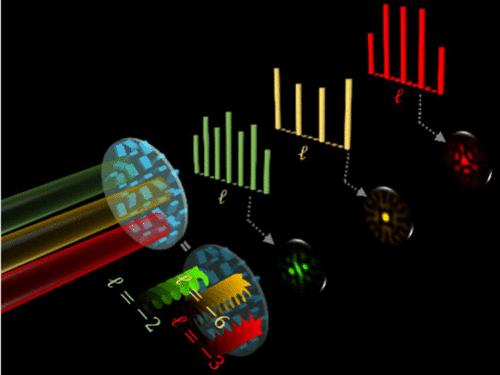
Current orbital angular momentum (OAM) combs generating technology is hindered by bulky optical systems, limited control, and lack of multicolored information, impeding system integration and practical applications. We present a metasurface approach to realizing multicolored OAM comb engineering along the light propagation direction. The OAM combs are measured based on the intensity of bright spots in the generated intensity patterns that correspond to the weights of the OAM modes. Three OAM combs with different colors are generated at different observation planes. The positioning of transition points along the azimuthal direction is the key to shaping the OAM distribution of the generated beams. OAM combs with customized mode spacings and broad OAM spectra are obtained. Our approach provides a compact platform to realize OAM combs with multidimensional information in the domains of the OAM spectra, frequency, and space, which can significantly enhance the information capacity for potential applications in optical communications.
期刊介绍:
Nano Letters serves as a dynamic platform for promptly disseminating original results in fundamental, applied, and emerging research across all facets of nanoscience and nanotechnology. A pivotal criterion for inclusion within Nano Letters is the convergence of at least two different areas or disciplines, ensuring a rich interdisciplinary scope. The journal is dedicated to fostering exploration in diverse areas, including:
- Experimental and theoretical findings on physical, chemical, and biological phenomena at the nanoscale
- Synthesis, characterization, and processing of organic, inorganic, polymer, and hybrid nanomaterials through physical, chemical, and biological methodologies
- Modeling and simulation of synthetic, assembly, and interaction processes
- Realization of integrated nanostructures and nano-engineered devices exhibiting advanced performance
- Applications of nanoscale materials in living and environmental systems
Nano Letters is committed to advancing and showcasing groundbreaking research that intersects various domains, fostering innovation and collaboration in the ever-evolving field of nanoscience and nanotechnology.



 京公网安备 11010802042870号
京ICP备2023020795号-1
京公网安备 11010802042870号
京ICP备2023020795号-1

 分享
分享
 求助内容:
求助内容: 应助结果提醒方式:
 扫码关注我们
