Steering the Selectivity of Electrochemical CO2 Reduction on the Cu Catalyst via the Interplay between the Electrode Morphology and Electrolyte Anion Identity
Cornelius A. Obasanjo, Gelson T. S. T. da Silva, Fatima Gonzalez Marin, Lucia H. Mascaro, Cao-Thang Dinh
{"title":"Steering the Selectivity of Electrochemical CO2 Reduction on the Cu Catalyst via the Interplay between the Electrode Morphology and Electrolyte Anion Identity","authors":"Cornelius A. Obasanjo, Gelson T. S. T. da Silva, Fatima Gonzalez Marin, Lucia H. Mascaro, Cao-Thang Dinh","doi":"10.1021/acscatal.4c08113","DOIUrl":null,"url":null,"abstract":"Electrochemical carbon dioxide (CO<sub>2</sub>) reduction (ECR) holds promise as a viable pathway for the generation of fuels and chemicals. Several strategies have been explored to enhance the product selectivity of ECR on copper (Cu) catalysts. A systematic approach to optimize the local reaction microenvironment, however, remains elusive. Engineering the electrode structure and reaction microenvironment is a facile but effective strategy for steering the product selectivity of ECR reactions and can enable the rational design of highly selective Cu electrodes. Herein, we demonstrate that the synergy between an optimized Cu gas diffusion electrode (GDE) morphology and electrolyte anion identity can steer ECR product selectivity toward ethylene (C<sub>2+</sub>) or methane via the local CO<sub>2</sub> availability, pH, and electrode morphology regulation. We show that using a relatively thin 100 nm Cu catalyst layer (CL) sputtered on an optimized macropore-sized hydrophobic poly(tetrafluoroethylene) substrate promotes methane selectivity at high reaction rates. We achieved a methane partial current density of 126 mA cm<sup>–2</sup> and a Faradaic efficiency (FE) of 42%. In contrast, a relatively thick 500 nm Cu CL favors ethylene production, reaching a high FE of 52% at 250 mA cm<sup>–2</sup> (with a total C<sub>2+</sub> value of 77%) in a near-neutral KHCO<sub>3</sub> electrolyte. Utilizing KI electrolyte significantly enhances methane selectivity, achieving ca. 56% at a partial current density of 168 mA cm<sup>–2</sup> while effectively suppressing the hydrogen evolution reaction (HER) on the thin CL. Furthermore, on the relatively thick CL, a higher C<sub>2+</sub> FE of 84% was achieved at 250 mA cm<sup>–2</sup>, demonstrating the impact of electrolyte anion identity and CL thickness on product selectivity in ECR. In addition, we find that a further increase in the Cu CL thickness does not result in a superior C<sub>2+</sub> performance in KI compared to the KHCO<sub>3</sub> electrolyte. Our result highlights the critical role of the interplay between Cu electrode morphology and the electrolyte anion identity, which can facilitate efficient CO<sub>2</sub> mass transport, enable selective Cu sites, and tune local pH – thereby steering ECR product selectivity.","PeriodicalId":9,"journal":{"name":"ACS Catalysis ","volume":"97 1","pages":""},"PeriodicalIF":13.1000,"publicationDate":"2025-03-24","publicationTypes":"Journal Article","fieldsOfStudy":null,"isOpenAccess":false,"openAccessPdf":"","citationCount":"0","resultStr":null,"platform":"Semanticscholar","paperid":null,"PeriodicalName":"ACS Catalysis ","FirstCategoryId":"92","ListUrlMain":"https://doi.org/10.1021/acscatal.4c08113","RegionNum":1,"RegionCategory":"化学","ArticlePicture":[],"TitleCN":null,"AbstractTextCN":null,"PMCID":null,"EPubDate":"","PubModel":"","JCR":"Q1","JCRName":"CHEMISTRY, PHYSICAL","Score":null,"Total":0}
引用次数: 0
Abstract
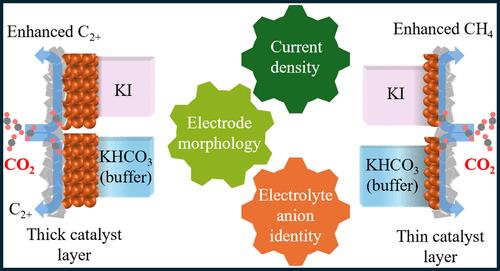
Electrochemical carbon dioxide (CO2) reduction (ECR) holds promise as a viable pathway for the generation of fuels and chemicals. Several strategies have been explored to enhance the product selectivity of ECR on copper (Cu) catalysts. A systematic approach to optimize the local reaction microenvironment, however, remains elusive. Engineering the electrode structure and reaction microenvironment is a facile but effective strategy for steering the product selectivity of ECR reactions and can enable the rational design of highly selective Cu electrodes. Herein, we demonstrate that the synergy between an optimized Cu gas diffusion electrode (GDE) morphology and electrolyte anion identity can steer ECR product selectivity toward ethylene (C2+) or methane via the local CO2 availability, pH, and electrode morphology regulation. We show that using a relatively thin 100 nm Cu catalyst layer (CL) sputtered on an optimized macropore-sized hydrophobic poly(tetrafluoroethylene) substrate promotes methane selectivity at high reaction rates. We achieved a methane partial current density of 126 mA cm–2 and a Faradaic efficiency (FE) of 42%. In contrast, a relatively thick 500 nm Cu CL favors ethylene production, reaching a high FE of 52% at 250 mA cm–2 (with a total C2+ value of 77%) in a near-neutral KHCO3 electrolyte. Utilizing KI electrolyte significantly enhances methane selectivity, achieving ca. 56% at a partial current density of 168 mA cm–2 while effectively suppressing the hydrogen evolution reaction (HER) on the thin CL. Furthermore, on the relatively thick CL, a higher C2+ FE of 84% was achieved at 250 mA cm–2, demonstrating the impact of electrolyte anion identity and CL thickness on product selectivity in ECR. In addition, we find that a further increase in the Cu CL thickness does not result in a superior C2+ performance in KI compared to the KHCO3 electrolyte. Our result highlights the critical role of the interplay between Cu electrode morphology and the electrolyte anion identity, which can facilitate efficient CO2 mass transport, enable selective Cu sites, and tune local pH – thereby steering ECR product selectivity.
电化学二氧化碳(CO2)还原(ECR)有望成为生产燃料和化学品的可行途径。为了提高ECR在铜(Cu)催化剂上的选择性,研究了几种策略。然而,优化局部反应微环境的系统方法仍然难以捉摸。设计电极结构和反应微环境是控制ECR反应产物选择性的简单而有效的策略,可以实现高选择性Cu电极的合理设计。在此,我们证明了优化的Cu气体扩散电极(GDE)形态和电解质阴离子特性之间的协同作用可以通过局部CO2可用性、pH和电极形态调节来引导ECR产物对乙烯(C2+)或甲烷的选择性。我们发现,在优化的大孔径疏水聚四氟乙烯底物上溅射相对较薄的100 nm Cu催化剂层(CL),在高反应速率下促进了甲烷的选择性。我们实现了甲烷分电流密度为126 mA cm-2,法拉第效率(FE)为42%。相比之下,相对较厚的500 nm Cu CL有利于乙烯的产生,在接近中性的KHCO3电解质中,在250 mA cm-2时达到52%的高FE(总C2+值为77%)。使用KI电解质显著提高了甲烷选择性,在168 mA cm-2的偏电流密度下,甲烷选择性达到56%,同时有效抑制了薄CL上的析氢反应(HER)。此外,在相对较厚的CL上,在250 mA cm-2下,C2+ FE达到了84%,这表明电解质阴离子特性和CL厚度对ECR中产物选择性的影响。此外,我们发现,与KHCO3电解质相比,进一步增加Cu CL厚度并不会导致KI中C2+性能的提高。我们的研究结果强调了Cu电极形态和电解质阴离子特性之间相互作用的关键作用,这可以促进有效的CO2质量运输,实现选择性Cu位点,并调节局部pH值-从而控制ECR产物的选择性。
期刊介绍:
ACS Catalysis is an esteemed journal that publishes original research in the fields of heterogeneous catalysis, molecular catalysis, and biocatalysis. It offers broad coverage across diverse areas such as life sciences, organometallics and synthesis, photochemistry and electrochemistry, drug discovery and synthesis, materials science, environmental protection, polymer discovery and synthesis, and energy and fuels.
The scope of the journal is to showcase innovative work in various aspects of catalysis. This includes new reactions and novel synthetic approaches utilizing known catalysts, the discovery or modification of new catalysts, elucidation of catalytic mechanisms through cutting-edge investigations, practical enhancements of existing processes, as well as conceptual advances in the field. Contributions to ACS Catalysis can encompass both experimental and theoretical research focused on catalytic molecules, macromolecules, and materials that exhibit catalytic turnover.



 京公网安备 11010802042870号
京ICP备2023020795号-1
京公网安备 11010802042870号
京ICP备2023020795号-1

 分享
分享
 求助内容:
求助内容: 应助结果提醒方式:
 扫码关注我们
