Felicia Daniela Cannavacciuolo, Laura Falivene, Ziyun Zhang, Gentoku Takasao, Diego De Canditiis, Mostafa Khoshsefat, Patchanee Chammingkwan, Giuseppe Antinucci, Toshiaki Taniike, Roberta Cipullo, Luigi Cavallo, Vincenzo Busico
{"title":"Data Driven Modeling of Ziegler–Natta Polypropylene Catalysts: Revisiting the Role of the Internal Donor","authors":"Felicia Daniela Cannavacciuolo, Laura Falivene, Ziyun Zhang, Gentoku Takasao, Diego De Canditiis, Mostafa Khoshsefat, Patchanee Chammingkwan, Giuseppe Antinucci, Toshiaki Taniike, Roberta Cipullo, Luigi Cavallo, Vincenzo Busico","doi":"10.1021/acscatal.4c07916","DOIUrl":null,"url":null,"abstract":"Automated High-Throughput Experimentation (HTE) workflows are increasingly used in catalysis to generate large and reliable databases of Quantitative Structure-Properties Relations (QSPR). Data-driven approaches integrating HTE and Artificial Intelligence (AI) tools such as Machine Learning (ML) and Deep Learning (DL), can be exploited to rapidly and thoroughly navigate complex variable hyperspaces and build models predicting catalyst performance. In a recent publication we highlighted the utilization of a custom-made HTE/AI workflow for the preparation, screening, and “black-box” QSPR modeling of a large library of “High-Yield” Ziegler–Natta (HY-ZN) catalyst formulations, with the ultimate goal of identifying Internal Donors (ID) specifically for tunable applications. In the present paper, we illustrate how a smaller but more homogeneous ID subset containing diesters only can be utilized for “clear-box” QSPR modeling also aiming at increased mechanistic insights. The study led to unconventional conclusions that challenge some long-standing hypotheses about the role of surface modification by electron donors in HY-ZN catalysis. In particular, evidence was achieved that the ID leaves a permanent footprint in the catalyst, which durably affects catalyst performance even in case the ID is reactive with the AlEt<sub>3</sub> activator and is extensively removed from the solid phase during polymerization.","PeriodicalId":9,"journal":{"name":"ACS Catalysis ","volume":"71 1","pages":""},"PeriodicalIF":13.1000,"publicationDate":"2025-03-24","publicationTypes":"Journal Article","fieldsOfStudy":null,"isOpenAccess":false,"openAccessPdf":"","citationCount":"0","resultStr":null,"platform":"Semanticscholar","paperid":null,"PeriodicalName":"ACS Catalysis ","FirstCategoryId":"92","ListUrlMain":"https://doi.org/10.1021/acscatal.4c07916","RegionNum":1,"RegionCategory":"化学","ArticlePicture":[],"TitleCN":null,"AbstractTextCN":null,"PMCID":null,"EPubDate":"","PubModel":"","JCR":"Q1","JCRName":"CHEMISTRY, PHYSICAL","Score":null,"Total":0}
引用次数: 0
Abstract
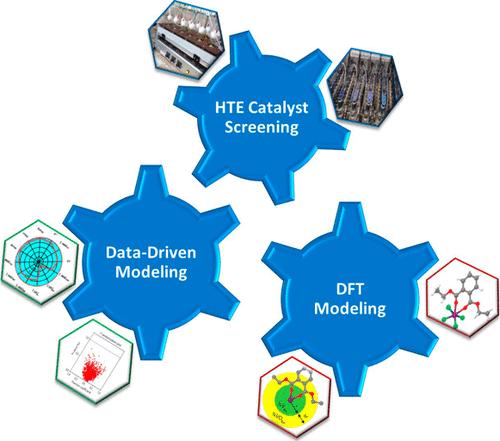
Automated High-Throughput Experimentation (HTE) workflows are increasingly used in catalysis to generate large and reliable databases of Quantitative Structure-Properties Relations (QSPR). Data-driven approaches integrating HTE and Artificial Intelligence (AI) tools such as Machine Learning (ML) and Deep Learning (DL), can be exploited to rapidly and thoroughly navigate complex variable hyperspaces and build models predicting catalyst performance. In a recent publication we highlighted the utilization of a custom-made HTE/AI workflow for the preparation, screening, and “black-box” QSPR modeling of a large library of “High-Yield” Ziegler–Natta (HY-ZN) catalyst formulations, with the ultimate goal of identifying Internal Donors (ID) specifically for tunable applications. In the present paper, we illustrate how a smaller but more homogeneous ID subset containing diesters only can be utilized for “clear-box” QSPR modeling also aiming at increased mechanistic insights. The study led to unconventional conclusions that challenge some long-standing hypotheses about the role of surface modification by electron donors in HY-ZN catalysis. In particular, evidence was achieved that the ID leaves a permanent footprint in the catalyst, which durably affects catalyst performance even in case the ID is reactive with the AlEt3 activator and is extensively removed from the solid phase during polymerization.
期刊介绍:
ACS Catalysis is an esteemed journal that publishes original research in the fields of heterogeneous catalysis, molecular catalysis, and biocatalysis. It offers broad coverage across diverse areas such as life sciences, organometallics and synthesis, photochemistry and electrochemistry, drug discovery and synthesis, materials science, environmental protection, polymer discovery and synthesis, and energy and fuels.
The scope of the journal is to showcase innovative work in various aspects of catalysis. This includes new reactions and novel synthetic approaches utilizing known catalysts, the discovery or modification of new catalysts, elucidation of catalytic mechanisms through cutting-edge investigations, practical enhancements of existing processes, as well as conceptual advances in the field. Contributions to ACS Catalysis can encompass both experimental and theoretical research focused on catalytic molecules, macromolecules, and materials that exhibit catalytic turnover.



 京公网安备 11010802042870号
京ICP备2023020795号-1
京公网安备 11010802042870号
京ICP备2023020795号-1

 分享
分享
 求助内容:
求助内容: 应助结果提醒方式:
 扫码关注我们
