Linh Nguyen, Ling Han, Elena N. Kitova, Jianing Li, Nai-Kong V. Cheung, Kenneth K. S. Ng, John S. Klassen
{"title":"Protein Recognition of Glycosphingolipids in Membranes: Mechanistic and Quantitative Insights","authors":"Linh Nguyen, Ling Han, Elena N. Kitova, Jianing Li, Nai-Kong V. Cheung, Kenneth K. S. Ng, John S. Klassen","doi":"10.1021/acs.analchem.4c03438","DOIUrl":null,"url":null,"abstract":"Recognition of glycosphingolipids (GSLs) in cell membranes by glycan-binding proteins (GBPs) is essential for diverse biological processes. However, owing to deficiencies in available analytical methods, the thermodynamics of GBP–GSL interactions remains poorly characterized. Native mass spectrometry (nMS) analysis performed using soluble GSL-containing model membranes provides a direct readout of the identity and stoichiometry of bound GSL ligands and, under certain conditions, can inform on affinity. Yet, for multivalent GBPs capable of engaging multiple model membranes simultaneously, data analysis relies on untested assumptions, which has limited adoption of the assay. Here, we apply mass photometry to quantify a series of high-affinity interactions between glycolipids in soluble model membranes (nanodiscs) and mono- and multivalent GBPs and compare with binding data acquired with nMS. Remarkably, the mass photometry results indicate that glycolipids are distributed nonstatistically across the lipid bilayer and engage in clustering that is sensitive to GBP binding. Moreover, the affinities and stoichiometries (of bound nanodiscs) measured for multivalent GBPs are strongly modulated by glycolipid clustering, which can overwhelm avidity gains from multivalent binding. After normalization for the number of GBP binding sites and glycolipid content, the affinities from mass photometry are found to be, overall, in good agreement with native nMS-derived affinities. Collectively, the findings of this study provide critically needed affinity and stoichiometry benchmarks for assay validation and significant new insights into the mechanisms of GBP recognition of GSLs in model membranes, which serve as a foundation for understanding binding in natural cellular environments.","PeriodicalId":27,"journal":{"name":"Analytical Chemistry","volume":"32 1","pages":""},"PeriodicalIF":6.7000,"publicationDate":"2025-03-24","publicationTypes":"Journal Article","fieldsOfStudy":null,"isOpenAccess":false,"openAccessPdf":"","citationCount":"0","resultStr":null,"platform":"Semanticscholar","paperid":null,"PeriodicalName":"Analytical Chemistry","FirstCategoryId":"92","ListUrlMain":"https://doi.org/10.1021/acs.analchem.4c03438","RegionNum":1,"RegionCategory":"化学","ArticlePicture":[],"TitleCN":null,"AbstractTextCN":null,"PMCID":null,"EPubDate":"","PubModel":"","JCR":"Q1","JCRName":"CHEMISTRY, ANALYTICAL","Score":null,"Total":0}
引用次数: 0
Abstract
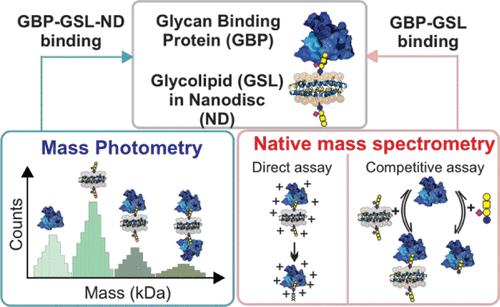
Recognition of glycosphingolipids (GSLs) in cell membranes by glycan-binding proteins (GBPs) is essential for diverse biological processes. However, owing to deficiencies in available analytical methods, the thermodynamics of GBP–GSL interactions remains poorly characterized. Native mass spectrometry (nMS) analysis performed using soluble GSL-containing model membranes provides a direct readout of the identity and stoichiometry of bound GSL ligands and, under certain conditions, can inform on affinity. Yet, for multivalent GBPs capable of engaging multiple model membranes simultaneously, data analysis relies on untested assumptions, which has limited adoption of the assay. Here, we apply mass photometry to quantify a series of high-affinity interactions between glycolipids in soluble model membranes (nanodiscs) and mono- and multivalent GBPs and compare with binding data acquired with nMS. Remarkably, the mass photometry results indicate that glycolipids are distributed nonstatistically across the lipid bilayer and engage in clustering that is sensitive to GBP binding. Moreover, the affinities and stoichiometries (of bound nanodiscs) measured for multivalent GBPs are strongly modulated by glycolipid clustering, which can overwhelm avidity gains from multivalent binding. After normalization for the number of GBP binding sites and glycolipid content, the affinities from mass photometry are found to be, overall, in good agreement with native nMS-derived affinities. Collectively, the findings of this study provide critically needed affinity and stoichiometry benchmarks for assay validation and significant new insights into the mechanisms of GBP recognition of GSLs in model membranes, which serve as a foundation for understanding binding in natural cellular environments.
期刊介绍:
Analytical Chemistry, a peer-reviewed research journal, focuses on disseminating new and original knowledge across all branches of analytical chemistry. Fundamental articles may explore general principles of chemical measurement science and need not directly address existing or potential analytical methodology. They can be entirely theoretical or report experimental results. Contributions may cover various phases of analytical operations, including sampling, bioanalysis, electrochemistry, mass spectrometry, microscale and nanoscale systems, environmental analysis, separations, spectroscopy, chemical reactions and selectivity, instrumentation, imaging, surface analysis, and data processing. Papers discussing known analytical methods should present a significant, original application of the method, a notable improvement, or results on an important analyte.



 京公网安备 11010802042870号
京ICP备2023020795号-1
京公网安备 11010802042870号
京ICP备2023020795号-1

 分享
分享
 求助内容:
求助内容: 应助结果提醒方式:
 扫码关注我们
