Xiaoming Cai , Dongxing Zhang , Peipei Jia , Xingxing Liu , Baodong Bi , Qiuquan Guo , Jun Yang
{"title":"Origami-inspired acoustic metamaterial with tristable property and tunable sound absorption","authors":"Xiaoming Cai , Dongxing Zhang , Peipei Jia , Xingxing Liu , Baodong Bi , Qiuquan Guo , Jun Yang","doi":"10.1016/j.ijmecsci.2025.110138","DOIUrl":null,"url":null,"abstract":"<div><div>Noise reduction is essential in engineering applications, and flexible impedance tuning in acoustic metamaterials, which enables low-frequency broadband absorption, has garnered attention within the physics and engineering research communities. However, traditional acoustic metamaterials suffer from fixed absorption bands due to their rigid cavities. We break this limitation by replacing the cavity walls of a Helmholtz resonator with Kresling origami sheets, creating the first tristable origami-inspired acoustic metamaterial (OIAM), enabling dynamic absorption frequency tuning through structural reconfiguration. By integrating theoretical modeling, numerical simulations, and experimental validation, our research successfully illustrates that the OIAM achieves tunable absorption frequencies (149 Hz, 180 Hz, and 275 Hz) with <span><math><mrow><mi>α</mi><mo>></mo><mn>0</mn><mo>.</mo><mn>95</mn></mrow></math></span> at a subwavelength thickness of 1/22<span><math><mi>λ</mi></math></span>, corresponding to its three stable states—the first demonstration of state-switched broadband tuning in Kresling pattern origami. The truss model shows that the angle parameter affects the stable states of the OIAM, enabling modes such as zero-stiffness, bistability, and tristability, as seen in compression tests. Compared to a single unit, the four-unit parallel OIAM can effectively broaden the absorption bandwidth by 230%. The multi-stable properties enhance energy absorption, load-bearing capacity, and multifunctionality, while the foldable design ensures convenient installation and transportation. In summary, our flexible design offers an effective solution for engineering applications that demand tunable sound absorption and load-bearing capacity.</div></div>","PeriodicalId":56287,"journal":{"name":"International Journal of Mechanical Sciences","volume":"293 ","pages":"Article 110138"},"PeriodicalIF":9.4000,"publicationDate":"2025-05-01","publicationTypes":"Journal Article","fieldsOfStudy":null,"isOpenAccess":false,"openAccessPdf":"","citationCount":"0","resultStr":null,"platform":"Semanticscholar","paperid":null,"PeriodicalName":"International Journal of Mechanical Sciences","FirstCategoryId":"5","ListUrlMain":"https://www.sciencedirect.com/science/article/pii/S0020740325002243","RegionNum":1,"RegionCategory":"工程技术","ArticlePicture":[],"TitleCN":null,"AbstractTextCN":null,"PMCID":null,"EPubDate":"2025/3/18 0:00:00","PubModel":"Epub","JCR":"Q1","JCRName":"ENGINEERING, MECHANICAL","Score":null,"Total":0}
引用次数: 0
Abstract
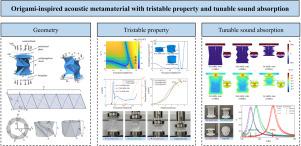
Noise reduction is essential in engineering applications, and flexible impedance tuning in acoustic metamaterials, which enables low-frequency broadband absorption, has garnered attention within the physics and engineering research communities. However, traditional acoustic metamaterials suffer from fixed absorption bands due to their rigid cavities. We break this limitation by replacing the cavity walls of a Helmholtz resonator with Kresling origami sheets, creating the first tristable origami-inspired acoustic metamaterial (OIAM), enabling dynamic absorption frequency tuning through structural reconfiguration. By integrating theoretical modeling, numerical simulations, and experimental validation, our research successfully illustrates that the OIAM achieves tunable absorption frequencies (149 Hz, 180 Hz, and 275 Hz) with at a subwavelength thickness of 1/22, corresponding to its three stable states—the first demonstration of state-switched broadband tuning in Kresling pattern origami. The truss model shows that the angle parameter affects the stable states of the OIAM, enabling modes such as zero-stiffness, bistability, and tristability, as seen in compression tests. Compared to a single unit, the four-unit parallel OIAM can effectively broaden the absorption bandwidth by 230%. The multi-stable properties enhance energy absorption, load-bearing capacity, and multifunctionality, while the foldable design ensures convenient installation and transportation. In summary, our flexible design offers an effective solution for engineering applications that demand tunable sound absorption and load-bearing capacity.
期刊介绍:
The International Journal of Mechanical Sciences (IJMS) serves as a global platform for the publication and dissemination of original research that contributes to a deeper scientific understanding of the fundamental disciplines within mechanical, civil, and material engineering.
The primary focus of IJMS is to showcase innovative and ground-breaking work that utilizes analytical and computational modeling techniques, such as Finite Element Method (FEM), Boundary Element Method (BEM), and mesh-free methods, among others. These modeling methods are applied to diverse fields including rigid-body mechanics (e.g., dynamics, vibration, stability), structural mechanics, metal forming, advanced materials (e.g., metals, composites, cellular, smart) behavior and applications, impact mechanics, strain localization, and other nonlinear effects (e.g., large deflections, plasticity, fracture).
Additionally, IJMS covers the realms of fluid mechanics (both external and internal flows), tribology, thermodynamics, and materials processing. These subjects collectively form the core of the journal's content.
In summary, IJMS provides a prestigious platform for researchers to present their original contributions, shedding light on analytical and computational modeling methods in various areas of mechanical engineering, as well as exploring the behavior and application of advanced materials, fluid mechanics, thermodynamics, and materials processing.



 京公网安备 11010802042870号
京ICP备2023020795号-1
京公网安备 11010802042870号
京ICP备2023020795号-1

 分享
分享
 求助内容:
求助内容: 应助结果提醒方式:
 扫码关注我们
