The edible lotus (Nelumbo nucifera Gaertn.) and its byproducts as valuable source of natural antioxidants: A review of phytochemicals, health benefits, safety and food applications
Jingxian Huang , Guohao He , Liyun Wu , Pei Ma , Lijia Xu , Le Sun , Peigen Xiao
{"title":"The edible lotus (Nelumbo nucifera Gaertn.) and its byproducts as valuable source of natural antioxidants: A review of phytochemicals, health benefits, safety and food applications","authors":"Jingxian Huang , Guohao He , Liyun Wu , Pei Ma , Lijia Xu , Le Sun , Peigen Xiao","doi":"10.1016/j.fufo.2025.100603","DOIUrl":null,"url":null,"abstract":"<div><div>The application of natural plant items as antioxidants in the field of food science has currently experienced growing recognition and popularity owing to their broad-spectrum health-enhancing properties for human-beings. Lotus (<em>Nelumbo nucifera</em>), containing commonly edible parts (root and seed), and other parts as byproducts (leaf, flower, stalk, etc.), are abundant in polyphenols, alkaloids and anthocyanin possessing excellent antioxidant capacities validated by scientific studies. In spite of the extensive research progress, research on antioxidants from lotus plant is scattered, limiting its practical exploration and utilization in the food industry. This review critically summarizes the high-quality publications findings on the antioxidants from different lotus parts and discusses their potential health benefits. In addition, the safety aspects, novel application of lotus antioxidants, and research direction in the upcoming years have also been covered. The outcomes from the studies evaluated suggest that lotus and its byproducts hold considerable promise to be administrated as antioxidant supplements in food formulations to exert health-improving properties for consumers due to their phenomenal antioxidant activity. The knowledge may provide a critical and comprehensive insight into potential development and applications for high-value-added food products containing lotus antioxidants, fueling sustainable economic development and healthy food industry.</div></div>","PeriodicalId":34474,"journal":{"name":"Future Foods","volume":"11 ","pages":"Article 100603"},"PeriodicalIF":8.2000,"publicationDate":"2025-03-17","publicationTypes":"Journal Article","fieldsOfStudy":null,"isOpenAccess":false,"openAccessPdf":"","citationCount":"0","resultStr":null,"platform":"Semanticscholar","paperid":null,"PeriodicalName":"Future Foods","FirstCategoryId":"1085","ListUrlMain":"https://www.sciencedirect.com/science/article/pii/S2666833525000668","RegionNum":0,"RegionCategory":null,"ArticlePicture":[],"TitleCN":null,"AbstractTextCN":null,"PMCID":null,"EPubDate":"","PubModel":"","JCR":"Q1","JCRName":"FOOD SCIENCE & TECHNOLOGY","Score":null,"Total":0}
引用次数: 0
Abstract
The application of natural plant items as antioxidants in the field of food science has currently experienced growing recognition and popularity owing to their broad-spectrum health-enhancing properties for human-beings. Lotus (Nelumbo nucifera), containing commonly edible parts (root and seed), and other parts as byproducts (leaf, flower, stalk, etc.), are abundant in polyphenols, alkaloids and anthocyanin possessing excellent antioxidant capacities validated by scientific studies. In spite of the extensive research progress, research on antioxidants from lotus plant is scattered, limiting its practical exploration and utilization in the food industry. This review critically summarizes the high-quality publications findings on the antioxidants from different lotus parts and discusses their potential health benefits. In addition, the safety aspects, novel application of lotus antioxidants, and research direction in the upcoming years have also been covered. The outcomes from the studies evaluated suggest that lotus and its byproducts hold considerable promise to be administrated as antioxidant supplements in food formulations to exert health-improving properties for consumers due to their phenomenal antioxidant activity. The knowledge may provide a critical and comprehensive insight into potential development and applications for high-value-added food products containing lotus antioxidants, fueling sustainable economic development and healthy food industry.
Future FoodsAgricultural and Biological Sciences-Food Science
CiteScore
8.60
自引率
0.00%
发文量
97
审稿时长
15 weeks
期刊介绍:
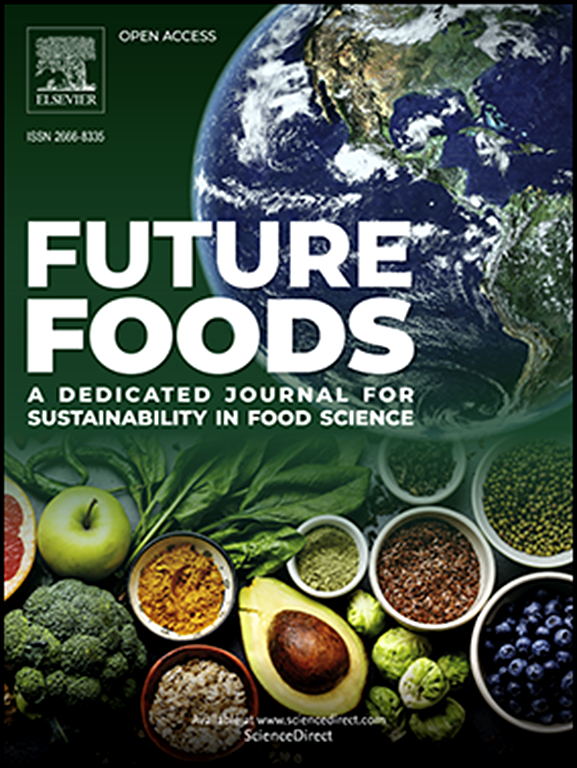
Future Foods is a specialized journal that is dedicated to tackling the challenges posed by climate change and the need for sustainability in the realm of food production. The journal recognizes the imperative to transform current food manufacturing and consumption practices to meet the dietary needs of a burgeoning global population while simultaneously curbing environmental degradation.
The mission of Future Foods is to disseminate research that aligns with the goal of fostering the development of innovative technologies and alternative food sources to establish more sustainable food systems. The journal is committed to publishing high-quality, peer-reviewed articles that contribute to the advancement of sustainable food practices.
Abstracting and indexing:
Scopus
Directory of Open Access Journals (DOAJ)
Emerging Sources Citation Index (ESCI)
SCImago Journal Rank (SJR)
SNIP




 京公网安备 11010802042870号
京ICP备2023020795号-1
京公网安备 11010802042870号
京ICP备2023020795号-1

 分享
分享
 求助内容:
求助内容: 应助结果提醒方式:
 扫码关注我们
