{"title":"Enhanced stabilisation of simulant organic nuclear wastes in metakaolin-based geopolymers using graphene oxide","authors":"Sivasubramaniam Seralathan, Xiaobo Niu, Yogarajah Elakneswaran, Chewei Fang","doi":"10.1016/j.clay.2025.107793","DOIUrl":null,"url":null,"abstract":"<div><div>Considering the hazardous nature of organic nuclear wastes to both humans and the environment, it is essential to dispose of them in an environmentally friendly manner. This research evaluated the solidification/stabilisation method for effectively disposing of organic nuclear wastes in metakaolin-based geopolymers by simulating highly contaminated organic waste in the laboratory. The oil was pre-emulsified with an alkali activator using graphene oxide (GO) as the emulsion stabiliser to stabilise oil droplets in the geopolymer matrix. Its performance was compared with samples using the cationic surfactant hexadecyltrimethylammonium bromide (CTAB). Experiments evaluated the emulsion stability and solidification of organic waste in the geopolymer composite. The results showed that GO-stabilised emulsions were highly stable, maintaining a constant creaming index due to GO's strong barrier around the oil droplets. Adding GO, CTAB, and oil does not interfere with geopolymerisation. GO reduces the flowability of the fresh paste by 41 % due to its high water demand and increased viscosity. However, it significantly enhances the compressive strength of the geopolymer by 65.5 % after 28 days, acting as a nanofiller that improves the material's load transfer and cohesion. Total organic carbon (TOC) leaching tests show minimal oil leaching, under 0.12 % of total oil content, stabilising within three days, giving high-performance organic waste-solidified samples.</div></div>","PeriodicalId":245,"journal":{"name":"Applied Clay Science","volume":"271 ","pages":"Article 107793"},"PeriodicalIF":5.8000,"publicationDate":"2025-07-01","publicationTypes":"Journal Article","fieldsOfStudy":null,"isOpenAccess":false,"openAccessPdf":"","citationCount":"0","resultStr":null,"platform":"Semanticscholar","paperid":null,"PeriodicalName":"Applied Clay Science","FirstCategoryId":"89","ListUrlMain":"https://www.sciencedirect.com/science/article/pii/S0169131725000985","RegionNum":2,"RegionCategory":"地球科学","ArticlePicture":[],"TitleCN":null,"AbstractTextCN":null,"PMCID":null,"EPubDate":"2025/3/20 0:00:00","PubModel":"Epub","JCR":"Q2","JCRName":"CHEMISTRY, PHYSICAL","Score":null,"Total":0}
引用次数: 0
Abstract
Considering the hazardous nature of organic nuclear wastes to both humans and the environment, it is essential to dispose of them in an environmentally friendly manner. This research evaluated the solidification/stabilisation method for effectively disposing of organic nuclear wastes in metakaolin-based geopolymers by simulating highly contaminated organic waste in the laboratory. The oil was pre-emulsified with an alkali activator using graphene oxide (GO) as the emulsion stabiliser to stabilise oil droplets in the geopolymer matrix. Its performance was compared with samples using the cationic surfactant hexadecyltrimethylammonium bromide (CTAB). Experiments evaluated the emulsion stability and solidification of organic waste in the geopolymer composite. The results showed that GO-stabilised emulsions were highly stable, maintaining a constant creaming index due to GO's strong barrier around the oil droplets. Adding GO, CTAB, and oil does not interfere with geopolymerisation. GO reduces the flowability of the fresh paste by 41 % due to its high water demand and increased viscosity. However, it significantly enhances the compressive strength of the geopolymer by 65.5 % after 28 days, acting as a nanofiller that improves the material's load transfer and cohesion. Total organic carbon (TOC) leaching tests show minimal oil leaching, under 0.12 % of total oil content, stabilising within three days, giving high-performance organic waste-solidified samples.
期刊介绍:
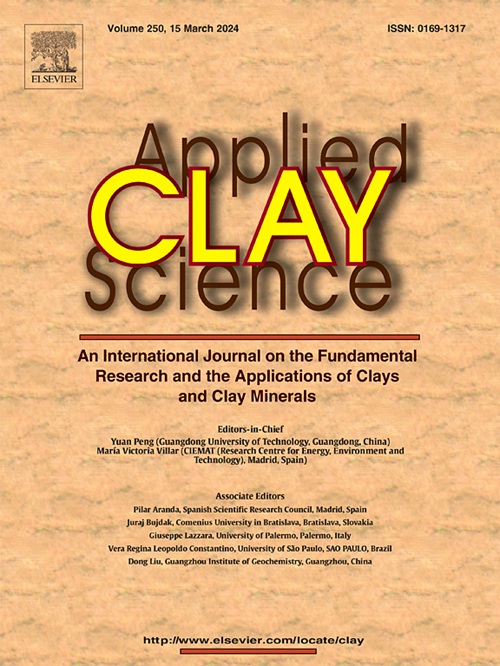
Applied Clay Science aims to be an international journal attracting high quality scientific papers on clays and clay minerals, including research papers, reviews, and technical notes. The journal covers typical subjects of Fundamental and Applied Clay Science such as:
• Synthesis and purification
• Structural, crystallographic and mineralogical properties of clays and clay minerals
• Thermal properties of clays and clay minerals
• Physico-chemical properties including i) surface and interface properties; ii) thermodynamic properties; iii) mechanical properties
• Interaction with water, with polar and apolar molecules
• Colloidal properties and rheology
• Adsorption, Intercalation, Ionic exchange
• Genesis and deposits of clay minerals
• Geology and geochemistry of clays
• Modification of clays and clay minerals properties by thermal and physical treatments
• Modification by chemical treatments with organic and inorganic molecules(organoclays, pillared clays)
• Modification by biological microorganisms. etc...




 京公网安备 11010802042870号
京ICP备2023020795号-1
京公网安备 11010802042870号
京ICP备2023020795号-1

 分享
分享
 求助内容:
求助内容: 应助结果提醒方式:
 扫码关注我们
