A.H. Hatin Betseba , Y. Brucely , G. Paulraj , Y. Christabel Shaji
{"title":"Targeted drug delivery for Cancer therapy using Cu(bpdc) and Ni(bpdc) - MOFs","authors":"A.H. Hatin Betseba , Y. Brucely , G. Paulraj , Y. Christabel Shaji","doi":"10.1016/j.ica.2025.122654","DOIUrl":null,"url":null,"abstract":"<div><div>Metal-Organic Frameworks (MOFs) have emerged as potentially useful porous materials due to their high surface area, ordered porous structure and versatility in the field of drug delivery and photocatalysis. Understanding the molecular and structural interactions that enable these MOFs to exhibit both high photocatalytic activity and effective drug delivery remains a key challenge. This study highlights the synthesis and evaluation of Cu and Ni-based metal-organic frameworks (MOFs) using biphenyl-4,4′-dicarboxylic acid as a ligand and DMF as a solvent via a hydrothermal method in a stainless-steel Teflon autoclave. The Cu(bpdc)-MOF and Ni(bpdc)-MOF demonstrated exceptional degradation efficiencies for congo red under UV–Visible light, achieving 99 % and 97 % degradation at 140 and 160 min, respectively. This highlights their potential for environmental remediation. Furthermore, these MOFs, when loaded with cisplatin through a simple impregnation method, exhibited significant cytotoxicity against breast cancer MDA-MB-231 cells, with cell viabilities of 37.63 % and 40.7 % at the higher concentration of 100 μg/mL with the IC<sub>50</sub> values of 55.78 μg/mL and 62.15 μg/mL. However, challenges remain in optimizing the synthesis process to improve reproducibility and scalability and further understanding the interactions governing their dual functionality in photo catalysis and drug delivery. These findings offer valuable insights into the development of multifunctional MOFs for environmental and biomedical applications.</div></div>","PeriodicalId":13599,"journal":{"name":"Inorganica Chimica Acta","volume":"582 ","pages":"Article 122654"},"PeriodicalIF":3.2000,"publicationDate":"2025-03-20","publicationTypes":"Journal Article","fieldsOfStudy":null,"isOpenAccess":false,"openAccessPdf":"","citationCount":"0","resultStr":null,"platform":"Semanticscholar","paperid":null,"PeriodicalName":"Inorganica Chimica Acta","FirstCategoryId":"92","ListUrlMain":"https://www.sciencedirect.com/science/article/pii/S0020169325001203","RegionNum":3,"RegionCategory":"化学","ArticlePicture":[],"TitleCN":null,"AbstractTextCN":null,"PMCID":null,"EPubDate":"","PubModel":"","JCR":"Q2","JCRName":"CHEMISTRY, INORGANIC & NUCLEAR","Score":null,"Total":0}
引用次数: 0
Abstract
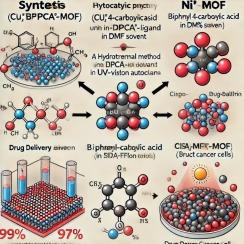
Metal-Organic Frameworks (MOFs) have emerged as potentially useful porous materials due to their high surface area, ordered porous structure and versatility in the field of drug delivery and photocatalysis. Understanding the molecular and structural interactions that enable these MOFs to exhibit both high photocatalytic activity and effective drug delivery remains a key challenge. This study highlights the synthesis and evaluation of Cu and Ni-based metal-organic frameworks (MOFs) using biphenyl-4,4′-dicarboxylic acid as a ligand and DMF as a solvent via a hydrothermal method in a stainless-steel Teflon autoclave. The Cu(bpdc)-MOF and Ni(bpdc)-MOF demonstrated exceptional degradation efficiencies for congo red under UV–Visible light, achieving 99 % and 97 % degradation at 140 and 160 min, respectively. This highlights their potential for environmental remediation. Furthermore, these MOFs, when loaded with cisplatin through a simple impregnation method, exhibited significant cytotoxicity against breast cancer MDA-MB-231 cells, with cell viabilities of 37.63 % and 40.7 % at the higher concentration of 100 μg/mL with the IC50 values of 55.78 μg/mL and 62.15 μg/mL. However, challenges remain in optimizing the synthesis process to improve reproducibility and scalability and further understanding the interactions governing their dual functionality in photo catalysis and drug delivery. These findings offer valuable insights into the development of multifunctional MOFs for environmental and biomedical applications.
期刊介绍:
Inorganica Chimica Acta is an established international forum for all aspects of advanced Inorganic Chemistry. Original papers of high scientific level and interest are published in the form of Articles and Reviews.
Topics covered include:
• chemistry of the main group elements and the d- and f-block metals, including the synthesis, characterization and reactivity of coordination, organometallic, biomimetic, supramolecular coordination compounds, including associated computational studies;
• synthesis, physico-chemical properties, applications of molecule-based nano-scaled clusters and nanomaterials designed using the principles of coordination chemistry, as well as coordination polymers (CPs), metal-organic frameworks (MOFs), metal-organic polyhedra (MPOs);
• reaction mechanisms and physico-chemical investigations computational studies of metalloenzymes and their models;
• applications of inorganic compounds, metallodrugs and molecule-based materials.
Papers composed primarily of structural reports will typically not be considered for publication.



 京公网安备 11010802042870号
京ICP备2023020795号-1
京公网安备 11010802042870号
京ICP备2023020795号-1

 分享
分享
 求助内容:
求助内容: 应助结果提醒方式:
 扫码关注我们
