{"title":"Cotton-derived carbon fibers and MoS2 hybrids for efficient I3− reduction in bifacial dye-sensitized solar cells","authors":"Shanyukta Upadhyay, Santhosh Narendhiran, Manoj Balachandran","doi":"10.1016/j.carbon.2025.120248","DOIUrl":null,"url":null,"abstract":"<div><div>In light of recent advancements, a novel platinum-free counter electrode for dye-sensitized solar cells (DSSCs) has been developed utilizing hierarchical MoS<sub>2</sub> structures in conjunction with bio-derived carbon materials. Carbon fibers produced from cotton and molybdenum-doped carbon rods synthesized from melamine were fabricated through a straightforward hydrothermal process, which significantly enhanced both electrocatalytic activity and stability. The resulting counter electrodes exhibited notably low charge transfer resistances of 9.45 Ω and 6.43 Ω, thus facilitating efficient redox reactions. Consequently, DSSCs incorporating these materials achieved remarkable power conversion efficiencies of 7.04 % and 7.58 %, surpassing traditional platinum-based counter electrodes, which recorded an efficiency of 7.50 %. Furthermore, the high optical transmittance of these materials renders them suitable for bifacial DSSCs, broadening their potential applications. This research underscores the promise of bio-inspired carbon composites as sustainable and efficient alternatives in solar energy technologies, offering an environmentally friendly substitute for conventional noble metal electrodes.</div></div>","PeriodicalId":262,"journal":{"name":"Carbon","volume":"238 ","pages":"Article 120248"},"PeriodicalIF":11.6000,"publicationDate":"2025-03-21","publicationTypes":"Journal Article","fieldsOfStudy":null,"isOpenAccess":false,"openAccessPdf":"","citationCount":"0","resultStr":null,"platform":"Semanticscholar","paperid":null,"PeriodicalName":"Carbon","FirstCategoryId":"88","ListUrlMain":"https://www.sciencedirect.com/science/article/pii/S0008622325002647","RegionNum":2,"RegionCategory":"材料科学","ArticlePicture":[],"TitleCN":null,"AbstractTextCN":null,"PMCID":null,"EPubDate":"","PubModel":"","JCR":"Q1","JCRName":"CHEMISTRY, PHYSICAL","Score":null,"Total":0}
引用次数: 0
Abstract
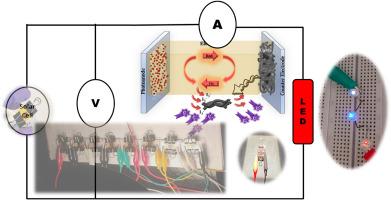
In light of recent advancements, a novel platinum-free counter electrode for dye-sensitized solar cells (DSSCs) has been developed utilizing hierarchical MoS2 structures in conjunction with bio-derived carbon materials. Carbon fibers produced from cotton and molybdenum-doped carbon rods synthesized from melamine were fabricated through a straightforward hydrothermal process, which significantly enhanced both electrocatalytic activity and stability. The resulting counter electrodes exhibited notably low charge transfer resistances of 9.45 Ω and 6.43 Ω, thus facilitating efficient redox reactions. Consequently, DSSCs incorporating these materials achieved remarkable power conversion efficiencies of 7.04 % and 7.58 %, surpassing traditional platinum-based counter electrodes, which recorded an efficiency of 7.50 %. Furthermore, the high optical transmittance of these materials renders them suitable for bifacial DSSCs, broadening their potential applications. This research underscores the promise of bio-inspired carbon composites as sustainable and efficient alternatives in solar energy technologies, offering an environmentally friendly substitute for conventional noble metal electrodes.
期刊介绍:
The journal Carbon is an international multidisciplinary forum for communicating scientific advances in the field of carbon materials. It reports new findings related to the formation, structure, properties, behaviors, and technological applications of carbons. Carbons are a broad class of ordered or disordered solid phases composed primarily of elemental carbon, including but not limited to carbon black, carbon fibers and filaments, carbon nanotubes, diamond and diamond-like carbon, fullerenes, glassy carbon, graphite, graphene, graphene-oxide, porous carbons, pyrolytic carbon, and other sp2 and non-sp2 hybridized carbon systems. Carbon is the companion title to the open access journal Carbon Trends. Relevant application areas for carbon materials include biology and medicine, catalysis, electronic, optoelectronic, spintronic, high-frequency, and photonic devices, energy storage and conversion systems, environmental applications and water treatment, smart materials and systems, and structural and thermal applications.



 京公网安备 11010802042870号
京ICP备2023020795号-1
京公网安备 11010802042870号
京ICP备2023020795号-1

 分享
分享
 求助内容:
求助内容: 应助结果提醒方式:
 扫码关注我们
