Cong Ma, Kai Bao, Junlei Qi, Wenbin Wang, Jingkun Wu, Ruijie Li, Yu Lin, Lingzhi Wang, Zhuangzhuang Yin, Zhixiang Tao, Chengxuan Ke, Zongxiao Wu, Yingxia Liu and Qiyuan He
{"title":"Emerging 15–16 group Xenes: structures, properties, preparation methods, and their catalytic applications","authors":"Cong Ma, Kai Bao, Junlei Qi, Wenbin Wang, Jingkun Wu, Ruijie Li, Yu Lin, Lingzhi Wang, Zhuangzhuang Yin, Zhixiang Tao, Chengxuan Ke, Zongxiao Wu, Yingxia Liu and Qiyuan He","doi":"10.1039/D4QM01089B","DOIUrl":null,"url":null,"abstract":"<p >Elemental two-dimensional (2D) materials, commonly referred to as Xenes, have attracted recent attention due to their many unique/remarkable chemical and physical properties. Xenes hold immense promise for multifarious applications across diverse domains, including optoelectronics, energy storage, energy conversion and biomedicine. Beyond graphene and phosphorene, a new cadre of Xenes has emerged, with particular attention directed toward antimonene, arsenene, tellurene and selenene. These nascent Xenes have garnered substantial interest due to their diverse allotropes, as well as their distinctive layer-dependent and modifiable properties, rendering them highly adaptable for engineering and catalytic applications. Herein, an overview is provided for the recent advancements in the structures, inherent properties and degradation behavior of Xenes, drawing upon both theoretical and experimental research. The synthesis methods of Xenes are summarized and primarily classified as bottom-up and top-down approaches. Furthermore, the catalytic potential of Xenes is elaborated, emphasizing both engineering strategies and theoretical understanding toward enhanced performance across a spectrum of catalytic reactions. Conclusively, a summary and perspectives on the future development of Xenes are given to boost their development.</p>","PeriodicalId":86,"journal":{"name":"Materials Chemistry Frontiers","volume":" 7","pages":" 1075-1100"},"PeriodicalIF":6.4000,"publicationDate":"2025-02-16","publicationTypes":"Journal Article","fieldsOfStudy":null,"isOpenAccess":false,"openAccessPdf":"https://pubs.rsc.org/en/content/articlepdf/2025/qm/d4qm01089b?page=search","citationCount":"0","resultStr":null,"platform":"Semanticscholar","paperid":null,"PeriodicalName":"Materials Chemistry Frontiers","FirstCategoryId":"88","ListUrlMain":"https://pubs.rsc.org/en/content/articlelanding/2025/qm/d4qm01089b","RegionNum":2,"RegionCategory":"材料科学","ArticlePicture":[],"TitleCN":null,"AbstractTextCN":null,"PMCID":null,"EPubDate":"","PubModel":"","JCR":"Q1","JCRName":"CHEMISTRY, MULTIDISCIPLINARY","Score":null,"Total":0}
引用次数: 0
Abstract
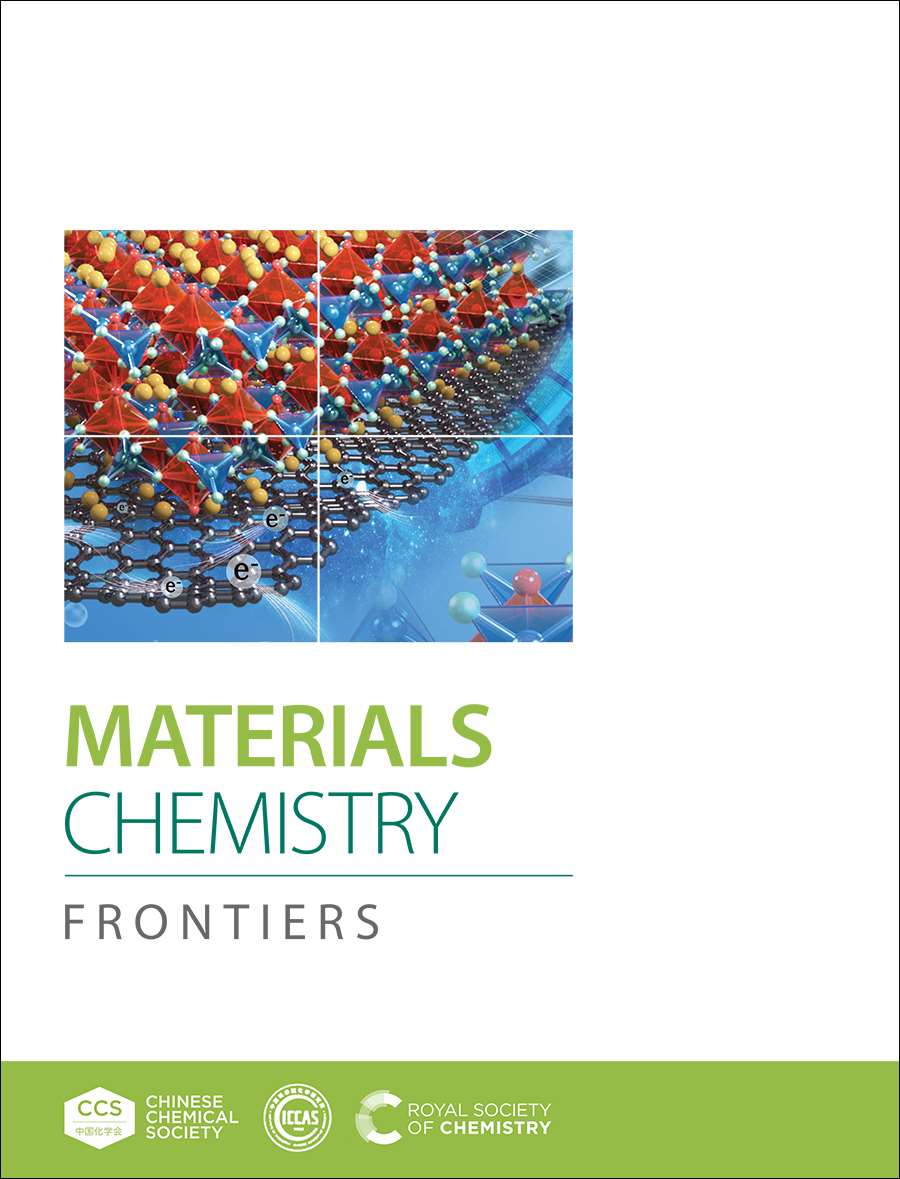
Elemental two-dimensional (2D) materials, commonly referred to as Xenes, have attracted recent attention due to their many unique/remarkable chemical and physical properties. Xenes hold immense promise for multifarious applications across diverse domains, including optoelectronics, energy storage, energy conversion and biomedicine. Beyond graphene and phosphorene, a new cadre of Xenes has emerged, with particular attention directed toward antimonene, arsenene, tellurene and selenene. These nascent Xenes have garnered substantial interest due to their diverse allotropes, as well as their distinctive layer-dependent and modifiable properties, rendering them highly adaptable for engineering and catalytic applications. Herein, an overview is provided for the recent advancements in the structures, inherent properties and degradation behavior of Xenes, drawing upon both theoretical and experimental research. The synthesis methods of Xenes are summarized and primarily classified as bottom-up and top-down approaches. Furthermore, the catalytic potential of Xenes is elaborated, emphasizing both engineering strategies and theoretical understanding toward enhanced performance across a spectrum of catalytic reactions. Conclusively, a summary and perspectives on the future development of Xenes are given to boost their development.
期刊介绍:
Materials Chemistry Frontiers focuses on the synthesis and chemistry of exciting new materials, and the development of improved fabrication techniques. Characterisation and fundamental studies that are of broad appeal are also welcome.
This is the ideal home for studies of a significant nature that further the development of organic, inorganic, composite and nano-materials.




 京公网安备 11010802042870号
京ICP备2023020795号-1
京公网安备 11010802042870号
京ICP备2023020795号-1

 分享
分享
 求助内容:
求助内容: 应助结果提醒方式:
 扫码关注我们
