Nagesh Manurkar, Mubashar Ilyas, Faiza Arshad, Prasanna Patil, Haroon Shah, Maroof Ahmad Khan, Wajid Hussain and Hui Li
{"title":"Exploring the first and second hyperpolarizabilities of l-glutamine-based Schiff base ligands and their Cu(ii) coordination complexes†","authors":"Nagesh Manurkar, Mubashar Ilyas, Faiza Arshad, Prasanna Patil, Haroon Shah, Maroof Ahmad Khan, Wajid Hussain and Hui Li","doi":"10.1039/D5NJ00477B","DOIUrl":null,"url":null,"abstract":"<p >Two new Schiff base ligands, H<small><sub>2</sub></small>L<small><sup>1</sup></small> and H<small><sub>2</sub></small>L<small><sup>2</sup></small>, as well as the corresponding Cu(<small>II</small>) coordination complexes, complex <strong>1</strong> and complex <strong>2</strong>, were synthesized in this work. A range of spectroscopic methods, such as NMR, UV-Vis, FT-IR, and X-ray diffraction (XRD), were used to thoroughly characterize the ligands and complexes and validate their structural integrity. Their electronic characteristics and nonlinear optical (NLO) behavior were examined through computational investigations, with particular attention paid to linear polarizability, first-order hyperpolarizability, and second-order hyperpolarizability. The findings showed that the free ligands and their complexes with Cu(<small>II</small>) ion differed significantly in terms of their electronic characteristics and NLO responses. The frontier molecular orbital (FMO) and partial density of states (PDOS) analyses corroborated the different electron density distributions which were further revealed by the molecular electrostatic potential (MEP) analysis. The impact of the Cu(<small>II</small>) coordination on the electronic structure and intermolecular interactions was brought to light by studies using the quantum theory of atoms in molecules (QTAIM) and natural bond orbital (NBO). Further information about the complexes’ molecular stability and possible reactivity was revealed by the reduced density gradient (RDG) and isosurface analyses. The Cu(<small>II</small>) complexes demonstrated enhanced first and second hyperpolarizabilities in terms of NLO properties, with complex <strong>1</strong> displaying the highest values, especially in second-order nonlinear optical processes like electro-optic properties (EOPE) and second-harmonic generation (SHG). These results imply that the Cu(<small>II</small>)-coordinated Schiff base complexes have encouraging potential for use in photonic devices and nonlinear optics. The role of metal coordination in adjusting the optical and electronic characteristics of Schiff base compounds is highlighted by the Cu(<small>II</small>) complexes’ enhanced NLO response when compared to the free ligands.</p>","PeriodicalId":95,"journal":{"name":"New Journal of Chemistry","volume":" 13","pages":" 5200-5212"},"PeriodicalIF":2.5000,"publicationDate":"2025-03-06","publicationTypes":"Journal Article","fieldsOfStudy":null,"isOpenAccess":false,"openAccessPdf":"","citationCount":"0","resultStr":null,"platform":"Semanticscholar","paperid":null,"PeriodicalName":"New Journal of Chemistry","FirstCategoryId":"92","ListUrlMain":"https://pubs.rsc.org/en/content/articlelanding/2025/nj/d5nj00477b","RegionNum":3,"RegionCategory":"化学","ArticlePicture":[],"TitleCN":null,"AbstractTextCN":null,"PMCID":null,"EPubDate":"","PubModel":"","JCR":"Q2","JCRName":"CHEMISTRY, MULTIDISCIPLINARY","Score":null,"Total":0}
引用次数: 0
Abstract
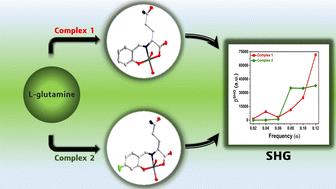
Two new Schiff base ligands, H2L1 and H2L2, as well as the corresponding Cu(II) coordination complexes, complex 1 and complex 2, were synthesized in this work. A range of spectroscopic methods, such as NMR, UV-Vis, FT-IR, and X-ray diffraction (XRD), were used to thoroughly characterize the ligands and complexes and validate their structural integrity. Their electronic characteristics and nonlinear optical (NLO) behavior were examined through computational investigations, with particular attention paid to linear polarizability, first-order hyperpolarizability, and second-order hyperpolarizability. The findings showed that the free ligands and their complexes with Cu(II) ion differed significantly in terms of their electronic characteristics and NLO responses. The frontier molecular orbital (FMO) and partial density of states (PDOS) analyses corroborated the different electron density distributions which were further revealed by the molecular electrostatic potential (MEP) analysis. The impact of the Cu(II) coordination on the electronic structure and intermolecular interactions was brought to light by studies using the quantum theory of atoms in molecules (QTAIM) and natural bond orbital (NBO). Further information about the complexes’ molecular stability and possible reactivity was revealed by the reduced density gradient (RDG) and isosurface analyses. The Cu(II) complexes demonstrated enhanced first and second hyperpolarizabilities in terms of NLO properties, with complex 1 displaying the highest values, especially in second-order nonlinear optical processes like electro-optic properties (EOPE) and second-harmonic generation (SHG). These results imply that the Cu(II)-coordinated Schiff base complexes have encouraging potential for use in photonic devices and nonlinear optics. The role of metal coordination in adjusting the optical and electronic characteristics of Schiff base compounds is highlighted by the Cu(II) complexes’ enhanced NLO response when compared to the free ligands.



 京公网安备 11010802042870号
京ICP备2023020795号-1
京公网安备 11010802042870号
京ICP备2023020795号-1

 分享
分享
 求助内容:
求助内容: 应助结果提醒方式:
 扫码关注我们
